
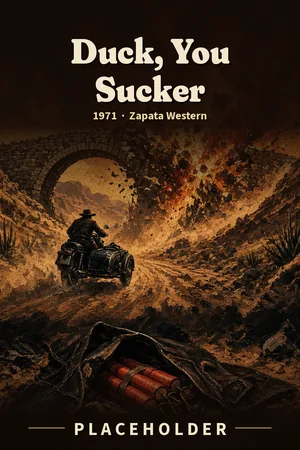

True Grit Rating: Duck, You Sucker!
Loading the ticket…
Duck, You Sucker! (Italian: Giù la testa), also known as A Fistful of Dynamite and Once Upon a Time... the Revolution, is a 1971 epic Zapata Western directed and co-written by Sergio Leone and starring Rod Steiger, James Coburn and Romolo Valli. Set during the Mexican Revolution, it follows a Mexican bandit and an Irish explosives expert who are swept, almost against their will, into the fighting. It was the last Western Leone directed and the second film of his unofficial "Once Upon a Time" trilogy, and some critics consider it among his most overlooked films.
Plot
In 1913, with Mexico torn by revolution, Juan Miranda (Steiger), the head of a family of bandits, holds up a coach full of wealthy passengers who despise people like him. Soon afterwards a motorcyclist roars by: John H. Mallory (Coburn), an Irish Republican explosives expert who has fled to Mexico and is working as a silver prospector. Juan sees a way to fulfil his dream of robbing the great bank at Mesa Verde, and when John refuses to help, Juan makes sure he has little choice.
In Mesa Verde, John has already made contact with revolutionaries led by the physician Dr. Villega (Valli). Juan's plan to get rich and John's plan to fight run into each other, and the bandit finds himself turned into a revolutionary hero he never meant to be. As the revolution's violence grows, John's memories of friendship and betrayal in Ireland, shown in flashback, explain his disillusionment. The film is about what the two men owe each other.
Production
Development began during the making of Once Upon a Time in the West, when Sergio Donati gave Leone an early treatment. With student unrest in Paris and revolutionary ideas popular across Europe, Leone decided to take apart the romantic image of revolution as he had taken apart the romantic image of the Old West. Leone, Donati and Luciano Vincenzoni wrote the screenplay. Leone at first wanted only to produce, and he offered the film to Peter Bogdanovich and then to Sam Peckinpah before the backers insisted on someone else. He gave it to his assistant Giancarlo Santi, but Steiger and Coburn insisted that Leone direct them himself. Coburn had earlier been approached for the lead in A Fistful of Dollars.
Exteriors were shot mainly in Andalusia in southern Spain, reusing some locations from the Dollars films. The Almería railway station from For a Few Dollars More became Mesa Verde's station. The Irish flashbacks were filmed at Howth Castle and Toner's Pub in Dublin. It was one of the last mainstream films shot in Techniscope.
Ennio Morricone's score, with its theme "Invention for John", was described by the critic Elvis Mitchell as one of the composer's "most glorious and unforgettable".
Themes
Leone said the film was not really a political film. The revolution was a symbol, and the true theme was friendship between a naïve man and an intellectual, "the story of Pygmalion reversed", in which the simple man teaches the intellectual a lesson. It belongs to the political "Zapata Western" strand of the spaghetti Western.
Release and reception
In Italy the film grossed about 1.83 billion lire on its first run, the lowest of Leone's five Westerns there but the highest for any Zapata Western. In France it was the fourth most popular film of 1972. Critics paid it little attention at first, although Leone won the David di Donatello award for Best Director. In the United States, United Artists released it in 1972 with scenes cut for violence, language and politics, including a quotation from Mao Zedong, and marketed it as a light-hearted follow-up to the Dollars films. It was later reissued as A Fistful of Dynamite to recall A Fistful of Dollars. Longer restored versions have since raised its reputation, and modern critics praise Coburn and Steiger's partnership and Leone's style.
Disputed or inconsistent points
- Length of the US release: accounts differ: some give 121 minutes for the original US release, others 138 minutes for the US theatrical version. Other accounts describe a 138-minute standard cut, with some later prints as short as 121 minutes.
- The Irishman's name: he introduces himself as "Seán" but is credited as John H. Mallory, and the names are used differently in different versions.
Key facts
- Released: 29 October 1971 (Italy); 1972 (US)
- Director: Sergio Leone
- Screenplay: Luciano Vincenzoni, Sergio Donati, Sergio Leone
- Producer: Fulvio Morsella
- Music: Ennio Morricone
- Cinematography: Giuseppe Ruzzolini (Techniscope)
- Countries: Italy, United States
- Running time: 157 minutes (Italian version)
- Filmed in: Andalusia, Spain; Dublin, Ireland
- Award: David di Donatello for Best Director
- Directed by Sergio Leone
- Released 1971
Cast
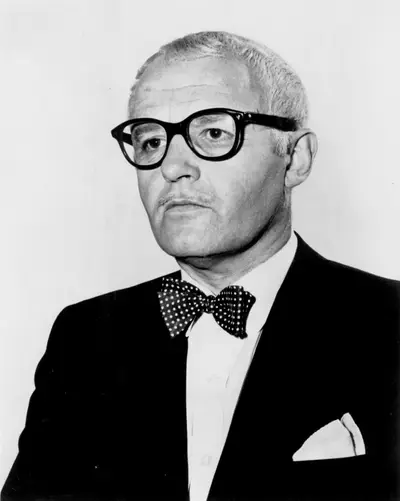
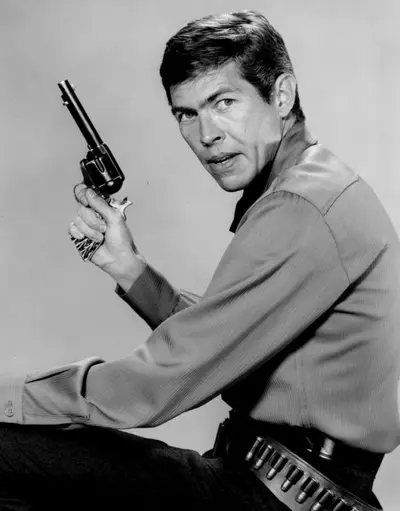
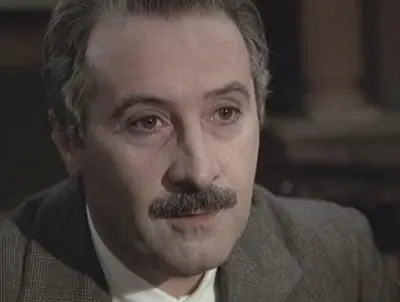


See also
Frontier folk
This film is listed on: Comancheros and bandit gangs · Mexican soldiers, revolutionaries and rurales (all Frontier folk)
Gallery 2




True Grit RatingWhat's this?Woke: None foundIMDb ★7.5Partly checked
True Grit score: 99/100, Gold Partly checked
How the score is worked out:
- Start100
- Diamond needs all five checks; not met (raw score under 109; content guide not complete): 100 → 99
- True Grit score99 · Gold
Classic Western checks
1 of 5 yes · Mostly classic
- Called “revisionist”YesYes: described as revisionist, or as taking apart the Western's myths.[1]
- Settlers or cavalry as villainsNoThe antagonists are the federal army in the Mexican Revolution, led by Colonel Ruiz, and Governor Don Jaime. [2][3]
more
The antagonists are the federal army in the Mexican Revolution, led by Colonel Ruiz, and Governor Don Jaime. The protagonist, the outlaw Juan Miranda, leads a family of bandits before joining the revolutionaries. - Faith shown negativelyNoThe plot shows no clergy or faith portrayed negatively.[2]
- History rewrittenNoFiction: invented leads (a Mexican bandit and an Irish revolutionary) set against the Mexican Revolution; no source alleges a misstatement. [4]
more
Fiction: invented leads (a Mexican bandit and an Irish revolutionary) set against the Mexican Revolution; no source alleges a misstatement. The basis confirms the invented leads only. - A people shown as villainsNoNo: the plot source pins the villainy on named individuals or a specific band, not on a people as a whole.[5]
Woke content (modern messaging)
None found0 of 8 items found so far
Show all 8 (4 not found · 4 not known)
Unless noted: Unknown.
- Characters recast for representationNot foundAn original story with invented characters (no source work and no real people), so no established or historical figure could be recast.[2]
- Gender roles reversed or critiquedNot known
- Present-day political languageNot known
- Allegory for current politicsNot foundReleased in 1971, before the 21st-century debates this item covers, so it cannot be an allegory of them.[2]
- Western civilisation framed as inherently guiltyNot known
- Environmental activismNot foundNo: no source raises an environmental message (5 Nov 2026).[2]
- Source material changed for messagingNot foundAn original screenplay (no novel, earlier film or established characters), so there is no source to change.[2]
- LGBT or gender-identity themesNot known
Audience
★ 7.5/10 from viewers on IMDb (41k votes)No deduction (5.0 and up).
Sources
Information courtesy of IMDb (https://www.imdb.com). IMDb rating as of 13 October 2026.
Checked 17 October 2026 · Reviewed by Frontier Editor
Partly checked: 4 checks not known. Not known items are left out of the score.
Member reviews
What members think. Member reviews never change the True Grit score. The True Grit score is worked out by the editors from sources.
Sources
- Duck, You Sucker! - Wikipedia en.wikipedia.org
- Wikidata: Q510657 wikidata.org
- A Fistful of Dynamite (Duck, You Sucker) - TCM article (Jeff Stafford, 2006) tcm.com
- IMDb Non-Commercial Datasets developer.imdb.com
- Rotten Tomatoes (score via Wikidata) rottentomatoes.com
- Metacritic (score via Wikidata) metacritic.com
- Wikimedia Commons: Gi%C3%B9 la testa.png commons.wikimedia.org
- Wikimedia Commons: Cathedral - Guadix - Spain - 20110808.jpg commons.wikimedia.org