

True Grit Rating: Rio Grande
Loading the ticket…
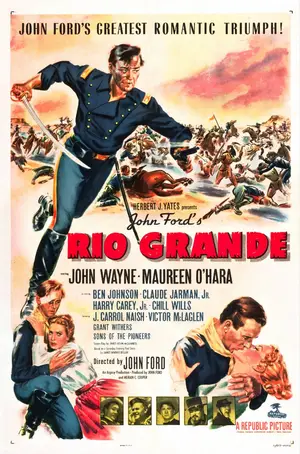
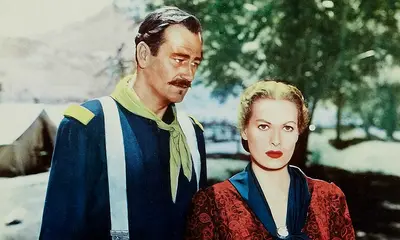
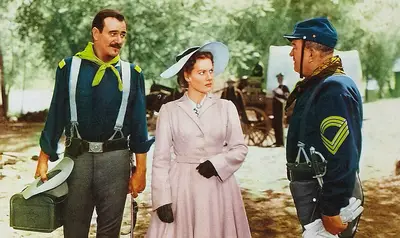
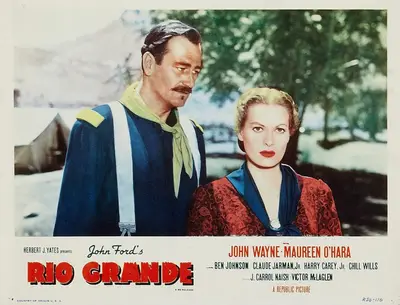
Rio Grande is a 1950 American romantic Western directed by John Ford and starring John Wayne and Maureen O'Hara. It completes Ford's "Cavalry Trilogy", after Fort Apache (1948) and She Wore a Yellow Ribbon (1949). Wayne, who had played Captain Kirby York in Fort Apache, now plays Lieutenant Colonel Kirby Yorke. The supporting cast includes Ben Johnson, Claude Jarman Jr., Harry Carey Jr., Victor McLaglen and the singing group the Sons of the Pioneers. It was the first of Wayne and O'Hara's films together for Ford.
Plot
In the summer of 1879, Lieutenant Colonel Kirby Yorke commands the 2nd US Cavalry on the Texas frontier, defending settlers against Apache raiders who escape pursuit by crossing into Mexico. His regiment is short of men. Yorke has not seen his wife Kathleen (O'Hara) or his son for 15 years, ever since he burned her family's plantation on orders during the Civil War's Shenandoah Valley campaign.
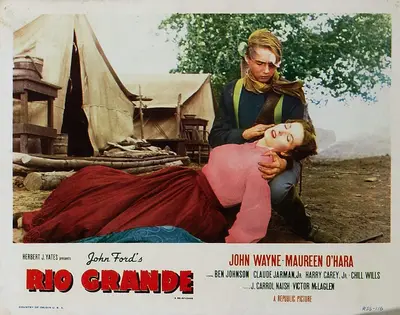
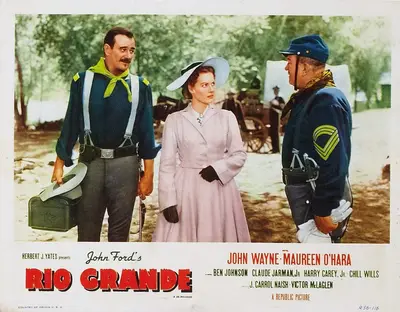
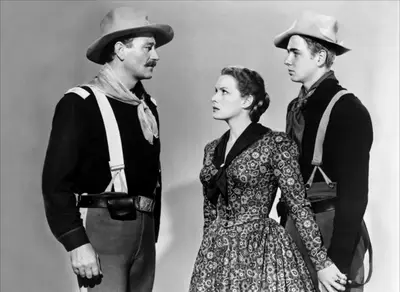
Then his son Jeff (Jarman), who has flunked out of West Point, turns up among a group of new recruits as an enlisted trooper. Yorke tells him he will receive no special treatment, and Jeff says he wants none. Soon Kathleen arrives at the fort, determined to take her son home. The family drama plays out alongside a growing military crisis, as Yorke is forced to weigh his orders against the border that shelters the raiders.
Production
After Wagon Master (1950), Ford did not want to make another Western. He wanted to make the Irish romantic comedy The Quiet Man with Wayne and O'Hara. Herbert Yates, president of Republic Pictures, thought that script was weak, so he insisted that Ford first make a box-office Western with the same stars. The Quiet Man was eventually released in 1952 and far out-earned Rio Grande.
James Kevin McGuinness wrote the screenplay from James Warner Bellah's story "Mission With No Record", published in The Saturday Evening Post in September 1947. McGuinness based it on a real raid of May 1873, when Colonel Ranald Mackenzie and the 4th Cavalry, under orders from General Phil Sheridan, crossed into Mexico to attack the Kickapoo. The film changes the history: in the film it is the Apache who carry off white women and children, whereas in the real raid the soldiers took Kickapoo women and children as hostages.
The film was shot in just 32 days in Utah. Bert Glennon photographed it, and Victor Young wrote the score. Harry Carey Jr. called it one of Ford's "vacation" pictures. Yates insisted that the Sons of the Pioneers appear, which Ford disliked.
Reception
The film cost about $1.2 million and made a modest profit of $215,634. The New York Times called it a "familiar story" that "travels a well-rutted road", but said "the horsemanship never was better" and enjoyed the Sons of the Pioneers' ballads. Variety expected its "big brawling mass action clashes" and "good, honest sentiment" to do well at the box office.
Later writers have been divided. Garry Wills called it the "most beautifully filmed" of the trilogy, while Ford's biographers note that Ford himself saw it as a throwaway, and critics often rank it the weakest of the three. The film historian Joseph McBride called it Ford's first "mature love story", whose family drama lifts it above what he describes as a crudely racist and jingoistic military plot. Some critics have linked its frustration with borders to the Korean War, which began that year.
Disputed or inconsistent points
- Location: accounts differ: some place the shoot in Monument Valley, others around Moab, Utah. The two are separate areas, so the exact location is disputed.
- Number of recruits: accounts differ: some say 18 recruits, others 15.
- Budget: accounts differ: both $1,214,899 and $1,511,043 are given.
Key facts
- Released: 15 November 1950
- Director: John Ford
- Screenplay: James Kevin McGuinness, from James Warner Bellah's "Mission With No Record" (1947)
- Cinematography: Bert Glennon
- Music: Victor Young
- Studios: Republic Pictures and Argosy Pictures
- Running time: accounts differ: 103 or 105 minutes
- Budget: about $1.2 million
- Filmed in: Utah (32 days); Monument Valley or Moab (disputed)
- Series: third film of Ford's Cavalry Trilogy
- Directed by John Ford
- Released 1950
Cast

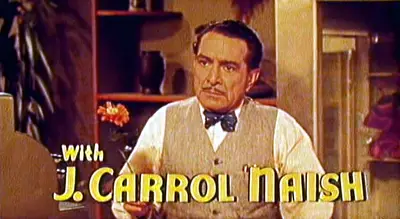
See also
If you liked this
Picked from this wiki's own links: same film series, same director, same lead actor.
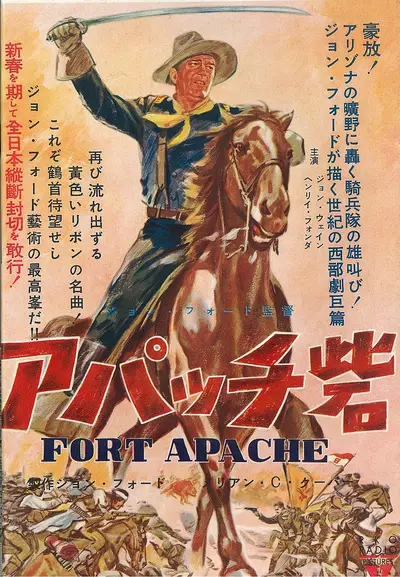 Fort Apache1948Same series


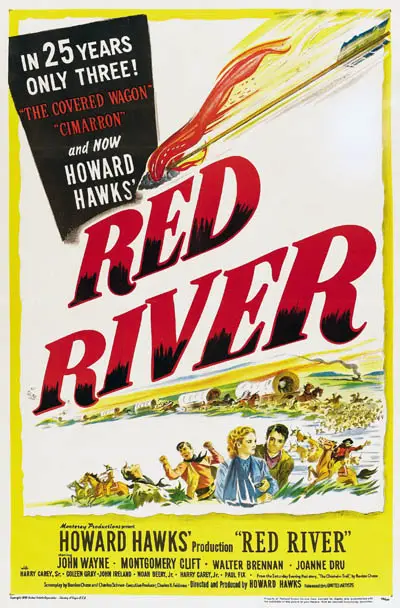 Red River1948Also starring John Wayne


Filming locations
- Monument Valley, Utah
Per Wikipedia (shot in 32 days in Monument Valley, Utah). The TCM article says it was shot on location in Moab, Utah; sources disagree, so 'Monument Valley near Moab' is not used.
Frontier folk
This film is listed on: Cavalry troopers and frontier scouts · Renegade raiding bands (by tribe) · Apache (all Frontier folk)
Gallery 7







True Grit RatingWhat's this?Woke: None foundSVLIMDb ★7.0Partly checked
True Grit score: 99/100, Gold Partly checked
How the score is worked out:
- Start100
- Diamond needs all five checks; not met (raw score under 109): 100 → 99
- Presumed (Hays Code, 1934–1967): violence, language presumed no, counted as checked0
- True Grit score99 · Gold
Classic Western checks
0 of 5 yes · Classic Western · 2 not known
- Called “revisionist”Not knownUnknown.
- Settlers or cavalry as villainsNoThe cavalry are the protagonists, posted to defend settlers against Apache attacks; Apache raiders capture a wagon carrying children, whom the cavalrymen … [1]
more
The cavalry are the protagonists, posted to defend settlers against Apache attacks; Apache raiders capture a wagon carrying children, whom the cavalrymen rescue. Their general orders a pursuit into Mexico that he cannot legally order. - Faith shown negativelyNoThe plot shows no clergy or faith portrayed negatively.[1]
- History rewrittenNoFiction with invented characters; it portrays no real historical events or people, so nothing documented is rewritten. [1]
more
Fiction with invented characters; it portrays no real historical events or people, so nothing documented is rewritten. Based on James Warner Bellah’s story. - A people shown as villainsNot knownUnknown.
Woke content (modern messaging)
None found0 of 8 items found so far
Show all 8 (2 not found · 6 not known)
Unless noted: Unknown.
- Characters recast for representationNot known
- Gender roles reversed or critiquedNot known
- Present-day political languageNot known
- Allegory for current politicsNot foundReleased in 1950, before the 21st-century debates this item covers, so it cannot be an allegory of them.[1]
- Western civilisation framed as inherently guiltyNot known
- Environmental activismNot foundNo: no source raises an environmental message (5 Nov 2026).[1]
- Source material changed for messagingNot known
- LGBT or gender-identity themesNot known
Content guide
Presumed no (Hays Code)
UK classification advice lists no sex or nudity issues.
Certificates: BBFC U FSK FSK 12
NoneMildModerateStrongNot known
Audience
★ 7.0/10 from viewers on IMDb (20k votes)No deduction (5.0 and up).
Sources
- Wikipedia: films/rio-grande-1950 (plot) (checked 17 October 2026)
- bbfc.co.uk/release/rio-grande-q29sbgvjdglvbjpwwc0ymzg0njq
Information courtesy of IMDb (https://www.imdb.com). IMDb rating as of 13 October 2026.
Checked 17 October 2026 · Reviewed by Frontier Editor
Partly checked: 3 checks not known. Not known items are left out of the score.
Member reviews
What members think. Member reviews never change the True Grit score. The True Grit score is worked out by the editors from sources.
Sources
- Rio Grande (1950 film) - Wikipedia en.wikipedia.org
- Wikidata: Q1138393 wikidata.org
- Wikimedia Commons: Rio Grande poster.jpg commons.wikimedia.org
- Wikimedia Commons: Rio Grande (1950) - publicity still 1.jpg commons.wikimedia.org
- Wikimedia Commons: Rio Grande (1950) trailer 1.jpg commons.wikimedia.org
- Rio Grande - TCM article (Jerry Renshaw, 2004) tcm.com
- IMDb Non-Commercial Datasets developer.imdb.com
- Rio grande q29sbgvjdglvbjpwwc0ymzg0njq - bbfc.co.uk bbfc.co.uk
- Rotten Tomatoes (score via Wikidata) rottentomatoes.com
- Wikimedia Commons: John Wayne Maureen O%27Hara from lobby card.jpg commons.wikimedia.org
- Wikimedia Commons: Maureen O%27Hara John Wayne from lobby card.jpg commons.wikimedia.org
- Wikimedia Commons: Maureen O%27Hara from lobby card.jpg commons.wikimedia.org
- Wikimedia Commons: Rio Grande lobby card 1.jpg commons.wikimedia.org
- Wikimedia Commons: Rio Grande lobby card 2.jpg commons.wikimedia.org
- Wikimedia Commons: Rio Grande lobby card 3.jpg commons.wikimedia.org
