
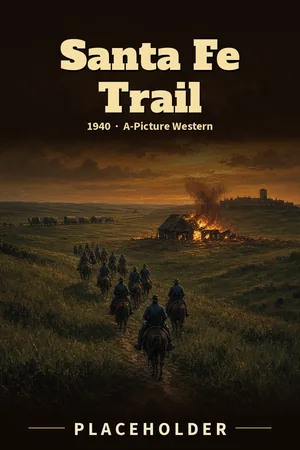

True Grit Rating: Santa Fe Trail
Loading the ticket…
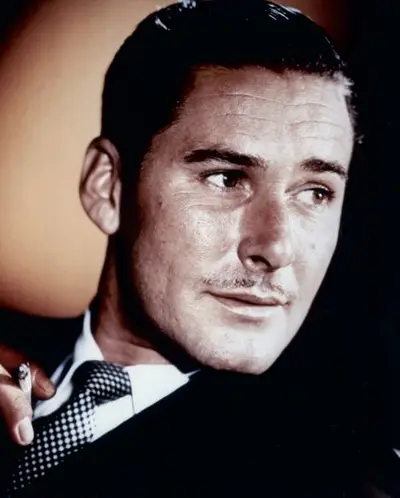
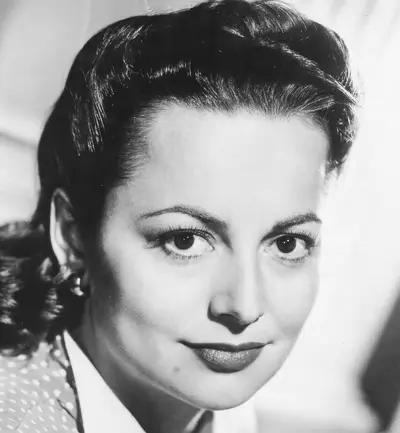
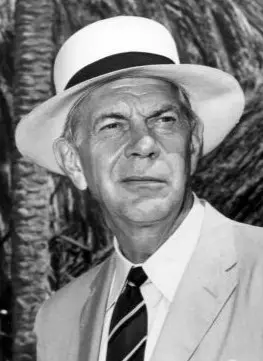
Santa Fe Trail is a 1940 American historical Western directed by Michael Curtiz for Warner Bros., with Errol Flynn as the young cavalry officer J. E. B. "Jeb" Stuart and Ronald Reagan as George Armstrong Custer, two West Point graduates posted to troubled Kansas Territory in the 1850s. Raymond Massey plays the abolitionist John Brown, whose armed campaign against slavery the two officers set out to stop, and Olivia de Havilland is Kit Holliday, the railway builder's daughter they both court. Despite its title, the film has little to do with the real Santa Fe Trail, and its story takes great liberties with history, but it was one of the most popular films of its year.
Plot
In 1854 a cadet at West Point, Carl Rader, is expelled after spreading John Brown's antislavery pamphlets and starting a brawl. His classmates Jeb Stuart and George Custer are commissioned and posted to Fort Leavenworth, then thought the most dangerous duty in the Army. On the way west they meet Cyrus K. Holliday, who is building a railway towards Santa Fe, and his daughter Kit, and both fall in love with her. In Kansas they find the territory torn by fighting over slavery, with Brown's band raiding the countryside and freeing slaves, and Rader serving Brown as a hired military adviser.
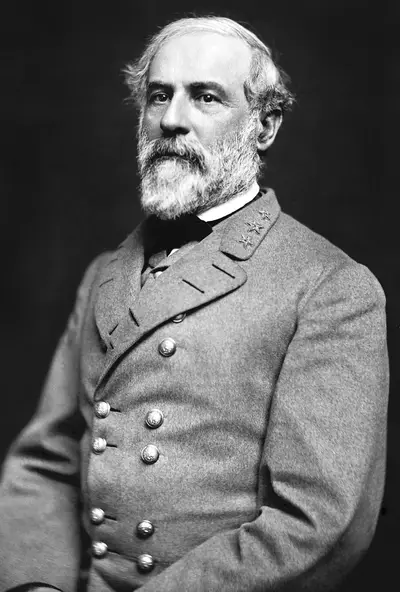
After a raid on an Army-guarded wagon train, the officers capture Brown's wounded son, who tells them before he dies where his father is hiding. Stuart rides into the abolitionist town in disguise but is recognised and taken prisoner; trapped in a burning barn, he is rescued when Custer leads the cavalry in, and Brown is driven out of Kansas. In 1859, after Brown refuses to pay him, Rader warns Stuart that Brown is planning to seize the federal arsenal at Harpers Ferry, Virginia. Brown takes the arsenal, but the townspeople resist him, and troops under Colonel Robert E. Lee capture him. He is tried and hanged, foretelling from the gallows that only war will settle the question of slavery, and the film ends with Stuart and Kit's wedding aboard one of her father's trains.
Production
Robert Buckner wrote the script under the working title Diary of the Santa Fe, as a follow-up to the success of Dodge City (1939) and part of the fashion for big-budget Westerns that followed that film. Dennis Morgan was first announced as Custer, but he was loaned to another studio and Reagan replaced him, and Van Heflin was signed as the villain Rader. Filming began in July 1940, delayed by a return of Flynn's malaria. The outdoor scenes were shot at the Lasky Mesa ranch in the hills of the western San Fernando Valley, and the railway scenes on the Sierra Railroad in Tuolumne County, California. It was one of the eight films that Flynn and de Havilland made together.
Release and reception
The film had its world premiere in Santa Fe, New Mexico, on 13 December 1940, with a three-day festival, special trains from Hollywood and the East, and a large crowd of film stars, paid for jointly by Warner Bros. and the Santa Fe railway. De Havilland was taken ill with appendicitis on the trip and missed the premiere. Some cities saw the film in an experimental sound system, Vitasound, designed to give a greater range of sound to the battle scenes. It was among the most successful films of the year, earning about $1.75 million in the United States and $785,000 abroad, according to Warner Bros. records. The film's copyright was not renewed, so it is in the public domain in the United States.
Legend and history
- John Brown in Kansas. Brown came to Kansas Territory in 1855, where several of his sons had settled, to help make it a free state. The struggle known as "Bleeding Kansas" saw wrongdoing on both sides: on 21 May 1856 a proslavery force sacked the free-state town of Lawrence, and three days later five proslavery settlers were killed on Pottawatomie Creek by a band of antislavery men under Brown. Brown himself denied taking part, and accounts differ on his own role, but the killings were condemned by free-state and proslavery men alike. His son Frederick was killed in fighting at Osawatomie that August.
- Harpers Ferry. Brown's raid on the arsenal at Harpers Ferry began on 16 October 1859. Four people were killed by his men, and ten of his own men died. He was captured not by cavalry, as in the film, but by a detachment of US Marines under Colonel Robert E. Lee, and he was hanged at Charles Town, Virginia, on 2 December 1859.
- Not classmates. Stuart graduated from West Point in 1854 and Custer in 1861, so they were never classmates, and Custer never served in Kansas Territory; he went there only after the Civil War, when Kansas was a state. Jason Brown did not betray his father or die in Kansas, the character of Carl Rader is invented, and the railway into New Mexico was not begun until 1879.
- A film of its time. Made on the eve of America's entry into the Second World War, the film shows the principle of abolition as just but condemns Brown's violent methods, and it blames the coming of the Civil War largely on him. Historians have long disagreed about Brown, some seeing him as a hero of emancipation and others as a fanatic. Some scenes, especially its portrayal of the freed slaves, have been criticised by later writers as dated and condescending.
Key facts
- Released: 28 December 1940 (world premiere Santa Fe, 13 December 1940)
- Director: Michael Curtiz
- Studio: Warner Bros.
- Screenplay: Robert Buckner
- Stars: Errol Flynn, Olivia de Havilland, Raymond Massey, Ronald Reagan, Alan Hale, Van Heflin
- Locations: Lasky Mesa, Simi Hills, California; Sierra Railroad, Tuolumne County
- Running time: 110 minutes (data)
- Copyright: public domain in the United States (not renewed)
- IMDb rating: 6.2 (data)
- Directed by Michael Curtiz
- Released 1940
Cast

See also
If you liked this
Picked from this wiki's own links: same film series, same director, same lead actor.


Gallery 1

True Grit RatingWhat's this?Woke: None foundSVLIMDb ★6.2Partly checked
True Grit score: 84/100, Silver Partly checked
How the score is worked out:
- Start100
- History rewritten: yes−15
- True story, revisionist or history check not answered, capped at Silver: 85 → 84 (2 checks not known)
- Presumed (Hays Code, 1934–1967): violence, language presumed no, counted as checked0
- True Grit score84 · Silver
Classic Western checks
1 of 5 yes · Mostly classic · 1 not known
- Called “revisionist”Not knownUnknown.
- Settlers or cavalry as villainsNoThe antagonist is the abolitionist John Brown and his armed band; the heroes are U.S. [1][2][3]
more
The antagonist is the abolitionist John Brown and his armed band; the heroes are U.S. Army officers, and the townspeople at Harpers Ferry resist the raid. - Faith shown negativelyNoThe plot shows no clergy or faith portrayed negatively.[3]
- History rewrittenYesPresents J. E. B. Stuart, George Armstrong Custer, James Longstreet, George Pickett, John Bell Hood and Philip Sheridan as West Point classmates of 1854; in … [2][1][4][5][6][7][8][9][10][11][12][13][14][15]
more
Presents J. E. B. Stuart, George Armstrong Custer, James Longstreet, George Pickett, John Bell Hood and Philip Sheridan as West Point classmates of 1854; in reality only Stuart graduated that year, Custer in 1861 and the others between 1842 and 1853. It shows John Brown as a sincere fanatic but invents a raid and a capture of Stuart, and leaves out the killing of five proslavery men at Pottawatomie Creek in 1856 by Brown and men under his command. At Harpers Ferry in 1859 Brown was captured by U.S. Marines under Robert E. Lee, not cavalry. One historian faults the film for blaming the Civil War mainly on abolitionists while making its Southerners wholly sympathetic and playing down slavery. - A people shown as villainsNoNo: the plot source names the villains as individuals; no ethnic, national or religious people is the enemy as a group.[2]
Woke content (modern messaging)
None found0 of 8 items found so far
Show all 8 (2 not found · 6 not known)
Unless noted: Unknown.
- Characters recast for representationNot knownIt portrays real people, among them J.[3]
- Gender roles reversed or critiquedNot known
- Present-day political languageNot known
- Allegory for current politicsNot foundReleased in 1940, before the 21st-century debates this item covers, so it cannot be an allegory of them.[3]
- Western civilisation framed as inherently guiltyNot known
- Environmental activismNot foundNo: no source raises an environmental message (5 Nov 2026).[3]
- Source material changed for messagingNot known
- LGBT or gender-identity themesNot known
Content guide
Presumed no (Hays Code)
UK classification advice (PG, 2024): There are infrequent, very mild sex references
Certificates: BBFC PG
NoneMildModerateStrongNot known
Audience
★ 6.2/10 from viewers on IMDb (4.7k votes)No deduction (5.0 and up).
Sources
- Robert E. Morsberger, “Slavery and The Santa Fe Trail, or, John Brown on Hollywood's Sour Apple Tree”, American Studies 18:2 (1977) (checked 18 October 2026)
- AFI Catalog: Santa Fe Trail (1940) (checked 18 October 2026)
- Wikipedia: Santa Fe Trail (plot)
- TCM article, “Santa Fe Trail” (2005) (checked 18 October 2026)
- HistoryNet, Gordon Berg, “Film Review: Santa Fe Trail”, America's Civil War (May 2011) (checked 18 October 2026)
- Cullum's Register (LacusCurtius transcription), No. 1643 (J. E. B. Stuart) (checked 18 October 2026)
- Cullum's Register (LacusCurtius transcription), No. 1966 (G. A. Custer) (checked 18 October 2026)
- Cullum's Register (LacusCurtius transcription), No. 1164 (James Longstreet) (checked 18 October 2026)
- Cullum's Register (LacusCurtius transcription), No. 1330 (George E. Pickett) (checked 18 October 2026)
- Cullum's Register (LacusCurtius transcription), No. 1622 (John B. Hood) (checked 18 October 2026)
- Cullum's Register (LacusCurtius transcription), No. 1612 (Philip H. Sheridan) (checked 18 October 2026)
- William G. Cutler, History of the State of Kansas (1883), Franklin County, part 3 (checked 18 October 2026)
- U.S. National Park Service: Bleeding Kansas (checked 18 October 2026)
- Kansas Historical Society, Kansapedia: John Brown (checked 18 October 2026)
- U.S. National Park Service: John Brown (checked 18 October 2026)
- bbfc.co.uk/release/santa-fe-trail-q29sbgvjdglvbjpwwc0ynjk3mtg
Information courtesy of IMDb (https://www.imdb.com). IMDb rating as of 13 October 2026.
Checked 18 October 2026 · Reviewed by Frontier Editor
Partly checked: 2 checks not known. Not known items are left out of the score, and a true-story title can't go above Silver (84) until “Called revisionist” and “History rewritten” are answered.
Member reviews
What members think. Member reviews never change the True Grit score. The True Grit score is worked out by the editors from sources.
Sources
- Santa Fe Trail (film) - Wikipedia en.wikipedia.org
- Wikidata: Q1598010 wikidata.org
- Wikimedia Commons: Santa Fe Trail (1940) by Michael Curtiz.webm commons.wikimedia.org
- Wikimedia Commons: Santa Fe Trail 2.jpg commons.wikimedia.org
- Wikimedia Commons: Santa Fe Trail.jpg commons.wikimedia.org
- Santa Fe Trail - Internet Archive archive.org
- Santa Fe Trail film by Curtiz - Britannica britannica.com
- IMDb Non-Commercial Datasets developer.imdb.com
- Santa fe trail q29sbgvjdglvbjpwwc0ynjk3mtg - bbfc.co.uk bbfc.co.uk
- Rotten Tomatoes (score via Wikidata) rottentomatoes.com
- Wikimedia Commons: Robert Edward Lee.jpg commons.wikimedia.org

