
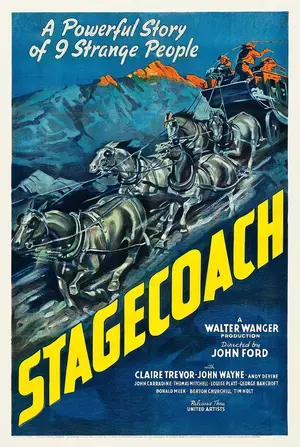
True Grit Rating: Stagecoach
Loading the ticket…
Stagecoach is a 1939 American Western directed by John Ford and starring Claire Trevor and John Wayne. Dudley Nichols adapted the screenplay from Ernest Haycox's 1937 short story "The Stage to Lordsburg". A mismatched group of travellers crosses dangerous Apache territory, and the film is widely considered one of the greatest and most influential films ever made. It is widely considered the first "adult" Western. It made Wayne a star and was the first of Ford's many Westerns shot in Monument Valley.
Plot
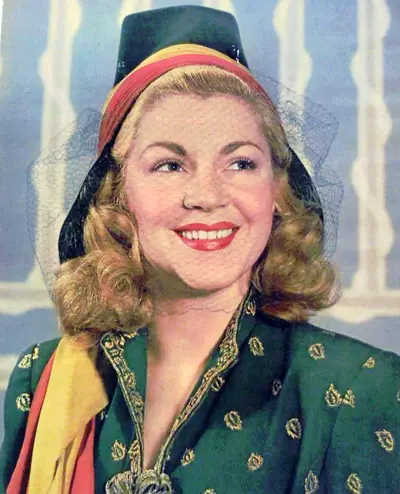
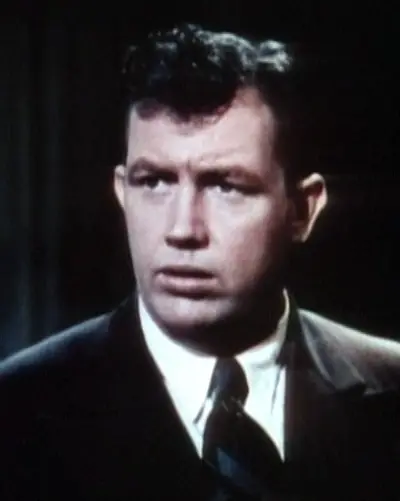
In June 1880 the driver Buck (Andy Devine) prepares a stagecoach to run from Tonto, Arizona Territory, to Lordsburg, New Mexico. His passengers are Dallas (Trevor), a prostitute driven out of town by the "Law and Order League"; Doc Boone (Thomas Mitchell), an alcoholic doctor; Lucy Mallory, a refined woman from Virginia travelling to join her cavalry officer husband; Samuel Peacock, a timid whiskey salesman; Hatfield (John Carradine), a gambler and self-styled Southern gentleman; and Gatewood, a banker who is secretly running off with stolen money. Marshal Curley Wilcox rides shotgun.
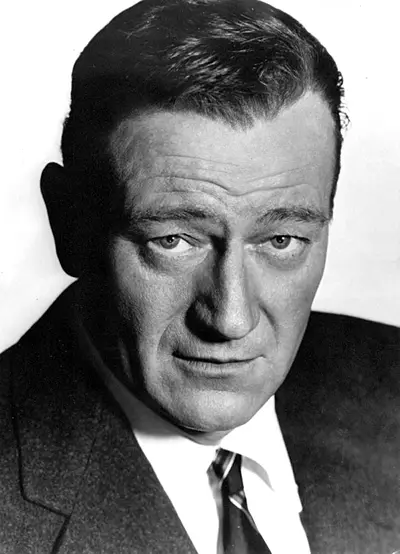
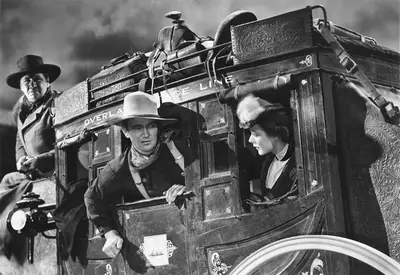
On the road they pick up the Ringo Kid (Wayne), who has broken out of prison to avenge the murder of his father and brother by Luke Plummer. Curley arrests him. Word arrives that Geronimo's Apaches are on the warpath, and the travellers' cavalry escort cannot stay with them. As the journey goes on, the passengers' snobbery, courage and weakness come out, and Ringo is drawn to Dallas. The film builds to a celebrated chase across open desert and a reckoning in Lordsburg.
Production
Ford bought the film rights to Haycox's story soon after it appeared in Collier's in April 1937. Ford said he had also been inspired by Guy de Maupassant's story "Boule de Suif". Big-budget Westerns had been out of fashion since the silent era, and several studios turned Ford down, partly because he insisted on casting Wayne, then a B-movie actor. The producer Walter Wanger shared those doubts but eventually made the film. It was Ford's first Western in more than a decade.
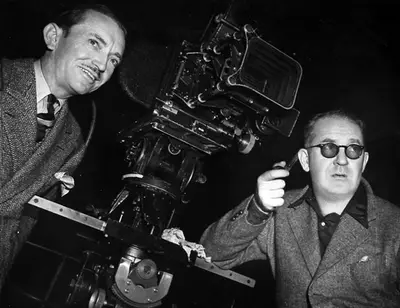
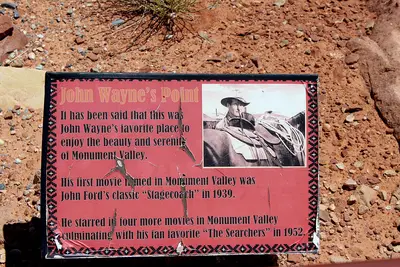
The crew was based in Kayenta in north-eastern Arizona, in an old Civilian Conservation Corps camp, and filmed near Goulding's Trading Post in Monument Valley in strong winds and low temperatures. Other scenes were shot at the Iverson Movie Ranch and the RKO Encino Ranch in California, so the geography on screen does not always add up. The Apache attack, with stunts by Yakima Canutt, was filmed at Lucerne Dry Lake near Victorville, California.
Reception
The film was released on 2 March 1939 to immediate praise from critics and the trade press, and it made a profit of $297,690. It cemented Wayne's standing as an A-list leading man. Nichols' script brought psychological depth to the characters, and that the film helped lift the Western from B-movie status to serious drama. Thomas Mitchell won the Academy Award for Best Supporting Actor, and the film also won the Oscar for its score. It was nominated for Best Picture and Best Director.
The film has also been criticised. Like most Westerns of its time, it shows its Apache characters only as faceless attackers, with no story or point of view of their own.
Legacy
Stagecoach began Ford's long association with Monument Valley, which became the backdrop for many of his later films, and his partnership with Wayne. Together they went on to make Fort Apache, She Wore a Yellow Ribbon, The Searchers and The Man Who Shot Liberty Valance. It was added to the US National Film Registry in 1995. The American Film Institute ranked it 63rd on its 1998 list of the 100 best American films and ninth among Westerns in 2008. It was adapted for radio several times, with Wayne and Trevor repeating their roles in 1949, and remade as a film in 1966 and for television in 1986.
Key facts
- Released: 2 March 1939
- Director: John Ford
- Producer: Walter Wanger
- Screenplay: Dudley Nichols, from Ernest Haycox's story "The Stage to Lordsburg" (1937)
- Original distributor: United Artists
- Running time: accounts differ: 96 or 97 minutes
- Filmed in: Monument Valley; Iverson Movie Ranch, RKO Encino Ranch and Lucerne Dry Lake, California
- Oscars: Best Supporting Actor (Thomas Mitchell), Best Score
- National Film Registry: 1995
- Directed by John Ford
- Released 1939
- Screenplay by Dudley Nichols
- Adapted from Ernest Haycox's 1937 short story "The Stage to Lordsburg"
Cast
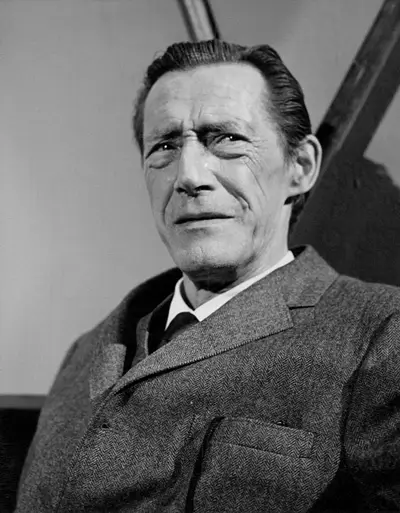

See also
If you liked this
Picked from this wiki's own links: same film series, same director, same lead actor.


Guns on screen
- Winchester Model 1892 saddle-ring carbine, Trapper length, with an enlarged loop lever used by The Ringo Kid (John Wayne) Ringo's carbine in his first scene. Two guns were used: a .44-40 for blanks and a .32-20 Trapper cut to about 15 inches so Wayne could spin-cock it one-handed; the big loop lever was worked out with stuntman Yakima Canutt. Sources: Stagecoach – Internet Movie Firearms Database (accessed 26 October 2026) · Stagecoach (1939) – NRA National Firearms Museum (accessed 26 October 2026) · Sequels – American Rifleman (accessed 26 October 2026)
- Colt Single Action Army used by Doc Boone (Thomas Mitchell) Several passengers carry Colt single-action revolvers. (single source) Sources: Stagecoach – Internet Movie Firearms Database (accessed 26 October 2026)
- Marlin 1875 pocket revolver (probably the No. 32 model) used by Hatfield (John Carradine) The small revolver Hatfield draws when all seems lost during the chase. Identification is tentative on the source page. (single source) Sources: Stagecoach – Internet Movie Firearms Database (accessed 26 October 2026)
- Coach shotgun (12-gauge double barrel) used by Marshal Curly Wilcox (George Bancroft) Carried up front beside the driver on the box of the coach. (single source) Sources: Stagecoach – Internet Movie Firearms Database (accessed 26 October 2026)
- Winchester Model 1892 rifle used by Luke Plummer (Tom Tyler) Plummer's rifle in the closing street showdown with Ringo; more '92s stand in a rack in the sheriff's office. (single source) Sources: Stagecoach – Internet Movie Firearms Database (accessed 26 October 2026)
Filming locations
- Monument Valley · Arizona–Utah border, United States · map · Wikidata · Ford's first use of the valley as a location; the main desert exteriors. · Sources: Stagecoach – AFI Catalog (accessed 26 October 2026) · Movies Filmed in Grand County and San Juan County – Moab to Monument Valley Film Commission (PDF) (accessed 26 October 2026) · Wikidata: Stagecoach (P915 filming location) (accessed 26 October 2026)
- Kayenta · Navajo County, Arizona, United States · map · Wikidata · Listed among the location sites in contemporary trade reports. · Sources: Stagecoach – AFI Catalog (accessed 26 October 2026)
- Kern River near Kernville · Kernville, Kern County, California, United States · map · Wikidata · Listed among the location sites in contemporary trade reports. · Sources: Stagecoach – AFI Catalog (accessed 26 October 2026)
- Muroc Dry Lake · near Victorville, California, United States · Listed among the location sites in contemporary trade reports; the source places it near Victorville. · Sources: Stagecoach – AFI Catalog (accessed 26 October 2026)
- Fremont Pass · Newhall, Los Angeles County, California, United States · Listed among the location sites in contemporary trade reports. · Sources: Stagecoach – AFI Catalog (accessed 26 October 2026)
- Chatsworth and Calabasas · Los Angeles County, California, United States · Listed among the location sites in contemporary trade reports. · Sources: Stagecoach – AFI Catalog (accessed 26 October 2026)
Frontier folk
This film is listed on: Gamblers and saloon owners · Sheriffs, marshals and Texas Rangers · Renegade raiding bands (by tribe) · Stage drivers, shotgun guards and express riders · Doctors, schoolteachers, newspaper editors and shopkeepers · Apache (all Frontier folk)
Gallery 4




True Grit RatingWhat's this?Woke: None found★★★★★SVLIMDb ★7.8
True Grit score: 94/100, Gold
How the score is worked out:
- Start100
- People as villains: yes−15
- Traditional values: 3 stars+9
- True Grit score94 · Gold
Classic Western checks
1 of 5 yes · Classic Western
- Called “revisionist”NoOne review treats it as a founding film of the classic Western.[1]
- Settlers or cavalry as villainsNoThe villains are the outlaw Luke Plummer and his brothers, and Geronimo's Apache warriors attack the stage. [2]
more
The villains are the outlaw Luke Plummer and his brothers, and Geronimo's Apache warriors attack the stage. The film criticises the town's "Law and Order League", which drives Dallas out, and the banker Gatewood, who is arrested for embezzling; the outcasts on the coach are the sympathetic side. - Faith shown negativelyNoThe plot shows no clergy or faith portrayed negatively.[2]
- History rewrittenNoFiction adapted from Ernest Haycox’s short story; its Apache attack is linked to Geronimo. [3][2]
more
Fiction adapted from Ernest Haycox’s short story; its Apache attack is linked to Geronimo. Criticism of its portrayal of Native Americans is recorded in the content guide. - A people shown as villainsYesYes: Native Americans are reduced to obstacles and the villainous counterpoint to the cowboys; Geronimo's Apache appear as a faceless enemy that attacks the … [4][5][6][7]
more
Yes: Native Americans are reduced to obstacles and the villainous counterpoint to the cowboys; Geronimo's Apache appear as a faceless enemy that attacks the stage.
Woke content (modern messaging)
None found0 of 8 items found so far
Show all 8 (3 not found · 5 not known)
Unless noted: Unknown.
- Characters recast for representationNot foundAdapted from Ernest Haycox's "The Stage to Lordsburg"; Haycox's Malpais Bill, renamed the Ringo Kid, is played by John Wayne, with no …[8][2]
- Gender roles reversed or critiquedNot known
- Present-day political languageNot known
- Allegory for current politicsNot foundReleased in 1939, before the 21st-century debates this item covers, so it cannot be an allegory of them.[2]
- Western civilisation framed as inherently guiltyNot known
- Environmental activismNot foundNo: no source raises an environmental message (5 Nov 2026).[2]
- Source material changed for messagingNot known
- LGBT or gender-identity themesNot known
Traditional values
★★★★★3/5[4]
From one parents' guide's positive messages and role models ratings: positive messages some (3) and positive role models some (3); average 3, rounded to 3.
Content guide
- SSex & nudityMildMild sex, romance and nudity (1/5 in one parents' guide).[4]
- VViolenceModerateModerate violence and scariness (3/5 in one parents' guide).[4]
- LLanguageMildMild language (1/5 in one parents' guide).[4]
- StereotypesYesStereotyped portrayals of Native Americans and Mexicans (noted in one parents' guide).[4]
NoneMildModerateStrongNot known
Audience
★ 7.8/10 from viewers on IMDb (60k votes)No deduction (5.0 and up).
Sources
- Decent Films, Steven D. Greydanus: Stagecoach
- Wikipedia: films/stagecoach-1939 (plot) (accessed 26 October 2026)
- TCM, James Steffen (2003) (checked 17 October 2026)
- commonsensemedia.org/movie-reviews/stagecoach
- escholarship.org/content/qt68n7n3fj/qt68n7n3fj.pdf
- sbs.com.au/whats-on/article/the-evolution-of-native-american-representation-in-westerns/63tmqv2y7
- catalog.afi.com/Catalog/MovieDetailsPrintView/4173
- True West Magazine, Henry C. Parke, "Stagecoach – The Legend At 80" (2019)
Information courtesy of IMDb (https://www.imdb.com). IMDb rating as of 13 October 2026.
Checked 17 October 2026 · Reviewed by Frontier Editor
Member reviews
What members think. Member reviews never change the True Grit score. The True Grit score is worked out by the editors from sources.
Sources
- Stagecoach (1939 film) - Wikipedia en.wikipedia.org
- Wikidata: Q50714 wikidata.org
- Wikimedia Commons: Stagecoach (1939 poster).jpg commons.wikimedia.org
- Wikimedia Commons: Stagecoach-1939.jpg commons.wikimedia.org
- Wikimedia Commons: Stagecoach-09.jpg commons.wikimedia.org
- Stagecoach film 1939 - Britannica britannica.com
- IMDb Non-Commercial Datasets developer.imdb.com
- Stagecoach q29sbgvjdglvbjpwwc0yntg0odi - bbfc.co.uk bbfc.co.uk
- Stagecoach - commonsensemedia.org commonsensemedia.org
- Rotten Tomatoes (score via Wikidata) rottentomatoes.com
- Metacritic (score via Wikidata) metacritic.com
- Wikimedia Commons: 1946 - Transit Theater - 3 Jul MC - Allentown PA.jpg commons.wikimedia.org
- Wikimedia Commons: Bert Glennon-John Ford in Stagecoach.jpg commons.wikimedia.org
- Wikimedia Commons: Monument Valley, Arizona, US - panoramio (4).jpg commons.wikimedia.org
