


The Comstock Lode was a huge deposit of silver and gold under the slopes of Mount Davidson in western Nevada. Found in 1859, it was the first major silver discovery in the United States. For some twenty years it dominated Nevada's history. It built the towns of Virginia City and Gold Hill, it drove some of the most advanced mining engineering of its age, and without it Nevada could not have become a state as early as 1864.
Discovery
Gold miners had been working placer diggings in the canyons below Mount Davidson for several years. In the spring of 1859 two Irish prospectors, Peter O'Riley and Patrick McLaughlin, struck rich ground at the head of Six-mile Canyon. Their rocker kept clogging with a "heavy black stuff" mixed in with the gold. They thought it worthless, but it was very rich silver ore. That evening Henry T. P. Comstock arrived and insisted that the ground was already his. He talked his way into a share, and the lode took his name, though by the best-known account he had little claim to be called its discoverer.
Few of the first claimants grew rich. McLaughlin sold his share in the Ophir claim for $3,500 and later worked as a cook. Comstock sold out cheaply, left Nevada and died in Montana in 1870. News of the strike soon set off the "Rush to Washoe" from California.
Three periods
The Comstock's history falls into three main periods:
- 1859–1865, the years of litigation. Companies fought in court over claim boundaries and over whether the lode was one vein or many. About $50 million of ore was mined in these years, and about $10 million of it went on lawsuits. The mining lawyer William Stewart, later a US senator, was a leading figure.
- 1865–1875, the Bank Crowd. The Bank of California, represented in Virginia City by William Sharon, lent money to the mines and mills and took them over when borrowers defaulted. It built the Virginia and Truckee Railroad, which greatly cut transport costs, and it controlled land, water and freighting companies.
- 1875–1881, the Bonanza Group. Four partners led by John Mackay and James Fair, three of them born in Ireland, found by far the richest ore in 1873: the "Big Bonanza". From 1873 to 1882 two of their mines produced more than $105 million of ore. After 1878 the bonanza ores quickly ran out. The Comstock went on producing until the 1940s, but at a much lower rate.
Most investors did badly. Of 103 companies reporting, 97 never paid a dividend. Share prices swung wildly: a share in the Belcher mine was worth $430 in April 1868, $1,525 in April 1872 and about $2 by September 1878.
People of the Comstock
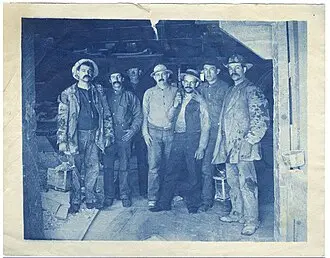
Most Comstock miners were immigrants. Of 2,770 men in mining in 1880, only 770 were American-born; the largest groups were 816 Irish and 640 English and Welsh. The miners' unions, founded in 1866–67, won a $4 daily wage for underground work and kept Chinese workers out of the mines. The unions also ran sick and burial funds for injured miners and their families. Many leading figures were also European-born, including Adolph Sutro from Prussia and John P. Jones from Wales. Several Comstock men became US senators, among them Jones, Stewart, Sharon and Fair. The population was overwhelmingly young, single and male. The young Samuel Clemens worked as a reporter in Virginia City and first signed himself "Mark Twain" there.
Technology
By 1880 the mines reached 2,100 feet below ground, deeper than any before them. The soft ground could not hold itself up, so the engineer Philipp Deidesheimer devised square-set timbering, a framework of timber cubes that could be extended in any direction. It was never patented and spread across the West. Timber came from the Lake Tahoe area, partly by V-shaped water flumes, and water was piped in from the Sierra Nevada. The Sutro Tunnel, almost four miles long, drained the deep, hot workings into the Carson River valley.
Decline
When the ore ran out, most of the leading owners left Nevada. Storey County, home of the Comstock, had perhaps 25,000 people at its height but only 3,560 by 1900. Between 1880 and 1900 Nevada as a whole lost a third of its people.
Legend and history
- Who found it? The lode bears Comstock's name, but the strike was made by O'Riley and McLaughlin. Accounts differ on how much credit Comstock deserves; the best-known early history says almost none.
- Miners' fortunes. The Comstock is remembered for its millionaires, but only a handful of companies and partners made fortunes. Most miners worked for wages, and most shareholders lost money.
In Westerns
Bonanza (1959) is set on the Ponderosa ranch near Virginia City in the Comstock years. The film Virginia City (1940) is set in the town during the Civil War.
Key facts
- Discovered: 1859, by Peter O'Riley and Patrick McLaughlin; named after Henry T. P. Comstock
- Place: Mount Davidson and Six-mile Canyon, Virginia City and Gold Hill, Storey County, Nevada
- Ore: about 57 per cent silver and 42 per cent gold by value
- Official output, 1859–1882: about $306 million
- Peak: the "Big Bonanza", found in 1873; decline after 1878
- Key people: William Stewart, William Sharon, John Mackay, James Fair, Adolph Sutro, Philipp Deidesheimer, John P. Jones
- Discovered in 1859 by Peter O'Riley and Patrick McLaughlin; Henry Comstock claimed the ground and gave it his name. Dan De Quille wrote in 1889 that Comstock 'was not entitled' to the credit (De Quille, A History of the Comstock Silver Lode & Mines; Online Nevada).
- The first major silver discovery in the United States; it built Virginia City and Gold Hill and helped Nevada become a state in 1864 (Online Nevada).
- Philip Deidesheimer's square-set timbering (1860) let miners work very wide ore bodies safely (De Quille, 1889; Online Nevada).
- The 'Big Bonanza' was found in 1873 by John Mackay, James Fair and their partners (Online Nevada).
- Of 103 mining companies on the Comstock, 97 never paid a dividend (Online Nevada).
- Miners' unions won a high daily wage and kept Chinese workers out of the mines; this exclusion is recorded at the time by Eliot Lord (1883) and by later historians (Online Nevada; Rocha, Nevada Historical Society Quarterly; Intermountain Histories).
- Storey County's population fell to 3,560 by 1900 after the great ores ran out (Online Nevada).
See also
Gallery 1

Sources
- Comstock Lode - Online Nevada Encyclopedia (Nevada Humanities) onlinenevada.org
- Dan De Quille, A History of the Comstock Silver Lode & Mines (1889) (contemporary) - Project Gutenberg gutenberg.org
- Guy Louis Rocha, 'Labor organizing on the Comstock' (NHSQ) - nevadalabor.com nevadalabor.com
- Anti-Chinese riot, Virginia City 1869 - Intermountain Histories intermountainhistories.org
- Comstock Lode - Britannica britannica.com
- Comstock Lode - Wikipedia en.wikipedia.org
- Wikidata: Q1122817 wikidata.org
- Wikimedia Commons: Mining on the Comstock.jpg commons.wikimedia.org
- Wikimedia Commons: Comstock miners.jpeg commons.wikimedia.org
- Comstock Mining and Miners (Eliot Lord), USGS Monograph IV archive.org