
American Indian Wars
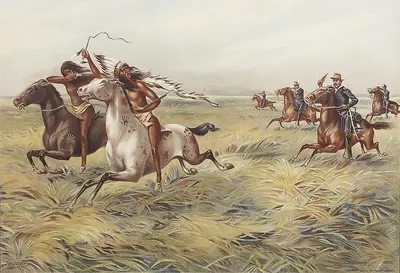
The American Indian Wars, also called the Indian Wars or the Frontier Wars, were the long series of conflicts between European colonists, and later the United States, and the many Native American nations of North America. They began with the first colonial settlements in the early 17th century and did not end until the close of the 19th. In the story of the Old West the name usually means the wars fought west of the Mississippi between about 1850 and 1890, on the Great Plains, in the deserts of the South-west and in the mountains of the North-west. These wars have given the Western some of its best-known history and its most enduring legends: the cavalry patrol, the frontier fort, the wagon train under attack, and great leaders on both sides.
Causes
There was no single Indian War. There were dozens of separate wars, campaigns and raids, fought by different nations at different times for different reasons. A few causes come up again and again:
- Land. As settlers, miners, ranchers and railways pushed west, they came into competition with Native peoples for land, grass, water and game. Gold strikes, such as those in Colorado in 1859, Montana in 1862–63 and the Black Hills in 1874–75, brought sudden rushes of newcomers into Native country.
- Treaties. The United States made hundreds of treaties with Native nations, often promising land and supplies in return for peace and passage. Many were broken, by settlers and governments that ignored them and sometimes by bands that had not agreed to them, and each broken promise made the next war more likely.
- The buffalo. The Plains nations depended on the bison for food, clothing and shelter. The mass slaughter of the herds by commercial hunters in the 1870s and 1880s destroyed their way of life faster than any army.
- Raiding and revenge. Raids on settlements, wagon trains and stage stations were met with punitive expeditions, and attacks on Native camps brought revenge in turn. Intertribal warfare also played a part: many nations fought one another, and several, such as the Crow, Pawnee and Shoshone, often allied themselves with the United States against their old enemies.
The soldiers
During the Civil War most regular troops went east, and volunteer regiments from the western states and territories took their place. After 1865 the frontier was guarded by a small regular army spread thin across the West in dozens of lonely posts, such as Fort Phil Kearny, Fort Larned, Fort Bowie and Fort Huachuca. Cavalry and infantry alike endured heat, cold, poor food, boredom and long campaigns in rough country. Among them were the Black regiments known as the Buffalo Soldiers, who served with distinction on the Plains and in the South-west, and Native scouts, whose tracking skills were often vital to the army's success.
The main wars in the West
- Texas and the Southern Plains. The Comanches and their Kiowa allies were among the finest light cavalry in the world and for decades held back Spanish, Mexican and then Texan settlement. Fighting with settlers, militia and the Texas Rangers went on from the 1830s until the Red River War of 1874–75, after which the last free bands, including that of the war chief Quanah Parker, moved to reservations in Indian Territory.
- The Pacific North-west. A string of wars followed the arrival of settlers and gold-seekers in Oregon and Washington in the 1840s and 1850s. The most famous came later: the Nez Perce War of 1877, when Chief Joseph and about 800 of his people, many of them women and children, made a fighting retreat of some 1,200 miles before surrendering near the Canadian border. Their courage and conduct won admiration even from the soldiers who pursued them.
- The Central and Northern Plains. In Minnesota in 1862, after treaty payments were delayed and many Dakota were going hungry, a faction of Dakota warriors attacked the agencies and farms of the Minnesota River valley. In six weeks of fighting, the Dakota War, they killed several hundred settlers, many of them women and children, and took many captives, though most Dakota did not take part and some saved settlers' lives. Fighting in Colorado in 1864–65 then spread across the Plains. At Sand Creek, Colorado, in November 1864, volunteer troops attacked a peaceful Cheyenne and Arapaho camp and killed many women, children and old people; it was condemned by Congressional and army inquiries at the time. In Red Cloud's War (1866–68) the Lakota and their allies fought the army to a standstill over the Bozeman Trail, destroying Captain William Fetterman's command of 81 men in December 1866, and the forts along the trail were given up under the Fort Laramie Treaty of 1868.
- The Great Sioux War. After gold was found in the Black Hills, land promised to the Lakota by treaty, war broke out again in 1876. On 25 June 1876 Lakota and Cheyenne warriors led by Sitting Bull, Crazy Horse and others wiped out Lieutenant Colonel George Armstrong Custer and five companies of the 7th Cavalry at the Little Bighorn in Montana, the army's most famous defeat of the era. Within a year, though, most of the bands had been forced to surrender.
- The South-west. The wars with the Apaches lasted longer than any other. Leaders such as Cochise, Victorio and Geronimo fought from mountain strongholds on both sides of the Mexican border, and the army needed thousands of troops and its Apache scouts to track them. Geronimo's final surrender in September 1886 ended the last major campaign. The Navajo were defeated in 1863–64 by troops under Kit Carson and forced on the "Long Walk" to Bosque Redondo in New Mexico, before being allowed home in 1868.
The end of the wars
By the late 1880s nearly all the Native nations of the West lived on reservations. In 1890 a religious movement called the Ghost Dance spread among the Lakota, alarming government agents. Sitting Bull was killed by Lakota agency police during an attempt to arrest him that December, and on 29 December 1890, at Wounded Knee Creek in South Dakota, soldiers of the 7th Cavalry disarming a band of Minneconjou Lakota under Big Foot opened fire after a shot rang out; about 250 or more Lakota, many of them women and children, were killed, along with some 25 soldiers. Wounded Knee is usually taken as the end of the Indian Wars, in the same year that the census declared the frontier closed, though small clashes went on for some years.
Counting the cost
Nobody knows how many people died in these wars. One careful study of recorded fights between 1850 and 1890, drawn mostly from army reports, counted about 21,500 casualties: roughly 6,600 soldiers and civilians and about 15,000 Native people, while admitting that the records are incomplete. Disease, hunger and the loss of the buffalo killed far more Native people than battle. Historians still debate how these wars should be judged as a whole, and accounts differ on many individual fights, where the army's reports and Native accounts often tell very different stories.
History and legend
Few parts of the American story have been told so often, or so loosely. Dime novels and Wild West shows, in which veterans such as Buffalo Bill Cody staged mock battles with real Native performers, fixed the image of whooping war parties and charging cavalry in the public mind. Hollywood carried it on: John Ford's cavalry trilogy, Fort Apache (1948), She Wore a Yellow Ribbon (1949) and Rio Grande (1950), celebrates the courage and loyalty of the frontier soldier, while Broken Arrow (1950) tells of the real friendship between the scout Tom Jeffords and Cochise. Many films freely mix real people and invented events, so their battles should be enjoyed as drama rather than taken as history. See Cavalry Westerns for more.
See also
Key facts
- Country: United States (Wikidata P17)
- Instance of: series of wars, war (Wikidata P31)
Gallery 1

Sources
- American Indian Wars - Wikipedia en.wikipedia.org
- Wikidata: Q849680 wikidata.org
- Isaac V. D. Heard, History of the Sioux War and Massacres of 1862 and 1863 (New York: Harper & Brothers; first publ. 1863, this copy 1865) – Internet Archive archive.org
- Big Eagle (Wamditanka), 'A Sioux Story of the War: Chief Big Eagle's Story of the Sioux Outbreak of 1862' (St Paul Pioneer Press, 1 July 1894; repr. Collections of the Minnesota Historical Society vol. 6, 1894) – Internet Archive archive.org
- U.S. Congress, Joint Committee on the Conduct of the War, Massacre of Cheyenne Indians (38th Congress, 2nd Session, report of 10 Jan 1865) – Internet Archive archive.org
- Capt. Silas S. Soule, letter to Maj. Edward W. Wynkoop, Fort Lyon, 14 Dec 1864 (full text) – Sand Creek Massacre NHS, National Park Service nps.gov
- Omaha Daily Bee, 13 Feb 1891, p. 1 (Secretary Proctor's decision on the Wounded Knee inquiry) – Nebraska Newspapers (UNL) / Chronicling America nebnewspapers.unl.edu
- 'Col. Forsyth Exonerated; His Action at Wounded Knee Justified', New York Times, 13 Feb 1891 nytimes.com
- James McLaughlin, letter to Lt. Bull Head ordering Sitting Bull's arrest, 14 Dec 1890 – National Archives at Kansas City archives.gov
- James McLaughlin, Standing Rock agent, account of Sitting Bull's death (1890 report) – PBS, The West pbs.org
- During the War – The U.S.-Dakota War of 1862, Minnesota Historical Society mnhs.org
- Aftermath – The U.S.-Dakota War of 1862, Minnesota Historical Society mnhs.org
- US–Dakota War of 1862 – MNopedia, Minnesota Historical Society mnhs.org
- History & Culture – Sand Creek Massacre National Historic Site, National Park Service nps.gov
- The Sand Creek Massacre: The Betrayal that Changed Cheyenne and Arapaho People Forever (exhibition) – History Colorado historycolorado.org
- Alan K. Lathrop, 'Another View of Wounded Knee', South Dakota History 16:3 (1986), publishing an eyewitness diary of Dec 1890–Jan 1891 sdhspress.com
- “Why Sitting Bull Was Killed by Indian Agency Police at His Cabin on the Standing Rock Reservation” (15 Dec 2024) – Smithsonian Magazine smithsonianmag.com
- US Army Center of Military History, American Military History, ch. 14 "Winning the West: The Army in the Indian Wars, 1865-1890" (mirror) ibiblio.org
- US Army CMH, "Indian Wars Campaigns" history.army.mil
- TSHA Handbook of Texas, "Comanche Indians" tshaonline.org
- NPS American Battlefield Protection Program battle summary nps.gov
- NPS, National Register/NHL nomination, Wounded Knee Battlefield npgallery.nps.gov
- TSHA Handbook of Texas, "Buffalo Soldiers" tshaonline.org
- Wikimedia Commons: U.S. Army-Cavalry Pursuing Indians-1876.jpg commons.wikimedia.org
- Wikimedia Commons: U.S. Army-Cavalry Pursuing Indians-1876 (cropped).jpg commons.wikimedia.org
