
Bodie, California
Bodie is a ghost town in the Bodie Hills of Mono County, California, on the dry eastern side of the Sierra Nevada, about 75 miles south-east of Lake Tahoe. At more than 8,300 feet above sea level it is one of the highest and coldest towns of the old mining West. It boomed after a rich strike in 1876, faded slowly over the next half-century, and is now kept as Bodie State Historic Park, preserved just as its last residents left it.
A slow start
Gold was first found here in 1859 by a small party of prospectors that included W. S. Bodey. He died in a blizzard that November on a supply trip and never saw the town that took his name; the spelling "Bodie" is said to have stuck after a sign painter lettered it that way on a stable. For years the camp went nowhere. Nearby Aurora and the great silver mines of Virginia City drew the crowds, and by 1868 both of Bodie's early stamp mills had failed.
The boom
In 1876 the Standard Company struck a rich deposit of gold ore, and a further find at the Bodie Mine in 1878 brought a rush. By 1879 Bodie had roughly 2,000 buildings and somewhere between about 8,000 and 10,000 or more people; accounts differ on the peak. Newspapers in California and Nevada predicted it would be the next Comstock. A local story claims that in 1880 it was California's second- or third-largest city, but the census of that year shows this is not true.
At its height Bodie had a Wells Fargo office, several newspapers, volunteer fire companies, a brass band, a miners' union, a jail and, by most accounts, 65 saloons along a Main Street a mile long. It also had a Chinatown of several hundred people, with its own Taoist temple. Bullion from the town's stamp mills went out by wagon to the mint at Carson City under armed guard.
Rough reputation and legend
Bodie had a name for violence: murders, shootings, saloon brawls and stagecoach hold-ups were regular events in the boom years. Some of the town's best-known tales, though, are unproven. One example is the story of Rosa May, a woman of the red-light district said to have nursed sick miners through an epidemic and then been buried outside the cemetery fence. It is a well-loved local legend, but the records do not confirm it.
Decline and preservation
From 1880 richer booms in places such as Tombstone and Butte drew the single miners away, and Bodie became a quieter family town. The mines still did well for a time: a narrow-gauge railway brought in timber from 1881, and in 1892 the Standard Company built one of the first long-distance electric power lines in the country to run its mill. But the population kept falling, to fewer than 700 by 1910 and about 120 by 1920. The last newspaper closed in 1912, the railway was abandoned in 1917, a fire swept the business district in 1932, and the last mine shut in 1942 under a wartime order closing non-essential gold mines.
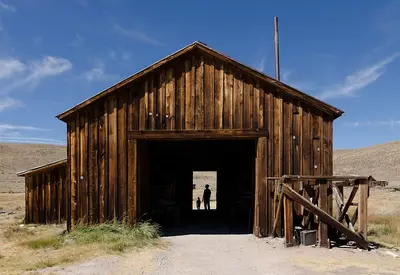
The Cain family, who by then owned most of the town, paid caretakers to protect it from vandals. Bodie became a National Historic Landmark in 1961 and a state historic park in 1962. About 110 buildings survive in what the park calls "arrested decay": they are kept standing but not restored, and many still hold their furniture and goods. Visitors may not take anything away, not even a nail. The roads are often shut by snow in winter.
See also
Nearby
- Virginia City, Nevada 134 km
- Goldfield, Nevada 166 km
- Rhyolite, Nevada 241 km
Key facts
- Founded/established: 1876 (Wikidata P571)
- Country: United States (Wikidata P17)
- Located in: Mono County (Wikidata P131)
- Instance of: ghost town (Wikidata P31)
- Boom: rich gold discoveries from 1876 (gold first found there in 1859)
- Peak population: roughly 8,000 to 10,000 or more (accounts differ)
Gallery 1

Sources
- Bodie, California - Wikipedia en.wikipedia.org
- Wikidata: Q832945 wikidata.org
- National Historic Landmark nomination: Bodie Historic District – NPS NPGallery npgallery.nps.gov
- “Bodie State Historic Park” – California State Parks parks.ca.gov
- Wikimedia Commons: Bodie ghost town.jpg commons.wikimedia.org
- Wikimedia Commons: Bodie September 2016 019.jpg commons.wikimedia.org
