
Cowboy boot
The cowboy boot is a tall leather riding boot with a high, slanted heel and a narrow, pointed or rounded toe. It was made for men who spent their working days in the saddle: the heel keeps the foot from sliding through the stirrup, the narrow toe slips into the stirrup quickly, and the tall shaft guards the leg against brush, thorns and the rub of the stirrup leathers. Born on the cattle frontier in the 1870s, it has since become, with the cowboy hat, the best-known piece of Western dress in the world.
Origins
Before the trail-driving years most American horsemen wore ordinary boots: flat-heeled, round-toed, and either too stiff or too loose for long days of riding. Cowboys took ideas from several sources. The Mexican vaquero rode in heeled boots and leggings, Civil War cavalrymen came home in tall military boots, and the high Wellington and Hessian styles were already popular in the East.
The first true cowboy boots were made in the 1870s by bootmakers in the towns where the cattle trails met the railways. No single inventor is securely established, and several makers have their claims:
- Charles Hyer of Olathe, Kansas, is said to have made a pair to a cowboy's own design in 1875, with a high cut, a pointed toe and a tall, slanted heel. Word of mouth brought him a flood of orders, and the family firm later kept patterns for customers as varied as Buffalo Bill, Tom Mix, Will Rogers and Theodore Roosevelt.
- Coffeyville, Kansas, gave its name to an early style with a lower heel and a squarer toe.
- H. J. Justin set up as a bootmaker at Spanish Fort, Texas, on the Red River crossing of the cattle trail, in 1879, mending and making boots for passing drovers. His business grew into one of the largest bootmakers in America.
How the boot works
- The heel. A high or underslung heel stops the foot from slipping through the stirrup, and it digs into the ground when a cowboy on foot is holding a roped animal.
- The toe. A narrow toe, pointed or rounded, finds the stirrup quickly when mounting a restless horse.
- The shaft. Reaching at least to mid-calf, it protects against brush, cactus, snakes and chafing. Leather pull straps at the top, sometimes called "mule ears", help the wearer pull the boots on.
- The stitching. The rows of stitching on the shaft began as a way of stiffening the leather so that it would not sag around the ankle, and became decoration later.
Boots were usually made of leather such as calfskin. Later makers also used kangaroo and exotic skins such as ostrich, lizard and snake. A lower-heeled style called the roper, designed for rodeo calf-ropers who must run on foot, became popular in the 20th century.
Legend and history
- "Died with his boots on". A man who died violently, rather than in bed, was said to have died with his boots on, and several frontier towns, including Dodge City and Tombstone, called their burial grounds Boot Hill. Many of the stories told about who lay there grew in the retelling.
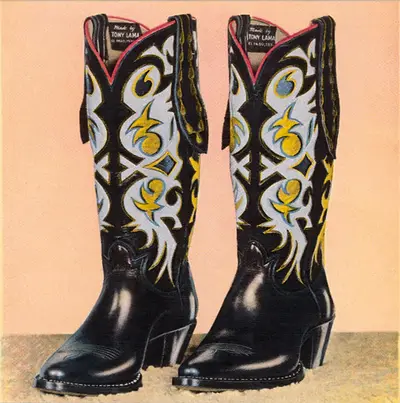
- The fancy boot. Working cowboys bought the best boots they could afford, often custom-made, and some are said to have spent a month's wages on a pair. The brightly coloured, heavily inlaid boots associated with cowboys today owe more to the singing-cowboy films and rodeo of the 1930s and 1940s than to the trail.
In Westerns
Boots are part of every screen cowboy's costume. Stars of the silent and singing-cowboy eras, such as Tom Mix, William S. Hart and Roy Rogers, helped to make showy custom boots fashionable, and the title of the Custer film They Died with Their Boots On (1941) uses the old frontier saying.
Quick facts
- Type: pull-on leather riding boot
- Developed: 1870s, on the Kansas and Texas cattle frontier
- Early makers: Charles Hyer (Olathe, Kansas), Coffeyville bootmakers, H. J. Justin (Spanish Fort, Texas)
- Main features: high or underslung heel, pointed or rounded toe, tall shaft
See also
Gallery 1

Sources
- Cowboy boot - Wikipedia en.wikipedia.org
- Wikidata: Q1138187 wikidata.org
- Emerson Hough, The Story of the Cowboy (1897) – Internet Archive archive.org
- Sears, Roebuck & Co., Consumers Guide, Catalogue No. 104 (Spring 1897) – Internet Archive archive.org
- Frank Leslie's Illustrated Newspaper, 14 Jan 1882, “Texan Cowboys on a Holiday Excursion” – Internet Archive archive.org
- Philip Ashton Rollins, The Cowboy: His Characteristics, His Equipment (1922) – Internet Archive archive.org
- “Boot and Saddle Makers” – Encyclopedia of Oklahoma History and Culture okhistory.org
- “Hyer Cowboy Boots” – Kansapedia, Kansas Historical Society kansashistory.gov
- Texas House Concurrent Resolution 151, 80th Legislature (2007) – Texas Legislature Online capitol.texas.gov
- Wikimedia Commons: Cowboy Boots (7413702698).jpg commons.wikimedia.org
- Wikimedia Commons: Cowboy boots cropped.png commons.wikimedia.org
