
Northern Pacific Railway
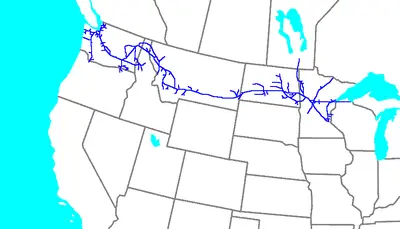
The Northern Pacific was the first of the northern transcontinental railways, running from Lake Superior across Minnesota, Dakota, Montana, Idaho and Washington to Puget Sound. Chartered by Act of Congress in 1864, it was given the largest land grant ever made by Congress, began building in 1870, was nearly destroyed by the Panic of 1873, and was finally completed when the rails from east and west were joined at Gold Creek, Montana Territory, on 8 September 1883. Its trains, land offices and immigrant agents did more than anything else to settle the northern plains, and the four states of North Dakota, South Dakota, Montana and Washington entered the Union within a few years of its completion. It became part of the Burlington Northern in 1970.
Charter and land grant
The idea of a railway along the northern route, roughly following the trail of Lewis and Clark, had been urged since the 1830s, and Isaac I. Stevens surveyed a route in the 1850s. On 2 July 1864, in the middle of the Civil War, President Abraham Lincoln signed the Act that created the Northern Pacific Railroad Company, with Josiah Perham of Massachusetts as its first president. Instead of money, the company received alternate sections of public land on each side of the line. Estimates of the grant's total size vary from about 40 million to 60 million acres, but all agree that it was the largest land grant in American history.
The land was worth little until the railway was built, and the Act at first forbade the company to raise money by bonds or mortgages. For six years almost nothing happened. In 1870 Congress allowed the company to issue bonds, and the Philadelphia banker Jay Cooke, who had financed the Union war effort, took charge of selling them.
Building west, and the Panic of 1873
Ground was broken on 15 February 1870 near Carlton, Minnesota, west of Duluth, and construction began that summer. The track reached Fargo in June 1872 and the Missouri River at Edwinton, soon renamed Bismarck, in June 1873. At the same time a western section was built north from Kalama on the Columbia River to Tacoma, which was chosen as the western terminus.
Beyond the Missouri the surveyors were entering the Yellowstone country, hunting grounds that the Lakota and Northern Cheyenne regarded as theirs. The Army escorted the survey parties, Fort Abraham Lincoln was built in 1872 to guard the line, and in the mid-1870s companies of the Seventh Cavalry under George Armstrong Custer rode out from there and from Fort Rice to protect the surveyors and construction crews.
Then, in September 1873, Jay Cooke and Company failed, setting off the Panic of 1873. Work almost stopped, and in 1875 the Northern Pacific went bankrupt. It was reorganised under Frederick Billings, after whom Billings, Montana, is named, and construction began again in 1879. The track reached Glendive in 1881 and Livingston, at the foot of the Bozeman Pass, early in 1883.
Villard and the last spike
In 1881 the German-born former journalist Henry Villard, who controlled the Oregon Railway and Navigation Company, bought control of the Northern Pacific in a famous "blind pool", raising millions from investors who were not told what the money was for. Under Villard the line was pushed hard from both ends. Labour and rails were both short. According to the company's own history, 15,000 of the 25,000 workers needed were brought over from China, and rails, plates and spikes were imported from England and France.
The track was technically complete on 22 August 1883, and on 8 September Villard held a great ceremony at Gold Creek, Montana Territory, for some 300 guests from America, Germany, Britain and Scandinavia, among them former President Ulysses S. Grant. A short stretch of track was taken up and relaid, and Grant and Villard drove the last spike, the same iron spike that had been used at the groundbreaking in Minnesota thirteen years before. Within months Villard's finances collapsed and he left the presidency in January 1884. The direct line over the Cascade Mountains to Tacoma, through the Stampede Pass tunnel, was finished in 1888.
Settling the northern plains
To sell its land and fill its trains, the Northern Pacific advertised the northern plains across eastern America and Europe. It opened emigration offices in Germany and Scandinavia, offering cheap land and passage as a package, and German and Scandinavian farmers came in their thousands to grow wheat on the prairies along the Red River of the North and in Dakota. Along the line grew the towns of Fargo, Bismarck, Billings, Livingston, Missoula and Spokane, and Tacoma rose from about 1,100 people in 1880 to some 36,000 by 1889. North and South Dakota became states on 2 November 1889, Montana on 8 November and Washington on 11 November.
The railway also promoted Yellowstone, the first national park, publishing guides for tourists, and in 1900 it began its famous passenger train, the North Coast Limited, between Chicago and Seattle. Its emblem was the monad, the ancient Chinese yin-yang symbol, which the company's chief engineer, E. H. McHenry, had seen on the Korean flag at the Chicago World's Fair of 1893.
Later years
From 1893 the Northern Pacific faced a rival on the northern route, James J. Hill's Great Northern. Hill bought an interest in the Northern Pacific in 1896, and in 1901 a battle between Hill and E. H. Harriman of the Union Pacific for control of it, the "Northern Pacific Corner", threw the stock market into turmoil. Hill's attempt to join the lines in a single holding company was struck down by the Supreme Court in 1904. On 2 March 1970 the two lines, with the Chicago, Burlington and Quincy and the Spokane, Portland and Seattle, finally merged to form the Burlington Northern, which in 1996 joined the Atchison, Topeka and Santa Fe to form today's BNSF Railway.
Legend and history
- A golden spike? The ceremony at Gold Creek is often called the "golden spike" ceremony, after the more famous one at Promontory in 1869. The company's own history says that the last spike was not gold, but the same spike that had been used at the 1870 groundbreaking.
- Crossing the frozen Missouri. Before the Bismarck bridge was finished in 1882, ferries carried the trains across the Missouri in summer, and in the winters of 1879 to 1882 track was laid across the ice.
Key facts
- Chartered: 2 July 1864, by Act of Congress
- Construction began: 15 February 1870, near Carlton, Minnesota
- Completed: 8 September 1883, Gold Creek, Montana Territory
- Route: Lake Superior to Puget Sound
- Land grant: the largest ever made by Congress
- Key figures: Josiah Perham, Jay Cooke, Frederick Billings, Henry Villard
- Merged: into the Burlington Northern, 2 March 1970
- Founded/established: 1864 (Wikidata P571)
- Ended/dissolved: 1970 (Wikidata P576)
- Country: United States (Wikidata P17)
- Located in: Ashland (Wikidata P131)
- Instance of: transport company, transcontinental railroad, business (Wikidata P31)
See also
Gallery 1

Sources
- Northern Pacific Railway - Wikipedia en.wikipedia.org
- Wikidata: Q1135434 wikidata.org
- Wikimedia Commons: Northern Pacific Railroad 1894.jpg commons.wikimedia.org
- Wikimedia Commons: Northern Pacific.png commons.wikimedia.org
