
Union Pacific No. 119
Union Pacific No. 119 was a coal-burning 4-4-0 steam locomotive that, with the Central Pacific's Jupiter, stood for the Union Pacific Railroad at the meeting of the rails at Promontory Summit, Utah Territory, on 10 May 1869, when the golden spike completed the first transcontinental railroad. Like the Jupiter it was an ordinary working engine that happened to be in the right place at the right time. The original was scrapped in 1903; a working replica now runs at Golden Spike National Historical Park.
An ordinary engine
No. 119 was built in 1868 by the Rogers Locomotive and Machine Works of Paterson, New Jersey, one of a batch of five engines (Nos. 116 to 120) for the railway. It was a typical "American" type of the period, with four leading wheels and four driving wheels, but unlike the wood-burning Jupiter it burned coal and had a straight smokestack. The Union Pacific gave its engines numbers rather than names. No. 119 worked on the Utah Division, hauling trains between Rawlins, Wyoming, and Ogden, Utah.
A last-minute choice
The Union Pacific had not planned to send No. 119 to the ceremony. The railway's vice-president, Thomas C. Durant, was travelling west by special train when heavy spring rains swelled a river and weakened the Devil's Gate Bridge in Weber Canyon. His engineer would not risk taking the locomotive across, and the lighter carriages were pushed over the bridge on their own. That left Durant's party with no engine, and No. 119 was sent out from Ogden to bring them the short distance to Promontory. The ceremony itself had already been put back from 8 May to 10 May because Durant's journey was held up; most accounts blame bad weather and a pay dispute with unpaid workers who stopped his train at Piedmont, Wyoming.
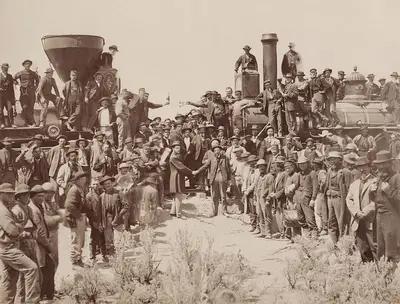
At Promontory the 119 was drawn up facing the Jupiter across the last gap in the track. Andrew J. Russell's photograph of the scene shows the Union Pacific engine on the right, with its engineer, Sam Bradford, holding out a bottle of champagne towards the Jupiter's engineer, George Booth. When the last spike was in, the two engines eased forward until their pilots (cowcatchers) touched, and each engineer broke a bottle over the other's locomotive.
Later years
After its moment of fame No. 119 went back to hauling freight. It was renumbered 343 in 1882 and scrapped in 1903, at a time when neither railway thought its Golden Spike engines worth keeping.
Replicas
For later re-enactments other engines were made up to look like No. 119, including a Chicago, Burlington and Quincy engine at the 1949 Chicago Railroad Fair and Virginia and Truckee locomotives such as the Reno and the Dayton around the centenary in 1969. The National Park Service then had exact replicas of both engines built from scratch. With no original drawings left, more than 700 new drawings were prepared from photographs and period research. The replicas were delivered to Promontory and began running on 10 May 1979. The No. 119 replica burns coal, as the original did, and the pair still steam along a restored stretch of track at the park.
Key facts
- Railway: Union Pacific Railroad, No. 119 (renumbered 343 in 1882)
- Type: 4-4-0 "American", coal-burning
- Built: 1868, Rogers Locomotive and Machine Works, Paterson, New Jersey
- Famous for: the Golden Spike ceremony, Promontory Summit, 10 May 1869
- Engineer on the day: Sam Bradford
- Fate: scrapped in 1903; a working replica was built in 1979
- Country: United States (Wikidata P17)
- Instance of: tender locomotive (Wikidata P31)
- Built 1868; original scrapped 1903; replica 1979 (Wikipedia)
See also
Appears in 2


Sources
- Union Pacific No. 119 - Wikipedia en.wikipedia.org
- Wikidata: Q10387729 wikidata.org
- Wikimedia Commons: UP steam loco.jpg commons.wikimedia.org
