

✦ Legend
Some statements on this page are still being checked and are marked "Needs further sources".
There's no firm evidence that Bass Reeves was the real Lone Ranger. The idea comes from his biographer Art T. Burton, who says himself that it can't be proven, and letters from the radio show's creators point to other models. Reeves himself was very real: born enslaved, he served as a deputy US marshal for over 30 years.Sources: Once and For All, Is the Lone Ranger Based on Bass Reeves?, True West Magazine, 25 January 2021 (accessed 27 October 2026) · Was the Real Lone Ranger a Black Man?, History.com, 1 February 2018 (accessed 27 October 2026) · Bass Reeves (Site Bulletin), US National Park Service – Fort Smith National Historic Site (accessed 27 October 2026)
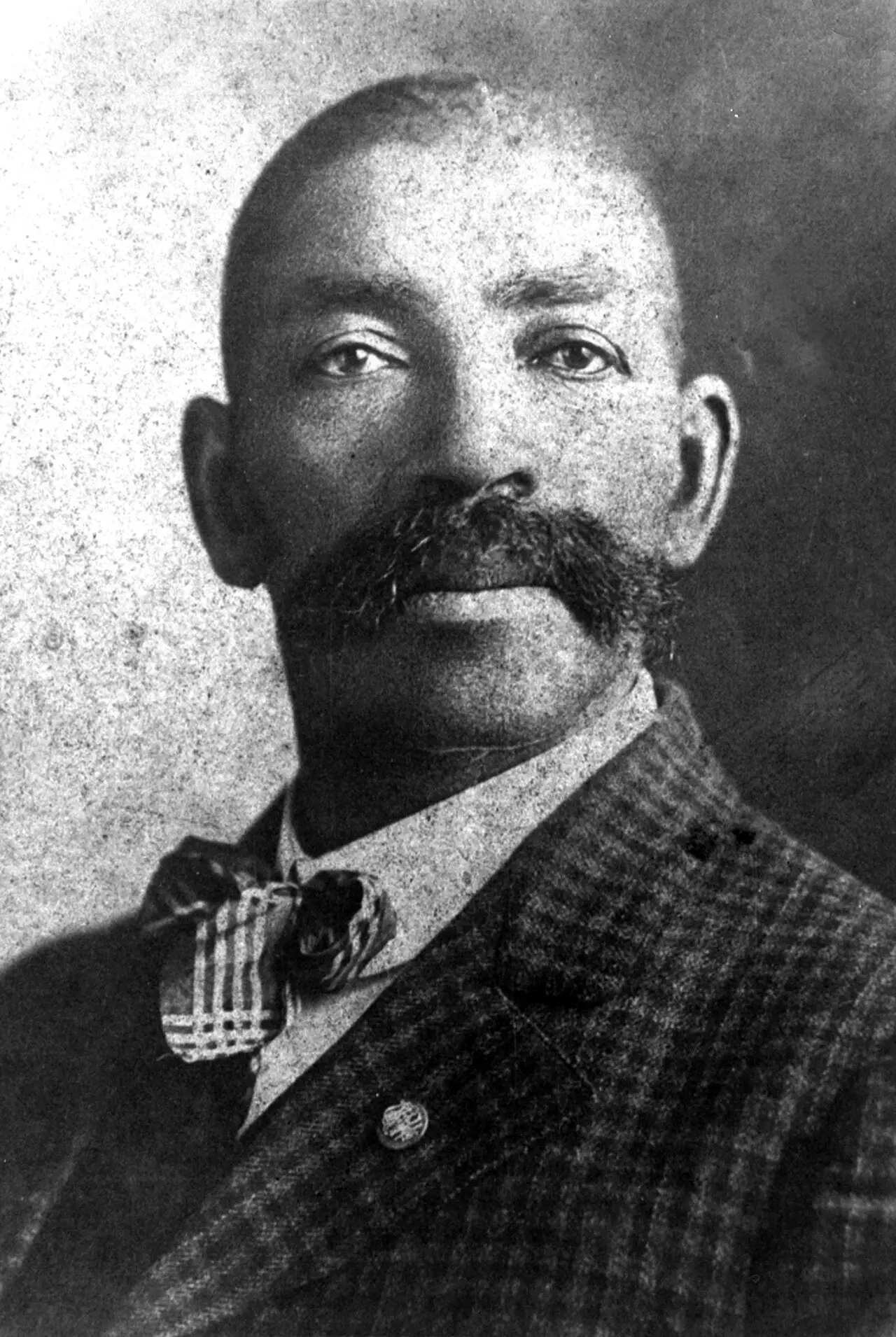
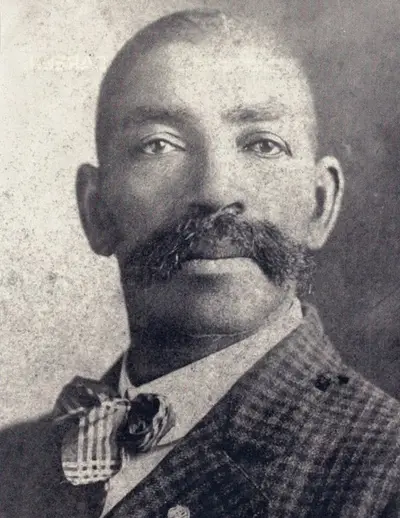
Bass Reeves (1838–1910) was born into slavery in Arkansas, escaped, and became one of the first Black deputy US marshals west of the Mississippi River. For 32 years, from 1875 until Oklahoma became a state in 1907, he hunted fugitives across Indian Territory for the federal courts, and he told a newspaper in 1901 that he had made more than 3,000 arrests. Unlike most Western legends, his reputation was built during his lifetime by sober newspaper reports rather than dime novels. Only in recent decades has he become widely known, partly through the claim that he inspired the Lone Ranger.
Early life
Reeves was born into slavery in Crawford County, Arkansas, in July 1838; only the month and year are recorded, and no exact day is known. The details of his early life are uncertain. His family was enslaved by the Arkansas legislator William Steele Reeves, who moved to Grayson County, Texas, around 1846, and Bass was probably held by his son, Colonel George R. Reeves, later Speaker of the Texas House of Representatives. Other accounts say simply that he belonged to George Reeves and grew up in Lamar and Grayson counties, Texas.
Escape and the Civil War
How and when he gained his freedom is disputed. George Reeves joined the Confederate army and took Bass with him. Family tradition says that in 1861 or 1862 Bass attacked his enslaver after a quarrel over a game of cards and fled to Indian Territory. It is believed he served as a soldier with the Union Indian Home Guard regiments during the war. Either way, he lived among the Cherokee, Creek and Seminole and learned their languages, customs and tracking skills. After the war he farmed near Van Buren, Arkansas, and sometimes guided deputy marshals into the Territory, which he said he knew "like a cook knows her kitchen".
Deputy marshal
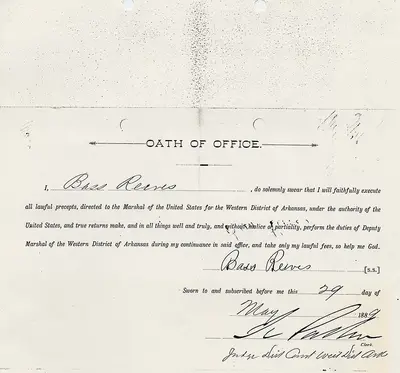
In 1875 Judge Isaac C. Parker took over the federal court at Fort Smith, Arkansas, whose jurisdiction covered Indian Territory, and Reeves was commissioned as a deputy US marshal. The district covered more than 75,000 square miles. Deputies set out from Fort Smith with a wagon, a cook and at least one posseman on round trips that could run to 800 miles and last for months. Reeves later served at Paris, Texas, then from 1897 at Wetumka and from 1898 at Muskogee, and he was the only deputy to serve from the start of Parker's court until statehood in 1907.
He was a marksman with rifle and pistol, and he was reportedly never wounded, although his hat and belt were shot off on separate occasions. He is said to have favoured Winchester rifles, including the Model 1873, which shared .44-40 ammunition with revolvers of the day. In a 1901 newspaper interview he said he had arrested more than 3,000 men and women.
His son
In 1902 he was handed a warrant for his own son, Bennie, who was charged with murdering his wife. Reeves brought him in. Bennie was convicted in 1903 and sentenced to life at Fort Leavenworth, but was released after about 11 years. This has been called the greatest testimony to Reeves's devotion to duty.
Later life and death
After statehood Reeves, then 68, joined the Muskogee police department and served for two years before illness forced him to retire. He died there on 12 January 1910. The Muskogee Phoenix wrote that "he got his man as often as any of the deputies"Needs further sources.
Legend versus history
- How many men did he kill? Territorial newspapers said he killed 14 outlaws, and his obituary gave the same figure. Some accounts credit him with 20. The number is disputed.
- The real Lone Ranger? The historian Art T. Burton has argued that Reeves "is the closest person to resemble the Lone Ranger", pointing to his Native American partners and his habit of handing out silver dollars. This is speculation: there is no firm evidence that the radio show's creators knew of him.
- 3,000 arrests. The figure is Reeves's own claim, made in a single 1901 newspaper interview. It is not backed by court records and should be treated with caution.
Legacy
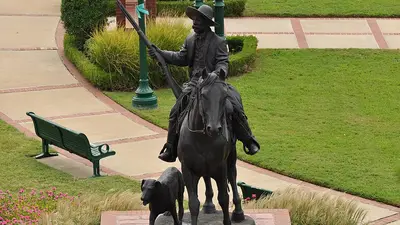
A bronze statue of Reeves was put up in Fort Smith in 2012, the US-62 bridge over the Arkansas River near Muskogee was renamed the Bass Reeves Memorial Bridge in 2011, and he was inducted into the Texas Trail of Fame.
Key facts
- Born: July 1838 (day unknown), Crawford County, Arkansas, US
- Died: 12 January 1910, Muskogee, Oklahoma
- Post: deputy US marshal, 1875–1907
- Courts: Fort Smith (Judge Isaac C. Parker); Paris, Texas; Muskogee
- Arrests: more than 3,000 (his own claim)
- Born 1838, Crawford County, Arkansas; died 12 January 1910, Muskogee, Oklahoma (Wikipedia, Britannica)
- Commissioned deputy US marshal in 1875 (Britannica)
- Came to know the Cherokee, Creek and Seminole of Indian Territory and spoke several Native languages (Encyclopedia of Oklahoma History)
See also
Questions and answers
Was Bass Reeves real?
Yes. He was born enslaved in about 1838. As a young man he asked his enslaver for permission to learn to read, because he wanted to read the Bible, and was refused. In 1875 he was commissioned as a deputy US marshal under Judge Isaac Parker, and he is believed to be one of the earliest Black deputy marshals west of the Mississippi. He served in Indian Territory until Oklahoma became a state in 1907, then spent two years with the Muskogee police.
Sources: Bass Reeves (Site Bulletin), US National Park Service – Fort Smith National Historic Site (accessed 27 October 2026) · Reeves, Bass, Oklahoma Historical Society – Encyclopedia of Oklahoma History and Culture (accessed 27 October 2026) · Was the Real Lone Ranger a Black Man?, History.com, 1 February 2018 (accessed 27 October 2026)
Was Bass Reeves the Lone Ranger?
Possibly, but it can't be proven. In his biography Art Burton points to likenesses: Reeves often worked in disguise, many of his possemen came from the Indian nations of Indian Territory, he handed out silver dollars, and many of his prisoners were sent to Detroit, where the radio show began in 1933. Burton himself says the link can't be proven, and the show's 1933 planning letters suggest models such as Zorro and Tom Mix. The fairest verdict is an interesting theory, not established history.
Sources: Once and For All, Is the Lone Ranger Based on Bass Reeves?, True West Magazine, 25 January 2021 (accessed 27 October 2026) · Was the Real Lone Ranger a Black Man?, History.com, 1 February 2018 (accessed 27 October 2026) · The Resurrection of Bass Reeves, Texas Monthly (link not checked yet)
How many outlaws did Bass Reeves arrest or kill?
Nobody knows exactly. The famous figure of more than 3,000 arrests was printed in the Chickasaw Enterprise in 1901, and figures for the men he killed range from 12 to 20 depending on the source. The National Park Service says these numbers must be used with historical caution, partly because newspapers of the time often left his name out of reports.
Sources: Bass Reeves (Site Bulletin), US National Park Service – Fort Smith National Historic Site (accessed 27 October 2026) · Reeves, Bass, Oklahoma Historical Society – Encyclopedia of Oklahoma History and Culture (accessed 27 October 2026)
How did Bass Reeves die?
He died on 12 January 1910 in Muskogee of Bright's disease, a kidney illness. The Muskogee Phoenix praised his devotion to duty and his "unflinching courage".
Sources: Bass Reeves (Site Bulletin), US National Park Service – Fort Smith National Historic Site (accessed 27 October 2026) · Reeves, Bass, Oklahoma Historical Society – Encyclopedia of Oklahoma History and Culture (accessed 27 October 2026)
Did Bass Reeves arrest his own son?
Yes. In June 1902 his son Benjamin shot and killed his wife in Muskogee. Reeves was given the warrant for his son's arrest and set out to bring him in. Benjamin was found guilty of murder, sentenced to life in prison in January 1903, and released after serving about eleven years.
Sources: Bass Reeves (Site Bulletin), US National Park Service – Fort Smith National Historic Site (accessed 27 October 2026) · Was the Real Lone Ranger a Black Man?, History.com, 1 February 2018 (accessed 27 October 2026)
Gallery 7







Sources
- Bass Reeves - Wikipedia en.wikipedia.org
- Wikidata: Q4867957 wikidata.org
- Bass Reeves - Britannica britannica.com
- Wikimedia Commons: BassReeves.jpg commons.wikimedia.org
- Reeves, Bass - Encyclopedia of Oklahoma History and Culture okhistory.org
- Obituary of Bass Reeves (transcription) lawmen.genealogyvillage.com