
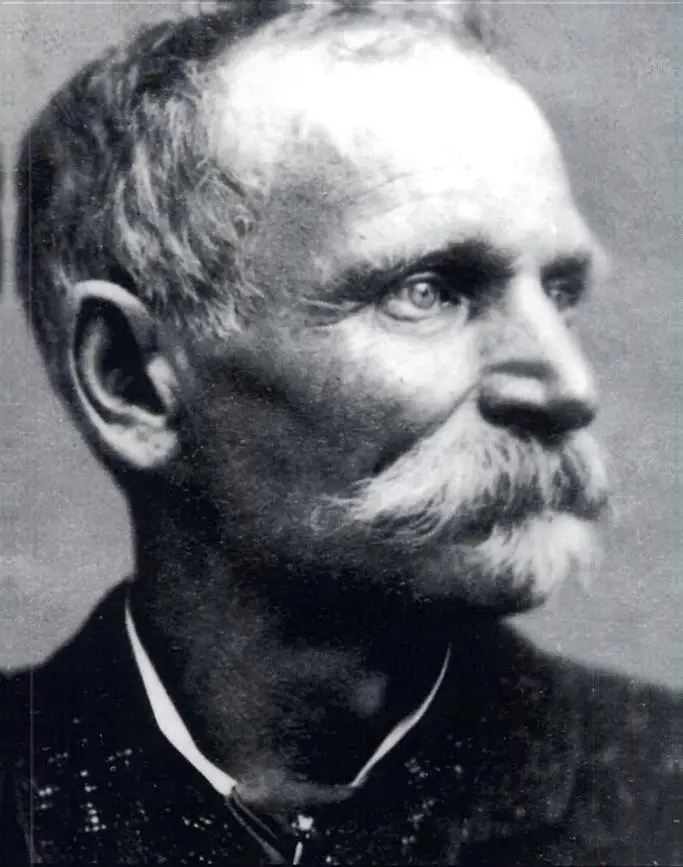

✦ Legend
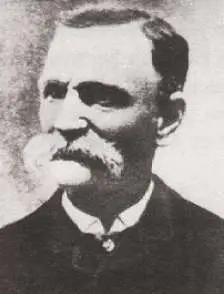
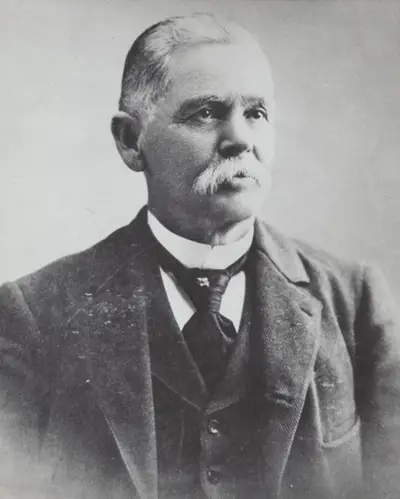
Black Bart was the name used by Charles E. Boles (also known as Charles Bolton), a polite, well-dressed stagecoach robber who held up Wells Fargo coaches in Northern California and southern Oregon between 1875 and 1883. He worked alone and on foot, wore a flour sack over his head, never fired his shotgun and twice left behind a scrap of comic verse signed "Black Bart, the Po8". His capture, through a laundry mark on a handkerchief, was a triumph for Wells Fargo's detectives. His end is a mystery: after leaving prison in 1888 he vanished.
Origins
Where and when he was born is disputed. Most accounts say he was born around 1829 in Norfolk, England, and that his family emigrated to Jefferson County, New York, when he was two. Others give his birth as about 1820 in New York state. In 1849 he joined the California Gold Rush with two of his brothers. He later married, settled in Illinois and, in August 1862, enlisted in the 116th Illinois Infantry. He was badly wounded at Vicksburg, marched with Sherman to the sea and left the army in 1865 with brevet commissions as a lieutenant. A San Francisco Museum account by a former Wells Fargo agent confirms he served in Company B of that regiment. After the war he went prospecting in Idaho and Montana. In a letter of 1871 he told his wife about an unpleasant run-in with Wells Fargo agents and vowed revenge.
The robber
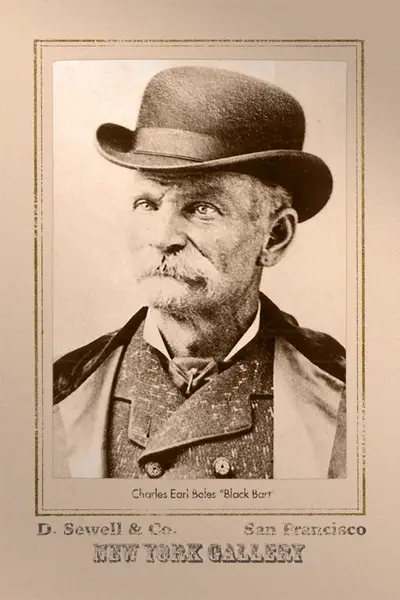
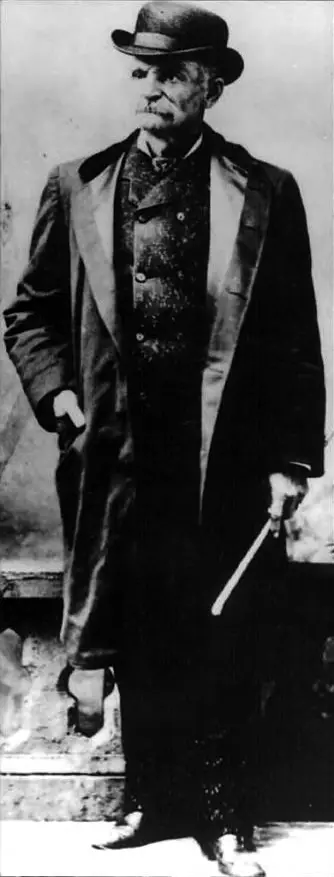
His first robbery came on 26 July 1875 in Calaveras County, on the road between Copperopolis and Milton. He ordered the driver to "throw down the box" and called out to imaginary accomplices; the rifles pointing from the bushes turned out to be sticks. Over the next eight years he robbed Wells Fargo coaches at least 28 times. He was afraid of horses and always escaped on foot, often walking long distances through the hills. He wore a long linen duster and a bowler hat, and he was unfailingly courteous.
The poems
He left verses at only two robberies, the fourth and fifth, but they made him famous. One, left in 1878, begins:
Here I lay me down to sleep to wait the coming morrow, perhaps success, perhaps defeat and everlasting sorrow.
He said the name "Black Bart" came to him while writing his first poem. He may also have read a serial in the Sacramento Union in the early 1870s whose villain, also called Black Bart, robbed Wells Fargo coaches.
Capture
On 3 November 1883 he robbed a coach on Funk Hill near Copperopolis, close to the scene of his first hold-up. This time a young man travelling with the stage fired at him, and he fled, wounded in the hand. He left behind a pair of spectacles and a handkerchief bearing the laundry mark F.X.O.7. Wells Fargo detectives checked about 90 laundries before tracing the mark to a "Mr. Bolton" who lived in a boarding house in San Francisco and described himself as a mining engineer.
He admitted to some of the robberies, and Wells Fargo pressed charges only for the last one. He was convicted and sentenced to six years in San Quentin, and released early, in January 1888, for good behaviour. Asked by reporters if he would write more poetry, he replied: "Didn't you hear me say that I am through with crime?"
Disappearance
His health had suffered in prison. He left the Bay Area, and the last confirmed sighting was at the Palace Hotel in Visalia on 28 February 1888. What became of him is unknown. A Wells Fargo detective said in 1897 that he believed Boles had gone to Japan, and there are local claims that he lived out his days in Marysville or was buried in Knights Landing, California. One account gives his death as "1917?, New York?", which is another unproven guess.
Legend versus history
- The gentleman bandit. The reputation is largely deserved. He reportedly never fired a shot during his robberies and was invariably polite, never swearing except in his poems.
- A prolific poet. Only two of his poems are known, both from 1877–78, yet they are what made him famous.
- The gang in the bushes. The rifles aimed at the first coach were sticks, and he always worked alone.
On screen
No films about Black Bart are listed here. The 1917 silent film A Romance of the Redwoods borrows heavily from his story.
Key facts
- Born: about 1829, Norfolk, England (disputed; some give about 1820, New York state)
- Died: Unknown; last seen 28 February 1888, Visalia, California
- Real name: Charles E. Boles (also Bolton, Bowles)
- Robberies: at least 28 Wells Fargo stagecoaches, 1875–1883
- Prison: San Quentin, 1883–1888
- Army service: 116th Illinois Infantry, 1862–1865
- Born c. 1829, Norfolk, England (Wikidata, Wikipedia)
- Last recorded after 28 February 1888 (Wikipedia)
See also
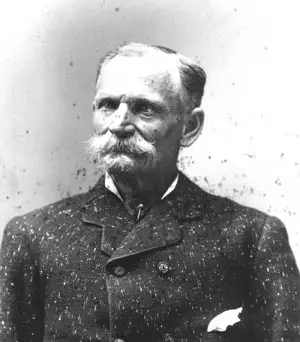
Gallery 5





Sources
- Black Bart (outlaw) - Wikipedia en.wikipedia.org
- Wikidata: Q880069 wikidata.org
- Wikimedia Commons: Charles Bowles aka Black Bart.jpg commons.wikimedia.org
- Black Bart | Outlaw, Western Frontier, Poet | Britannica britannica.com
- November 3, 1883: Black Bart's Last Stage Robbery - California State Library celebratecalifornia.library.ca.gov