
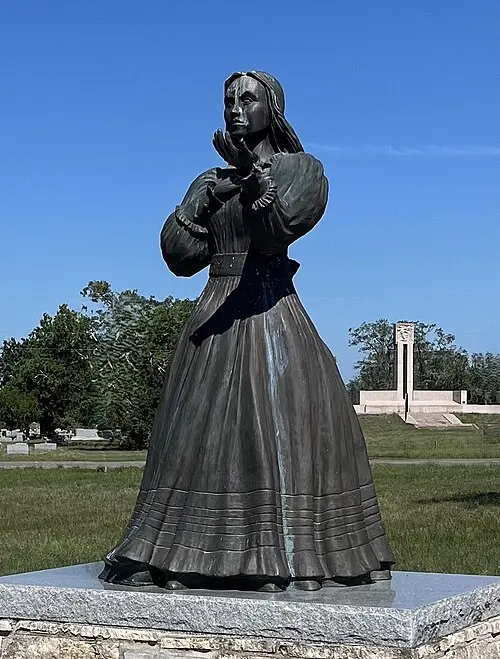

✦ Legend
Francita Alavez, remembered in Texas as the Angel of Goliad, was a Mexican woman who saved the lives of Texian prisoners during the Texas Revolution of 1836. She came to Texas by ship from Matamoros with a Mexican army officer, and she persuaded Mexican officers to treat captured men humanely and, on the eve of the Goliad massacre, helped hide several men who would otherwise have been shot. Survivors remembered her with deep gratitude for the rest of their lives.
Who she was
Almost everything about her early life is uncertain. Her real name is given variously as Francita, Francisca, Panchita or Pancheta, and her surname as Alavez, Alvárez or Alevesco. Her dates and place of birth are Unknown; she is usually thought to have been young in 1836. She was the companion, not the wife, of Captain Telesforo Alavez of the Mexican army, and in March 1836 she came with him by ship from Matamoros to the port of Copano on Copano Bay. The story that she marched overland with General José de Urrea's army is very unlikely.
The Angel of Goliad
At Copano, Mexican troops captured some 80 men of Major William P. Miller's Nashville Battalion as they landed. The prisoners were tied so tightly that their hands swelled. Señora Alavez had the cords loosened and saw that the men were given food and water.
The prisoners taken after the Battle of Coleto were held in the presidio at Goliad. On 27 March 1836, Palm Sunday, most of them were marched out and shot on the orders of General Antonio López de Santa Anna (see Presidio La Bahía). General Urrea had asked Santa Anna for clemency, and the commander at Goliad, Colonel José Nicolás de la Portilla, who carried out the order, wrote in his diary that the scene had filled him with horror. The night before, she is said to have gone into the presidio and brought several men out with her, hiding them until the killing was over. With Colonel Francisco Garay, who also opposed the executions, she persuaded the officers to spare about twenty more men as doctors, interpreters, mechanics and workers. Miller's men, who had been taken without a fight as they landed, were spared too, and accounts credit her with helping to save them.
At Victoria, where Captain Alavez was left in command, she helped secure the release of more than twenty men of Colonel William Ward's command who had been kept alive as labourers. After San Jacinto, when the Mexican army withdrew, she went with Alavez to Matamoros, where she went on helping the Texian prisoners held there.
Later life
Her later life is uncertain, and accounts differ. After the war she was befriended by Texans who knew what she had done. A 1936 memoir by Elena Zamora O'Shea, a teacher on the King Ranch, says that she came back to Texas and lived out her life on the ranch. That account cannot be checked against older records. When and where she died is Unknown.
Legend versus history
- The Angel. That a Mexican woman with the army saved Texian prisoners is well attested. Dr Joseph H. Barnard, one of the surgeons spared at Goliad, praised her in his journal, and Dr Jack Shackelford, another survivor, also recorded what she had done. Texans came to call her the Angel of Goliad.
- How many she saved. Numbers vary from a handful to several dozen, depending on whether the Copano, Goliad and Victoria prisoners are counted together; accounts differ.
- Her identity. Her name, age, origins and later life are uncertain, and some later details may be legend.
- Her place in memory. Texans have long honoured her as a sign that courage and kindness were shown on both sides of the war.
Key facts
- Born: Unknown; accounts differ
- Died: Unknown
- Also known as: Angel of Goliad; Francisca, Panchita or Pancheta Alavez or Alvárez
- Known for: saving Texian prisoners at Copano, Goliad, Victoria and Matamoros (1836)
- Known as the 'Angel of Goliad'; she came to Texas in March 1836 with Captain Telesforo Alavez of the Mexican army, by ship from Matamoros to Copano Bay (TSHA, 'Alavez, Francita').
- At Copano Bay she persuaded Mexican soldiers to loosen the cords binding Texian prisoners and to feed them; at Goliad she is credited with saving Major William P. Miller's men from execution and with bringing several men out of the fort and hiding them the evening before the massacre (TSHA, 'Alavez, Francita'; TSHA, 'Goliad Massacre').
- Her real name, her dates and her later life are uncertain; some accounts give her name as Panchita, and dates of about 1816 to 1906 are not confirmed (TSHA; Wikipedia).
- After the war she was befriended by Texans; Dr Joseph H. Barnard and Dr Jack Shackelford, both Goliad prisoners, wrote of her gratefully. A statue of the Angel of Goliad stands at the Fannin Memorial Monument (TSHA, 'Alavez, Francita'; Wikimedia Commons).
See also
Sources
- Alavez, Francita – Handbook of Texas Online (Texas State Historical Association) tshaonline.org
- Goliad Massacre – Handbook of Texas Online (Texas State Historical Association) tshaonline.org
- Francita Alavez - Wikipedia en.wikipedia.org
- Wikidata: Q5484389 wikidata.org
- Wikimedia Commons: Angel of Goliad statue with Fannin Memorial Monument in background.jpg commons.wikimedia.org