


Grace Patricia Kelly (1929–1982) was an American actress who became one of Hollywood's biggest stars in the early to mid-1950s, and then gave up acting to become Princess of Monaco. Her film career lasted only about five years, and she made just one Western, but it was an important one: Fred Zinnemann's High Noon (1952), the film that made her a star.
Before High Noon
Kelly was born on 12 November 1929 into a prominent Catholic family in Philadelphia. After graduating from the American Academy of Dramatic Arts in 1949, she worked in New York theatre and live television. Her film debut, a small role in Henry Hathaway's Fourteen Hours (1951), went largely unnoticed by critics, but Gary Cooper noticed her during a visit to the set.
High Noon (1952)
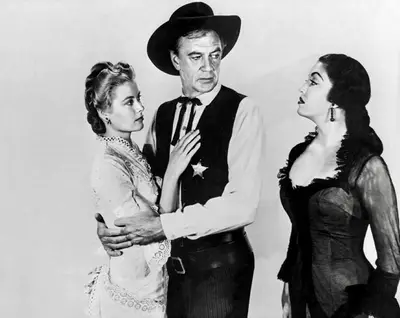
Kelly was performing at the Elitch Theatre in Colorado when the producer Stanley Kramer offered her the female lead opposite Cooper in High Noon. She played Amy Fowler, a young Quaker and pacifist who has just married Marshal Will Kane on the day a vengeful outlaw is due back on the noon train. Amy begs her husband to leave town with her and, when he insists on staying, threatens to leave on the same train without him.
The film was shot in late summer and early autumn 1951 on a 28-day schedule, in hot weather, largely at Columbia, California, and around the Sierra Railroad. Kelly wore what one account describes as a "suitably demure vaguely Victorian dress". The story unfolds almost in real time, and Amy's choice between her faith and her husband gives the film its moral climax. At the end the pacifist bride picks up a gun and shoots one of the gang to save Kane.
High Noon won four Academy Awards, including Best Actor for Cooper, and it is often ranked among the greatest Westerns. Kelly's own reviews were more mixed. Her biographer H. Haughland wrote that her acting "did not excite the critics, or live up to her own expectations". Some critics mocked the ending, in which the hero has to be rescued by his wife, and Alfred Hitchcock later called her performance "rather mousey". Kelly herself took private acting lessons in New York afterwards because she wanted to be taken seriously as an actress. Thomas Mitchell, who played the town's mayor, and Katy Jurado also appear in the film.
After the Western
After High Noon, John Ford saw her screen test and cast her in his African adventure Mogambo (1953), which brought her an Academy Award nomination for Best Supporting Actress. Kelly later said that if Mogambo had been made in Arizona she would not have done it. She went on to star in three Hitchcock thrillers, Dial M for Murder (1954), Rear Window (1954) and To Catch a Thief (1955), and won the Academy Award for Best Actress for The Country Girl (1954).
In April 1956, aged 26, she married Prince Rainier III of Monaco and retired from acting. As Princess Grace she worked for children's and arts charities, setting up the Princess Grace Foundation in 1964. She died in Monaco on 14 September 1982, aged 52, from injuries suffered in a car crash.
Place in the Western
Kelly's single Western role made her part of one of the genre's most debated films. The scholar Don Graham has argued that High Noon marked a notable advance in how Westerns portrayed women, because it gives Amy and the businesswoman Helen Ramírez (Jurado) far more presence than the stock heroines of earlier films. Amy Fowler is at the centre of High Noon's argument about duty, violence and conscience, and the film's success started the short but glittering career that followed.
Key facts
- Born: 12 November 1929, Philadelphia, Pennsylvania, US
- Died: 14 September 1982, Monaco
- Western: High Noon (1952), as Amy Fowler
- Film debut: Fourteen Hours (1951)
- Major award: Academy Award for Best Actress, The Country Girl (1954)
- Later life: Princess of Monaco from 1956
- Occupations (Wikidata): film actor, model, television actor, stage actor
- Born 1929-11-12
- Died 1982-09-14
See also
Filmography
As actor 1
- 1952High Noon
In the films 1

Sources
- Grace Kelly - Wikipedia en.wikipedia.org
- Wikidata: Q3925 wikidata.org
- Wikimedia Commons: Gracia van Monaco (1972).jpg commons.wikimedia.org