
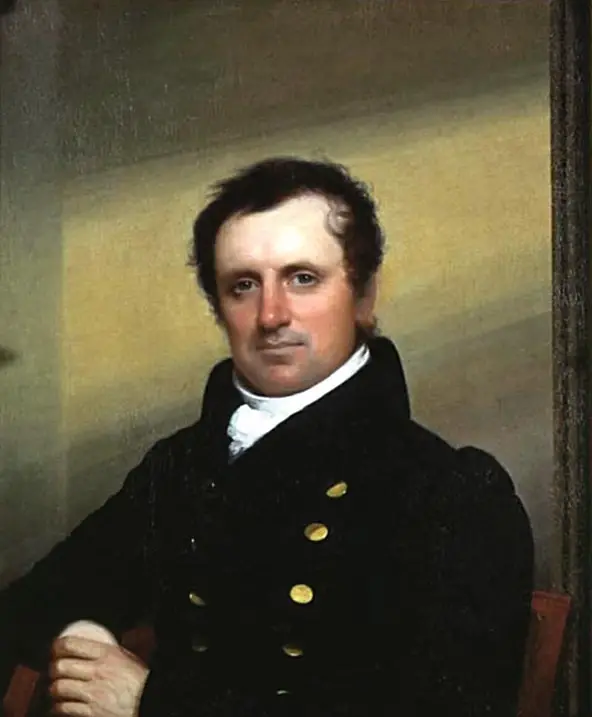

James Fenimore Cooper (15 September 1789 – 14 September 1851) was one of the first great American novelists. His five Leatherstocking Tales follow the frontiersman Natty Bumppo, also called Hawkeye, Leatherstocking, Pathfinder and Deerslayer, from youth to old age. The best known of them, The Last of the Mohicans (1826), helped create the figure of the American frontier hero long before the cowboy rode onto the page. Almost every later Western, on paper or on screen, owes something to the honest, self-reliant woodsman he invented.
Early life
Cooper was born in Burlington, New Jersey, the eleventh of twelve children of William and Elizabeth (Fenimore) Cooper. When he was about a year old the family moved to Cooperstown, New York, a settlement his father had founded on a large tract of land at the head of the Susquehanna River, beside Otsego Lake. William Cooper later sat in Congress. The boy grew up on the edge of the wilderness, among settlers, hunters and the memory of the frontier wars.
He entered Yale at thirteen but was expelled in his third year after a series of pranks, one of which involved blowing up a fellow student's door. In 1806 he went to sea as a common sailor on a merchant ship, and in 1808 he joined the US Navy as a midshipman. He served on Lake Ontario and elsewhere before resigning in 1810. On 1 January 1811 he married Susan Augusta De Lancey, and the couple settled down to family life.
Becoming a novelist
According to a family story, Cooper was reading a novel aloud to his wife when he said he could write a better one; she challenged him to try. The result was Precaution (1820), a novel of English manners. His second, The Spy (1821), a tale of the Revolutionary War, was a great success and made his name. He went on to invent the American sea story with The Pilot (1824), drawing on his naval years.
The Leatherstocking Tales
The five Leatherstocking novels were not written in the order of their hero's life:
- The Pioneers (1823): Natty, an old hunter, clashes with the new laws and settlers of a frontier village modelled on Cooperstown in the 1790s.
- The Last of the Mohicans (1826): in 1757, during the French and Indian War, Hawkeye and his Mohican friends Chingachgook and Uncas guide two sisters through the forests around Lake George and Fort William Henry.
- The Prairie (1827): Natty, now a very old trapper, meets a family of squatters on the Great Plains soon after the Louisiana Purchase. It closes his life.
- The Pathfinder (1840): Natty as a scout and guide on Lake Ontario.
- The Deerslayer (1841): the young hunter's first war-path, on Otsego Lake in the 1740s.
Natty Bumppo is a man of courage, skill and plain honesty. He lives by a strong sense of right and wrong and a simple faith in God, and his friendship with Chingachgook is one of the most famous in American fiction. He is happiest in the forest and keeps one step ahead of the settlements, a pattern that later Western heroes would follow across the Plains and beyond. Cooper's picture of the frontier was romantic, and Mark Twain mocked his style in the comic essay "Fenimore Cooper's Literary Offenses" (1895). But readers loved the books, and they were translated across Europe: Victor Hugo, Honoré de Balzac and many others admired him.
Later life and faith
Cooper lived in Europe from 1826 to 1833, then returned to Otsego Hall, the family house in Cooperstown, which he made his permanent home. His later years brought sharp political writing, a series of libel suits against newspapers, which he mostly won, and a History of the Navy of the United States of America (1839). He was an active member of Christ Church, the Episcopal church in Cooperstown, where he served as warden and vestryman and paid for a new oak interior. He died at Cooperstown on 14 September 1851, the day before his 62nd birthday, and was buried in the churchyard of Christ Church. Susan survived him by only a few months.
On screen
The Last of the Mohicans has been filmed many times, including silent versions, a 1936 film with Randolph Scott as Hawkeye and a 1992 version. European film-makers also took up Cooper's stories: the West German The Last Tomahawk (1965) is a loose version of The Last of the Mohicans. The Deerslayer was filmed in Hollywood as The Deerslayer (1957) and in East Germany as Chingachgook, the Great Snake (1967).
Key facts
- Born: 15 September 1789, Burlington, New Jersey
- Died: 14 September 1851, Cooperstown, New York (aged 61)
- Occupations: novelist, naval officer, historian
- Best known for: the Leatherstocking Tales (1823–41), especially The Last of the Mohicans (1826)
- Hero: Natty Bumppo (Hawkeye, Leatherstocking, Pathfinder, Deerslayer)
- Spouse: Susan Augusta De Lancey (m. 1811)
- Church: Christ Church (Episcopal), Cooperstown
- Occupations (Wikidata): writer, military officer, novelist, children's writer, biographer, Western author
See also
Filmography
Books 3
Gallery 1

Sources
- James Fenimore Cooper - Wikipedia en.wikipedia.org
- Wikidata: Q167856 wikidata.org
- Wikimedia Commons: James Fenimore Cooper by Jarvis.jpg commons.wikimedia.org
- Wikimedia Commons: James Fenimore Cooper by Brady.jpg commons.wikimedia.org