

✦ Legend
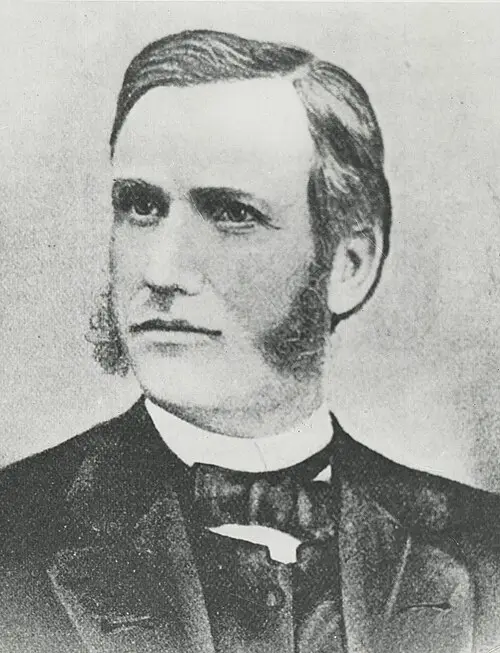
Marcus Whitman (1802–1847) was an American physician and Presbyterian missionary who founded the Whitman Mission among the Cayuse near present-day Walla Walla, Washington, in 1836. A man of deep faith, great physical courage and a strong will, he helped open the Oregon Trail to families and cared for hundreds of emigrants. He and his wife Narcissa were killed by a group of Cayuse men in November 1847, and he became one of the most honoured, and most argued-over, figures in the history of the Pacific Northwest.
Early life and faith
Whitman was born on 4 September 1802 in a log cabin at Federal Hollow (later Rushville), New York. His father died when he was seven, and he was sent to live with his grandfather and uncle in Massachusetts, both devout Baptists, who gave him, as he later wrote, "constant religious instruction and care". At 17 he experienced a religious awakening and hoped to become a minister, but he could not afford the long training. Instead he apprenticed himself to a doctor, studied at the College of Physicians and Surgeons in Fairfield, New York, and qualified as a Doctor of Medicine in 1832. He practised as a country doctor, riding on horseback with his medicines in saddlebags, and was an elder and Sunday school superintendent in his Presbyterian church.
To the Rockies
Inspired by appeals to send missionaries to the Indians beyond the Rockies, Whitman applied to the American Board of Commissioners for Foreign Missions. In 1835 he travelled with the Reverend Samuel Parker and a fur company caravan to the trappers' rendezvous in present-day Wyoming. When cholera broke out in the caravan, he moved the sick to clean, high ground and nursed them, and at the rendezvous he removed an old iron arrowhead from Jim Bridger's back. He returned east to raise a mission party and in February 1836 married Narcissa Prentiss at Angelica, New York (accounts give the 18th or the 19th). The next day they set out for the West with Henry and Eliza Spalding.
Waiilatpu
At Waiilatpu, Whitman ran a farm, a mill and a clinic and preached to the Cayuse, with whom he came to have an increasingly difficult relationship. He hoped the Cayuse would settle down to farming so that they could be taught the Gospel, but few did, and he and the Cayuse disagreed over land, payment and religion.
In 1842 the American Board ordered Waiilatpu closed. Whitman rode east in midwinter across the Rockies, reached Boston in March 1843 and persuaded the board to keep the mission open. On his way back he joined the first great wagon train to Oregon, about 120 wagons and some 800 emigrants, and helped guide it over the Blue Mountains. After that the mission became a haven for travellers, and the Whitmans took in eleven orphaned children. Whitman's letters show his focus shifting from the Cayuse to the settlers. In 1844 he wrote that "our greatest work is to be to aid the white settlement of this country".
Death
When measles killed many Cayuse in 1847 while most of Whitman's white patients recovered, some Cayuse believed he was poisoning them. Under Cayuse custom a healer whose patients died could be killed. On 29 November 1847 a small group of Cayuse men came to the mission asking for medicine, and one struck Whitman from behind with a tomahawk. He died of his wounds that evening, and Narcissa and eleven others were also killed (see Whitman Mission).
Legend versus history
- Did he save Oregon? After his death, Henry Spalding spread the story that Whitman's ride east in 1842–43 was a mission to the President to stop Britain taking Oregon. The record shows he went to save his mission. The story was disproved in 1901, though it was repeated for many years afterwards.
- Hero or failure? Whitman has been honoured with a college, a national forest, a state holiday in Washington and, from 1953, a statue in the US Capitol. He has also been criticised as a stern, impatient man who never understood the Cayuse. A Methodist missionary who knew him wrote in 1849 that the Cayuse "feared the Doctor" but "did not love him". Accounts differ on how much blame he bears for the breakdown with the Cayuse. In 2021 Washington voted to replace his Capitol statue.
Key facts
- Born: 4 September 1802, Federal Hollow (Rushville), New York, US
- Died: 29 November 1847, Waiilatpu, near Walla Walla, Oregon Country (now Washington)
- Spouse: Narcissa Prentiss (married 1836)
- Children: Alice Clarissa (1837–1839); eleven adopted and foster children, including the seven Sager orphans
- Occupations: physician, missionary, farmer
- Church: Presbyterian; sent by the American Board of Commissioners for Foreign Missions
- Known for: the Whitman Mission; guiding the 1843 wagon train; his death in 1847
- Born 4 September 1802 at Federal Hollow (Rushville), New York; qualified as a doctor in 1832 and served as an elder in his Presbyterian church (HistoryLink; NPS Handbook 37).
- Sent by the American Board of Commissioners for Foreign Missions, he founded the mission at Waiilatpu among the Cayuse in 1836 (NPS; HistoryLink; Oregon Encyclopedia).
- At the 1835 fur-trade rendezvous he removed an old iron arrowhead from the back of the mountain man Jim Bridger (HistoryLink; NPS).
- In 1842–43 he rode east in winter and persuaded the American Board not to close the mission; on the way back he travelled with the great emigration of 1843 to Oregon (HistoryLink; NPS Handbook 37; Bourne, 1901).
- He and Narcissa gave food, shelter and medical care to emigrants and took eleven orphaned children into their home, among them the seven Sager children (NPS; HistoryLink).
- On 29 November 1847, during a measles epidemic that killed many Cayuse, a group of Cayuse men killed him, Narcissa and others at the mission (NPS; HistoryLink; Oregon Encyclopedia; Brouillet, 1853).
- Legend vs history: the story that he rode east in 1842–43 to 'save Oregon' from Britain was spread after his death; Edward Gaylord Bourne showed it to be a legend in 1901 (Bourne, 1901; HistoryLink).
See also
Sources
- HistoryLink.org essay 10912 (Whitman) historylink.org
- HistoryLink.org essay 5192 (Jason Lee) historylink.org
- Whitman Murders – Oregon Encyclopedia (Oregon Historical Society) oregonencyclopedia.org
- National Park Service Historical Handbook No. 37, Whitman Mission (1959) npshistory.com
- Whitman Mission National Historic Site – National Park Service nps.gov
- Edward G. Bourne, Essays in Historical Criticism (1901) – 'The Legend of Marcus Whitman' archive.org
- J. B. A. Brouillet, Authentic Account of the Murder of Dr. Whitman and Other Missionaries (1853 ed.) archive.org
- Marcus Whitman - Wikipedia en.wikipedia.org
- Wikidata: Q979972 wikidata.org
- Wikimedia Commons: Marcus Whitman, ca. 1895 - DPLA - aa6b0038ac3c27c768095c16dff49db1 (cropped).jpg commons.wikimedia.org