
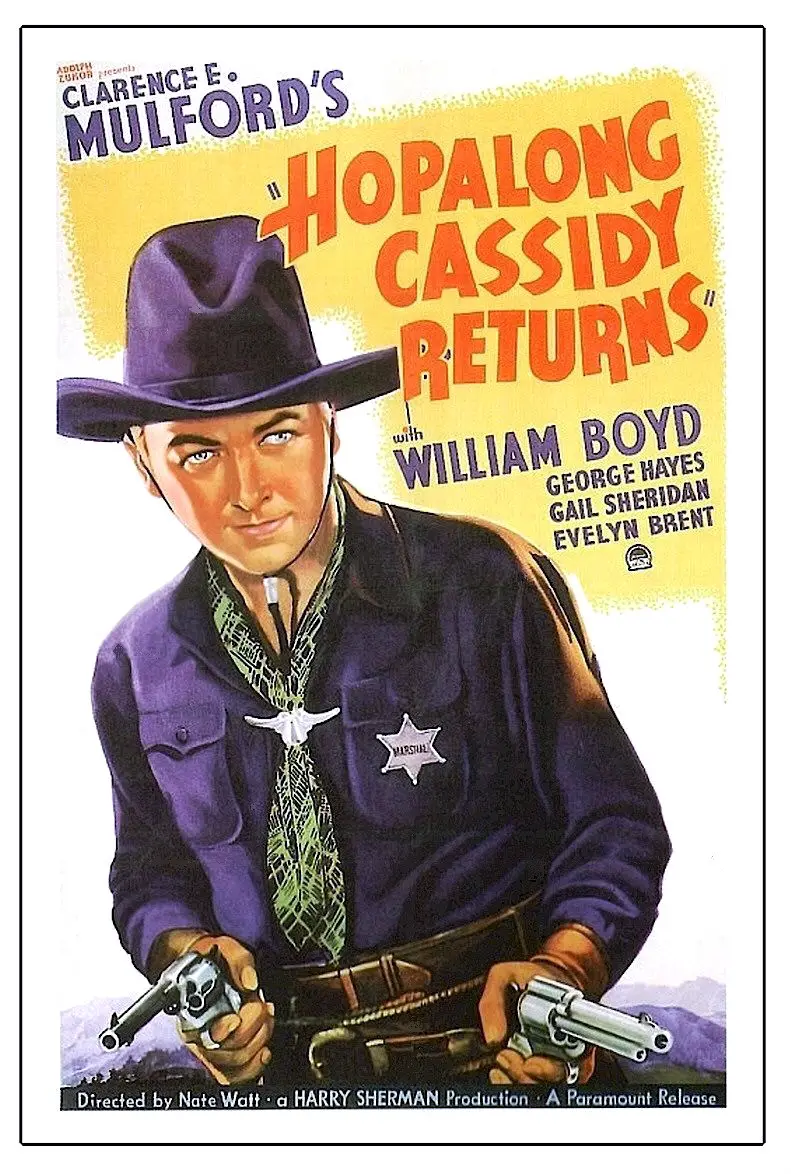

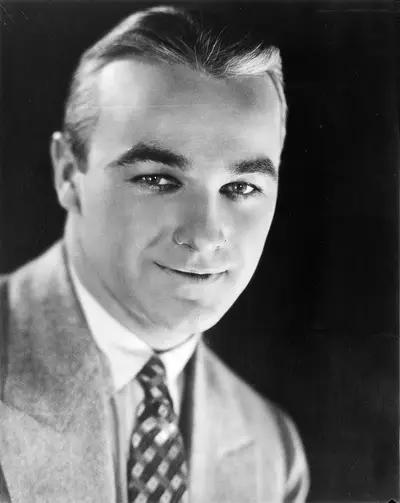
William Lawrence "Bill" Boyd (1895–1972) was an American actor and producer who became famous as the cowboy hero Hopalong Cassidy. A handsome romantic lead in Cecil B. DeMille's silent pictures of the 1920s, he fell on hard times in the early 1930s, then found new fame in 1935 when he was cast as Hoppy. He made 66 Hopalong Cassidy films, turned the rough cowhand of Clarence E. Mulford's stories into a clean-living hero who did not drink, smoke or swear, and in 1948 gambled everything he owned on the rights to the character. The gamble paid off: the Hopalong Cassidy television series made him one of the first national television stars and one of the most successful merchandisers of his time.
Early life
Boyd was born on 5 June 1895 in Hendrysburg, Ohio, the son of a day labourer, Charles William Boyd, and his wife Lida. He grew up in Cambridge, Ohio, and in Tulsa, Oklahoma, where the family moved when he was a boy. After his father's death he went to California and worked as an orange picker, surveyor, tool dresser and car salesman. He enlisted in the army during the First World War but was released because of a heart condition.
Silent star
Boyd started in Hollywood as an extra, and his breakthrough came in Cecil B. DeMille's The Road to Yesterday (1925). DeMille made him the leading man of The Volga Boatman (1926), a critical success, and cast him in The King of Kings (1927), his film of the life of Christ. By the late 1920s Boyd was a matinée idol earning $100,000 a year.
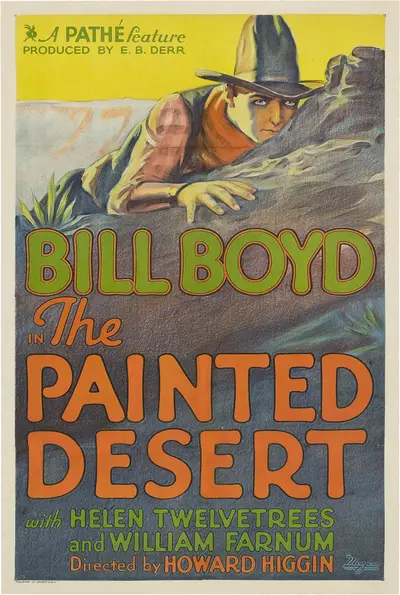
His fortunes changed in 1931, when a newspaper mistakenly printed his photograph with a story about the arrest of another actor, William "Stage" Boyd. Although the paper apologised the next day, Boyd said, "The damage was already done." RKO dropped his contract, and for some years he was billed as "Bill Boyd" to avoid the confusion. He played in the early sound Western The Painted Desert (1931), in which Clark Gable made one of his first screen appearances.
Hopalong Cassidy
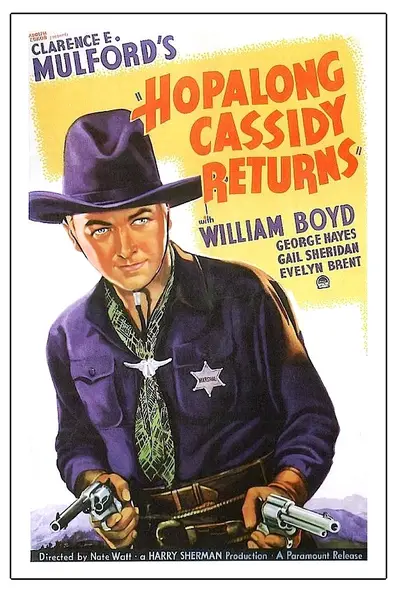
In 1935 the producer Harry "Pop" Sherman offered Boyd the supporting part of Red Connors in Hop-Along Cassidy. Boyd asked to be considered for the title role and won it. The films changed Mulford's hard-drinking, rough-living, red-haired wrangler into a soft-spoken, white-haired hero dressed in black, who drank sarsaparilla, never shot first and believed in fair play. Boyd admitted that he had never branded a cow or mended a fence, and he did not even like Western music, but the part became his for life.
The Hopalong films, released by Paramount and later United Artists, were more polished than most low-budget Westerns, with fine outdoor photography and good supporting casts, and they were shown in big-city cinemas that rarely booked Westerns. George "Gabby" Hayes, Andy Clyde and Russell Hayden were among Hoppy's screen partners, and the young Robert Mitchum appeared in seven of the films. When Sherman lost interest, Boyd produced the last twelve films himself, and the series ended in 1948.
The great gamble
Boyd was convinced that Hoppy could live again on television. He sold or mortgaged almost everything he owned to pay $350,000 for the rights to the character and the films. In November 1948 he persuaded NBC's Los Angeles station to show one of the films for a small fee; it was so popular that NBC took the whole library for its network, and Boyd went on to produce new half-hour episodes for television. Hopalong Cassidy began on the NBC network in June 1949, the first network television Western, and was followed by a radio series and a newspaper comic strip.
The craze that followed restored his fortune. In 1950 more than 100 companies made Hopalong goods worth about $70 million, and Boyd earned about $800,000 that year. Hoppy was on the first lunch box ever to carry a picture. Boyd felt a real responsibility to the children who looked up to Hoppy. He dressed as the character in public, refused to license products he thought unsuitable or dangerous, and would not appear where children had to pay to see him. When he led a Thanksgiving parade in Charlotte, North Carolina, in 1950, it drew an estimated crowd of half a million.
He made a cameo appearance as himself in DeMille's circus picture The Greatest Show on Earth (1952). It is said that DeMille asked him to play Moses in The Ten Commandments, but that Boyd refused, believing that audiences would never accept Hopalong Cassidy as Moses.
Personal life
Boyd was married five times. His only child, a son by his second wife, the actress Ruth Miller, died of whooping cough at nine months old. His fifth marriage, to the actress Grace Bradley in the late 1930s, lasted the rest of his life; she outlived him by nearly forty years and in 2008 published a book about Hoppy. After retiring he invested in property and moved to Palm Desert, California, and in his last years he refused interviews and photographs, so as not to spoil the image of Hoppy for his young admirers.
Death and legacy
Boyd died in September 1972 of complications of Parkinson's disease and heart failure, and was buried at Forest Lawn Memorial Park in Glendale, California. He has a star on the Hollywood Walk of Fame, at 1734 Vine Street, and in 1995 he was inducted into the Western Performers Hall of Fame at the National Cowboy & Western Heritage Museum in Oklahoma City.
Key facts
- Born: 5 June 1895, Hendrysburg, Ohio, US
- Died: 12 September 1972, Laguna Beach, California, US (some sources give 13 September)
- Known as: Hopalong Cassidy
- Hopalong films: 66, from 1935 to 1948
- Horse: Topper
- Spouse: Grace Bradley, his fifth wife
- Honours: Hollywood Walk of Fame; Western Performers Hall of Fame (1995)
- Guest credits in Western TV episodes in this wiki (IMDb title.principals): 0
- Main cast of a Western TV series in this wiki (IMDb title.principals)
- Portrayed Hopalong Cassidy beginning with Paramount's first Hopalong Cassidy film in 1935; over about 20 years the franchise included 66 original movies, 52 television episodes, and 104 radio shows (per official Hopalong Cassidy site).
- Hopalong Cassidy merchandise under Boyd's guidance reportedly grossed over $70 million in 1952; Hoppy watches outsold Mickey Mouse watches 3 to 1 that year (per official site).
- Died 12 September 1972 at a South Laguna Beach, California, hospital (NYT/AP, 14 Sept 1972); OHS gives 13 September – accounts differ
See also
Filmography
As actor 1
Television 1
- 1949Hopalong Cassidy main cast
Gallery 2


Appears in 2

Sources
- Nm0101955 - imdb.com imdb.com
- hopalongcassidy.com hopalongcassidy.com
- William Boyd (actor) - Wikipedia en.wikipedia.org
- “William Boyd, ‘Hopalong Cassidy,’ Dies” (AP), New York Times, 14 Sept 1972, p. 50 nytimes.com
- Guy Logsdon, “Boyd, William Lawrence (1895–1972)” – Encyclopedia of Oklahoma History and Culture okhistory.org
- “Hopalong Cassidy rides off into his last sunset” (12 Sept 1972) – HISTORY history.com
- Wikidata: Q1477751 wikidata.org
- Wikimedia Commons: Jo Stafford William Boyd Voice of America 1951.jpg commons.wikimedia.org
- Wikimedia Commons: Hopalong Cassidy Returns FilmPoster.jpeg commons.wikimedia.org
- Wikimedia Commons: William Boyd, portrait.jpg commons.wikimedia.org