
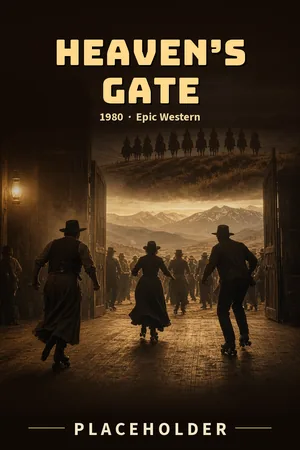

True Grit Rating: Heaven's Gate
Loading the ticket…
Heaven's Gate is Michael Cimino's 1980 epic western, loosely based on the Johnson County War in Wyoming. It tells of a US marshal, James Averill, who stands against a cattlemen's association that has drawn up a death list of poor settlers in his county. The film borrows real names and a real conflict, but it changes the story so much that it is best treated as fiction set against a historical backdrop. This page sets out what the film shows, then what really happened in Johnson County in 1892, and where the two part company.
The film's story
The film opens with a prologue at Harvard in 1870 (shot at Oxford, with Magdalen College standing in for Harvard). It then jumps twenty years to 1890. Averill is now a US marshal in Johnson County, Wyoming, which the film shows as crowded with poor immigrants from Eastern Europe. The Stock Growers Association has drawn up a list of 125 names of people it calls thieves and anarchists, and hires gunmen at five dollars a day, plus a bounty for each man killed, to deal with them.
Ella Watson, a brothel madam who takes stolen cattle in payment, is loved by both Averill and Nate Champion, who in the film is an enforcer for the Association. Champion turns against his employers and dies in a burning cabin, writing a last letter as the fire takes hold. The settlers then build log siege wagons and explosive charges and fight a pitched battle with the Association's men, with heavy losses on both sides, until the cavalry arrives to rescue the cattlemen. Ella is later killed in an ambush. An epilogue shows Averill, still alive, on a yacht off Newport, Rhode Island, in 1903.
The real history: the Johnson County War
Open range, the Association and rustling
By the 1880s the Wyoming Stock Growers Association, founded in 1872, had become a strong, centralised power in the territory, and its leading members had close links with the Cheyenne press and with Wyoming's politicians. A maverick law of 1884 made it a felony to brand an unbranded calf on the open range except under the Association's direction. Before that, cowboys had often been paid to brand mavericks for their employers. The new law shut small men out of the way the big outfits had built their own herds. The state's livestock board also seized cattle shipped by men it suspected of rustling, and the Association treated the money from those seizures as the proceeds of theft.
Honest history has to say plainly that cattle theft was real. Even A. S. Mercer, the cattlemen's fiercest critic in 1894, admitted that cattle stealing had been practised by "a limited number of disreputable people". Modern historians agree that rustling was widespread, and that some cowboys working for the big outfits stole too. In 1889 Johnson County juries acquitted in several cattle-theft cases, which helps explain why the big cattlemen lost faith in the courts. What the sources do not support is the cattlemen's claim that the county as a whole was a nest of thieves.
The 1889 lynching on the Sweetwater
On 20 July 1889 James Averell (often spelt Averill at the time) and Ella Watson were hanged near the Sweetwater River by a group of cattlemen. Both were homesteaders. Averell had filed on 160 acres and served at various times as postmaster, notary public and justice of the peace. Watson had fenced land and was running a small herd. A witness said the whole affair grew out of land troubles, and even Mercer said Averell was never accused of cattle stealing. Six men were named at the coroner's inquest, but before the grand jury met one witness had died and three others had left the territory, so the case was dropped and no one was tried.
The Cheyenne papers reported the killings as the hanging of cattle thieves, and Watson became known as "Cattle Kate". There is no evidence the nickname was used of her in her lifetime, and whether she was a prostitute is disputed: the claim appears in period writing on both sides, but it has never been shown to be true.
Killings in 1891
In 1891 several men were killed or attacked in the region. Tom Waggoner, a horse trader, was found hanged in June (some accounts say September), and the charge that he was a rustler was never established. On 1 November men attacked Nate Champion in a cabin; he drove them off, and one man was later charged with attempted murder. In late November and early December Orley "Ranger" Jones and John A. Tisdale were shot dead from ambush in separate attacks; Tisdale was driving home a wagon of groceries and Christmas toys. Johnson County offered a reward for the killers. A former county sheriff turned Association detective was charged with Tisdale's murder, but the main witness was unreliable and the accused had strong alibis. He was never convicted, and this page does not name him as the killer.
The invasion, April 1892
On 5 April 1892 a special train left Cheyenne carrying somewhere between about fifty and sixty armed men: Association cattlemen and their friends, led by Major Frank Wolcott, and a group of gunmen hired in Texas, paid five dollars a day. They planned to shoot or hang men named on a list of suspected rustlers. Accounts of how many names were on it, and of how many Texans came, differ.
On 9 April they surrounded the KC Ranch, where Nate Champion and Nick Ray were staying. Ray was shot, and Champion dragged his friend into the house under fire. Champion held out for hours, keeping a diary as he fought. His last entries survive: "Nick is dead, he died about 9 o'clock", and finally, "The house is all fired. Goodbye, boys, if I never see you again." The invaders set the cabin alight by pushing a burning wagon against it. Champion ran out and was shot down; a card reading "Cattle thieves, beware!" was pinned to his body. Even a Chicago reporter riding with the invaders called him "the bravest man in Johnson county". Whether Champion had ever stolen cattle has never been shown; the cattlemen's own lawyer later said there was no evidence against him. A Johnson County coroner's jury found that the invaders had murdered both men.
The siege of the TA Ranch
Jack Flagg, who happened to drive past, came under fire at the KC but escaped to raise the alarm. Sheriff W. G. "Red" Angus rode for help, and within a few days several hundred men from Johnson and Sheridan counties had gathered under his authority. They captured the invaders' supply wagons, which held ammunition and dynamite, and besieged them at the TA Ranch, building a movable log breastwork on wagon axles to edge closer to the defences.
The fighting lasted two days and, remarkably, killed no one on either side. Acting Governor Amos Barber telegraphed President Benjamin Harrison that an insurrection existed in Johnson County. Harrison ordered troops in, and at dawn on 13 April Colonel J. J. Van Horn rode out of Fort McKinney with three troops of cavalry. Wolcott refused to surrender to Sheriff Angus but surrendered to Van Horn. The Buffalo paper itself judged that storming the ranch would have cost the besiegers heavily, so the cavalry's arrival probably saved lives on both sides. One invader died afterwards from an accidental gunshot wound.
The town of Buffalo kept good order throughout. Its Baptist meeting house served for a week as a kitchen and dining room for the ranchmen who had come in, and the Baptists worshipped with the Methodists that Sunday.
No trial
The prisoners were taken out of Johnson County. In August 1892 they were arraigned at Cheyenne, but Johnson County was bankrupt and could not meet the cost of holding them, and they were released on their own recognisances. In January 1893 most of the cattlemen appeared in court; the hired Texans did not. The county prosecutor dropped the case, and every man was discharged. No invader was ever convicted. In the elections that autumn Wyoming swung heavily against the party linked with the cattlemen, and in 1893 the Association opened its membership to all stock growers.
Wrong and right on all sides
The big cattlemen answered real theft with lynching, killing from ambush and a private army, and none of them was ever punished. Some small ranchers and cowboys did steal cattle. Against that, Champion's courage, a sheriff's posse that besieged the invaders without killing anyone, a town that kept the peace and fed the posse from its churches, and the soldiers who prevented a massacre all deserve to be remembered. The hired Texans fought for pay alone.
How the film differs from history
- The date. The film is set in 1890; the invasion took place in April 1892.
- The settlers. The film's victims are mostly poor Eastern European immigrants. The real targets were small ranchers and cowboys, many of them Americans, including Texans such as Champion and a Missourian, Nick Ray.
- The death list. The film has 125 names; the real list was said to hold about 70, though the exact number is not established.
- Averell and Watson. In the film Averill is a marshal and Ella is a madam, both alive in 1892. The real Averell and Watson were homesteaders lynched in 1889, nearly three years before the invasion, and there is no evidence that either of them knew Champion.
- Nate Champion. The film makes him an Association enforcer. In reality he was the invaders' chief target. His last letter in the film is drawn closely from his real diary, one of the most faithful touches in the picture.
- The siege wagons. The film's log siege wagons echo the real posse's movable breastwork.
- The battle. The film ends with a bloody pitched battle. The real siege killed no one, and Wolcott surrendered to the cavalry rather than dying in battle.
- The cavalry. The arrival of the troops to rescue the cattlemen is accurate in outline.
- The ending. Ella's death in an ambush and Averill's later life in Newport are pure invention.
- "Genocide". Cimino described the events in terms of genocide. That is his opinion; the real death toll does not support the word.
Cast




Frontier folk
This film is listed on: Cattle barons, crooked railroad men and bankers · Hired guns and range bullies · Homesteaders, settlers and wagon-train families · Lynch mobs and vigilantes · Rustlers and horse thieves (all Frontier folk)
Key facts
- Directed by Michael Cimino
- Released 1980
- Stars Kris Kristofferson and Christopher Walken
- Production faced numerous problems
Gallery 1


True Grit RatingWhat's this?Woke: None found★★★★★SVLIMDb ★6.7
True Grit score: 76/100, Silver
How the score is worked out:
- Start100
- Settlers as villains: yes−15
- Traditional values: 2 stars+6
- Sex & nudity: Strong−10
- Language: Strong−5
- True Grit score76 · Silver
Classic Western checks
2 of 5 yes · Mixed
- Called “revisionist”YesYes: three or more reviews describe it as a revisionist Western.[1][2][3]
- Settlers or cavalry as villainsYesThe film dramatises the real Johnson County War of 1892; reviews describe the cattle barons of the Wyoming Stock Growers' Association and their hired gunmen as … [4][5][6]
more
The film dramatises the real Johnson County War of 1892; reviews describe the cattle barons of the Wyoming Stock Growers' Association and their hired gunmen as its villains, with immigrant homesteaders, also settlers, as their victims. - Faith shown negativelyNoNo: reviews show no clergy or faith portrayed negatively.[7]
- History rewrittenNoNo: the film is a dramatised version of the Johnson County War of 1892, built on real events; critics dispute some of its details, including how real figures … [8][9][10][11]
more
No: the film is a dramatised version of the Johnson County War of 1892, built on real events; critics dispute some of its details, including how real figures such as James Averell, Ella Watson and Nate Champion are portrayed. - A people shown as villainsNoNo: the plot source pins the villainy on named individuals, a gang or a specific band, not on a people as a whole.[12]
Woke content (modern messaging)
None found0 of 8 items found so far
Show all 8 (2 not found · 6 not known)
Unless noted: Unknown.
- Characters recast for representationNot known
- Gender roles reversed or critiquedNot known
- Present-day political languageNot known
- Allegory for current politicsNot foundReleased in 1980, before the 21st-century debates this item covers.[13][12][6]
- Western civilisation framed as inherently guiltyNot known
- Environmental activismNot foundNo: no source raises an environmental message (5 Nov 2026).[13]
- Source material changed for messagingNot known
- LGBT or gender-identity themesNot known
Traditional values
★★★★★2/5[12]
From one parents' guide's positive messages and role models ratings: positive messages very little (1) and positive role models a little (2); average 1.5 …
Content guide
- SSex & nudityStrongStrong sex, romance and nudity (4/5 in one parents' guide).[12]
- VViolenceStrongStrong violence and scariness (5/5 in one parents' guide).[12]
- LLanguageStrongStrong language (4/5 in one parents' guide).[12]
- StereotypesYesNegative stereotypes of immigrants (noted in one parents' guide).[12]
NoneMildModerateStrongNot known
Audience
★ 6.7/10 from viewers on IMDb (19k votes)No deduction (5.0 and up).
Sources
- NPR: Heaven's Gate
- The Guardian: Heaven's Gate
- The A.V. Club: Heaven's Gate
- Variety, review (1980)
- The Observer, Philip French (4 Aug 2013)
- BBC Culture (20 Nov 2015)
- Dennis Schwartz Reviews: Heaven's Gate
- Nate Champion's diary (9 Apr 1892), as quoted on the Buffalo, Wyo., historical marker (HMdb) (checked 17 October 2026)
- WyoHistory.org, “The Johnson County War” (checked 17 October 2026)
- The Criterion Collection, Giulia D'Agnolo Vallan, “Heaven's Gate: Western Promises” (20 Nov 2012) (checked 17 October 2026)
- NRC Handelsblad, Hans Beerekamp (17 Jul 1981) (checked 17 October 2026)
- Common Sense Media: Heaven's Gate
- Wikipedia: Heaven's Gate (opening sentence, giving the release year)
Information courtesy of IMDb (https://www.imdb.com). IMDb rating as of 13 October 2026.
Checked 17 October 2026 · Reviewed by Frontier Editor
Member reviews
What members think. Member reviews never change the True Grit score. The True Grit score is worked out by the editors from sources.
Sources
- Heaven's Gate (film) - Wikipedia en.wikipedia.org
- Wikidata: Q148204 wikidata.org
- Heavens Gate film by Cimino - Britannica britannica.com
- IMDb Non-Commercial Datasets developer.imdb.com
- Heavens gate - commonsensemedia.org commonsensemedia.org
- Rotten Tomatoes (score via Wikidata) rottentomatoes.com
- Wikimedia Commons: Entrance to Pinewood Film Studios, Iver Heath - geograph.org.uk - 20405.jpg commons.wikimedia.org