
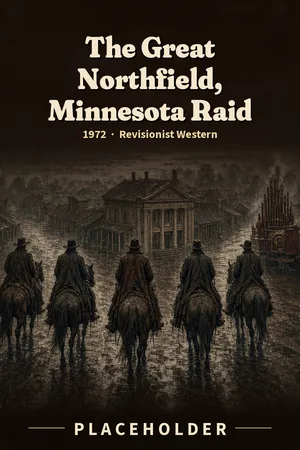

True Grit Rating: The Great Northfield, Minnesota Raid
Loading the ticket…
The Great Northfield Minnesota Raid is a 1972 western about the James–Younger gang's attempt to rob the First National Bank of Northfield, Minnesota, on 7 September 1876. It follows Cole Younger and Jesse James from Missouri to Minnesota and through the raid, the manhunt and the capture of the Younger brothers. The raid itself is one of the best-documented events of the outlaw West, but the film rearranges and invents a great deal. This page sets out the film's story, then the real history, and where they differ.
The film's story
The film opens with the Missouri legislature debating an amnesty for the gang, which is voted down after a bribe. Cole Younger plans the Northfield raid partly to pay for another try. In Northfield the bank is run by a greedy president, Wilcox, with Heywood as his accountant, and one of Wilcox's men, Bunker, arrives on a coach seemingly loaded with bags of gold in a staged shipment. During the raid Jesse shoots Heywood, Bob Younger shoots a townsman called Gustavson, and the robber Chadwell is locked inside the vault. Bunker alerts the sheriff, and the townspeople turn out against the gang. In the hunt that follows the Youngers are taken at the house of a woman called Dottie, whom Jesse murders before escaping in her dress. The film ends with crowds cheering as the Youngers are taken to prison.
The real history: the Northfield raid of 1876
The gang
Eight men rode north from Missouri in the late summer of 1876. A Northfield history of 1895 lists them as Jesse James and his brother Frank, Cole Younger and his brothers Jim and Bob, Clell Miller, a man known as Bill Chadwell or William Stiles, and Charlie Pitts. Cole Younger himself, writing in 1903, denied that the James brothers were there. Historians generally accept that they were, but it has never been proven, so this page treats it as widely believed rather than certain. Cole later claimed the bank was chosen because the Union general Benjamin Butler, whom the gang felt no qualms about robbing, was said to have money in it, and that the gang meant to make one big haul and start new lives abroad; only his own account supports this.
Before the raid some of the gang were seen in Mankato, where one local man is said to have greeted a stranger as Jesse. Cole admitted that the men who rode into Northfield first had been drinking, calling it "the initial blunder at Northfield".
Inside the bank
On 7 September three robbers entered the bank. Inside were the teller, Alonzo E. Bunker, the assistant bookkeeper, F. J. Wilcox, and the bookkeeper, Joseph Lee Heywood, who was acting as cashier that day. The robbers ordered Heywood to open the safe. He refused, telling them there was a time lock on it and it could not be opened. In fact the safe was not locked at all: the door was shut and the bolts were in place, but the dial had not been turned. Heywood even tried to shut one of the robbers inside the vault. The robbers threatened him, cut his neck with a knife and fired a shot past his head, but he would not give way. Accounts differ over which robber held the knife.
Bunker made a dash for the back door and was shot through the right shoulder as he escaped. Bunker himself named Charlie Pitts as the man who fired at him, and other period accounts agree.
As the robbers left the bank empty-handed, the last of them turned and shot the unarmed Heywood through the head, killing him. The coroner's jury recorded that he died from a shot "fired by an unknown man". A Northfield writer called it cowardly revenge by a man made desperate by defeat; the captured Youngers later said the killer thought Heywood was reaching for a pistol. Neither explanation has been proven, and who fired the shot has never been established. Heywood's refusal to betray his trust has been honoured ever since as an example of faithfulness, and his funeral was led by the town's Methodist, Baptist and Congregational ministers, with the usual Sunday services set aside. The banks raised a fund of over twelve thousand dollars for his family.
The fight in the street
Outside, the townspeople of Northfield fought back. Men from the hardware stores and others armed themselves, and some threw stones. A. R. Manning, using a single-shot rifle, shot a robber's horse, wounded Cole Younger and killed the man known as Chadwell or Stiles. Henry Wheeler, a medical student, killed Clell Miller and shattered Bob Younger's elbow. The inquest found that the two robbers died at the hands of citizens acting in self-defence and in protection of the bank.
Nicholas Gustavson, a Scandinavian immigrant who understood little English, was shot in the head in the street, apparently for not obeying the robbers' orders to get off it, and died a few days later. Period accounts say a robber shot him. Cole Younger was indicted for his murder on the evidence of two witnesses, but Cole always denied it and claimed Gustavson was hit by a stray shot from a townsman's rifle. The charge was never tried, so who killed him is not established. Sources disagree over whether Gustavson was Swedish or Norwegian.
The manhunt
The surviving six robbers fled, several of them wounded, and hundreds of men turned out to hunt them. Near Mankato the gang took a farmer named Dunning prisoner. Some wanted to kill him, but in the end they let him go after making him swear to keep silent. The gang then split. The two men widely believed to be Frank and Jesse James went their own way and escaped.
On 21 September a farm boy of about seventeen, Oscar Suborn (also recorded as Sorbel), spotted the remaining four and rode hard to Madelia shouting "Look out! The robbers are about!", falling from his horse in the mud on the way. Seven men, led by Captain W. W. Murphy and Sheriff James Glispin, cornered the gang in a thicket at Hanska Slough. Charlie Pitts was killed. Cole and Jim Younger were badly wounded, Cole with eleven wounds. Bob Younger stood up and surrendered, saying "They are all down but me." One man then turned his gun on Bob, but an officer stopped him at once.
Prisoners, not lynch victims
The wounded prisoners were treated with what one writer called "such attention as humanity dictated": their wounds were dressed and their wet clothes changed. There was talk of a lynching, but the sheriffs and people of Madelia and later Faribault made clear they would resist any mob, and none came. Cole Younger himself later wrote that the only mob he saw was one of sightseers, reporters and detectives, and that the sheriff swore they would never be mobbed while in his care. One night at Faribault a city policeman was shot by the jail guard.
In jail Cole spoke of his mother as a praying Christian woman and of two uncles who were Methodist ministers, read the Bible much of the time, and told young Oscar to read his Bible and follow it. The prisoners asked for the prayers of the women who visited and urged young men to keep clear of bad ways. No source records a formal conversion. The Youngers admitted who they were but refused to name the two who had escaped.
Trial and prison
In November 1876 the three brothers were arraigned at Faribault before Judge Samuel Lord on four indictments: as accessories to Heywood's murder, for the attack on Bunker, for robbery, and for Gustavson's murder. Minnesota law at the time did not allow a death sentence on a guilty plea, so all three pleaded guilty and were sentenced to life at hard labour in Stillwater prison. People called it "cheating the gallows", and the law was later changed.
Bob Younger died in prison in 1889. In 1901 Cole and Jim were paroled, with the board citing a quarter of a century of exceptionally good conduct and evidence of sincere reform.
Wrong and right on all sides
The robbers came to steal at gunpoint and left a faithful bank clerk and an immigrant passer-by dead, and the man who killed Heywood was never brought to justice. Northfield's people defended their town, and Heywood's refusal to give way remains the heart of the story. The posse, the sheriffs and the townsfolk mostly treated their prisoners with decency and refused mob justice, though one man threatened a surrendered prisoner. The Youngers in turn spared Dunning, behaved well in prison and earned their parole.
How the film differs from history
- The amnesty. The Missouri amnesty debate and the bribe plot have not been checked against historical sources, and Cole's own stated reasons for the raid were different.
- The bank staff. Wilcox was the assistant bookkeeper, not a greedy bank president, and Heywood was the bookkeeper acting as cashier, not Wilcox's accountant. There was no staged gold shipment.
- Bunker was the bank's teller, inside the bank, and was shot escaping out of the back; he did not arrive by coach or fetch the sheriff.
- Heywood's killer. The film has Jesse James shoot Heywood. Who fired the shot has never been established.
- Gustavson. The film has Bob Younger shoot him, and gives him a son lost in the war. No source supports either; it was Cole who was charged, and he denied it.
- Chadwell was killed in the street by Manning, not locked in the vault. Cole said it was another robber whom Heywood tried to shut in.
- The capture happened in a gunfight at Hanska Slough, not at a woman's house. "Dottie" and her murder are invented.
- The crowds. Sightseers did gather, but no source records them cheering the prisoners off to jail.
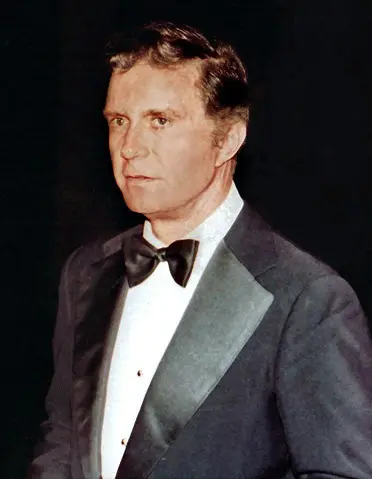
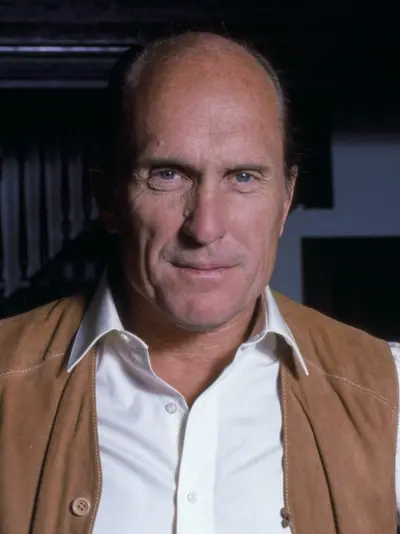
Cast

Frontier folk
This film is listed on: Outlaws, gangs and robbers (all Frontier folk)
Key facts
- Directed by Philip Kaufman
- Released 1972
Gallery 1

True Grit RatingWhat's this?Woke: None foundIMDb ★6.1Partly checked
True Grit score: 99/100, Gold Partly checked
How the score is worked out:
- Start100
- Diamond needs all five checks; not met (raw score under 109; IMDb under 7.0 or under 10,000 votes; content guide not complete): 100 → 99
- True Grit score99 · Gold
Classic Western checks
1 of 5 yes · Mostly classic · 1 not known
- Called “revisionist”YesYes: described as a revisionist Western.[1]
- Settlers or cavalry as villainsNoNo: the story follows the James–Younger gang's raid, opposed by Pinkerton detectives; the grasping townsfolk and bankers of Northfield are not counted as … [2][1]
more
No: the story follows the James–Younger gang's raid, opposed by Pinkerton detectives; the grasping townsfolk and bankers of Northfield are not counted as settlers cast as villains. - Faith shown negativelyNoThe plot shows no clergy or faith portrayed negatively.[3][1]
- History rewrittenNot knownThe 1876 raid on the Northfield bank at the centre of the film is a real event. [4][5][6][7][8]
more
The 1876 raid on the Northfield bank at the centre of the film is a real event. In the film a character named Bunker arrives on a coach apparently carrying gold and alerts the sheriff; the real Alonzo Bunker was a bank employee who was inside the bank during the raid and was shot in the shoulder escaping out of the back. This changes a minor figure's part, not the course of the raid. Unknown. - A people shown as villainsNoNo: the plot source pins the villainy on named individuals, a gang or a specific band, not on a people as a whole.[2][1]
Woke content (modern messaging)
None found0 of 8 items found so far
Show all 8 (2 not found · 6 not known)
Unless noted: Unknown.
- Characters recast for representationNot known
- Gender roles reversed or critiquedNot known
- Present-day political languageNot known
- Allegory for current politicsNot foundReleased in 1972, before the 21st-century debates this item covers, so it cannot be an allegory of them.[4]
- Western civilisation framed as inherently guiltyNot known
- Environmental activismNot foundNo: no source raises an environmental message (5 Nov 2026).[3]
- Source material changed for messagingNot known
- LGBT or gender-identity themesNot known
Audience
★ 6.1/10 from viewers on IMDb (2.7k votes)No deduction (5.0 and up).
Sources
- Grokipedia: The Great Northfield, Minnesota Raid
- Once Upon a Time in a Western: The Great Northfield Minnesota Raid (1972)
- Wikipedia: The Great Northfield, Minnesota Raid (plot)
- AFI Catalog: The Great Northfield, Minnesota Raid (1972) (accessed 26 October 2026)
- George Huntington, Robber and Hero (Northfield, 1895), Project Gutenberg text (accessed 26 October 2026)
- MNopedia (Minnesota Historical Society): Northfield Bank Raid (accessed 26 October 2026)
- Minnesota Digital Library: Northfield Bank Raid, 1876 (primary source set) (accessed 26 October 2026)
- Northfield History Center: 1876 Bank Raid (accessed 26 October 2026)
Information courtesy of IMDb (https://www.imdb.com). IMDb rating as of 13 October 2026.
Checked 18 October 2026 · Reviewed by Frontier Editor
Partly checked: 5 checks not known. Not known items are left out of the score.
Member reviews
What members think. Member reviews never change the True Grit score. The True Grit score is worked out by the editors from sources.
Sources
- The Great Northfield, Minnesota Raid - Wikipedia en.wikipedia.org
- Wikidata: Q7737869 wikidata.org
- The Great Northfield Minnesota Raid - Britannica britannica.com
- IMDb Non-Commercial Datasets developer.imdb.com
- Rotten Tomatoes (score via Wikidata) rottentomatoes.com
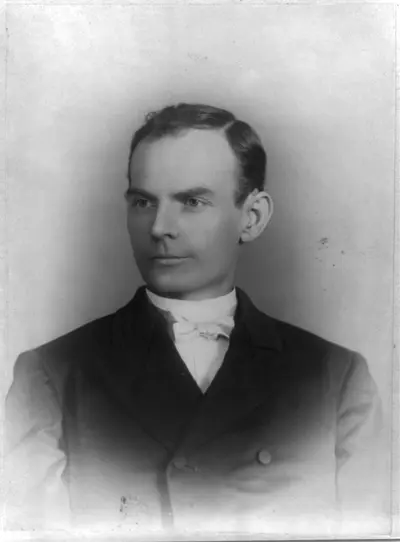
- Wikimedia Commons: Robert Ewing Younger%2C head and shoulders%2C facing left LCCN2005679754.jpg commons.wikimedia.org