
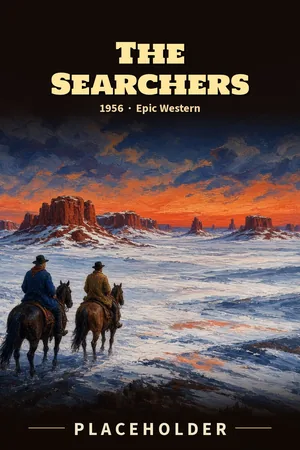

True Grit Rating: The Searchers
Loading the ticket…
The Searchers is a 1956 American Western directed by John Ford and starring John Wayne. Frank S. Nugent wrote the screenplay from Alan Le May's 1954 novel. The film is set during the Texas–Indian wars after the American Civil War. Wayne plays Ethan Edwards, a bitter former Confederate soldier who spends years hunting for his niece after Comanche raiders kill her family and carry her off. The film was a hit on release, and it is now regarded as one of the greatest films ever made: a visually stunning, deeply uncomfortable portrait of obsession and racism.
Plot
In 1868 Ethan Edwards returns to his brother Aaron's ranch in West Texas after eight years away. Soon afterwards a Comanche raid lures the men away, and the war party burns the homestead. Aaron, his wife Martha and their son Ben are killed, and their daughters Lucy and Debbie are taken. Lucy is soon found dead. Ethan sets off to find Debbie with Martin Pawley, Debbie's adoptive brother, who is one-eighth Cherokee. The search lasts about five years.
When they finally find Debbie (Natalie Wood), she is living as one of the wives of the Comanche chief Scar and says she wants to stay. Ethan tries to shoot her, and Martin shields her. In the final attack on Scar's camp, Martin kills Scar. Ethan runs Debbie down on horseback, but instead of killing her he lifts her into his arms and says, "Let's go home, Debbie." In the film's famous last shot, the family goes indoors and Ethan stays framed in the doorway, then turns and walks away alone.
Production
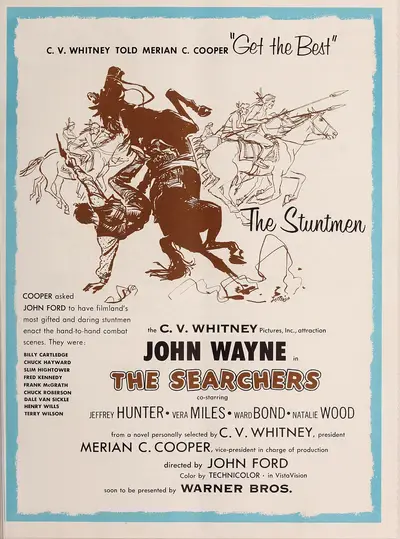
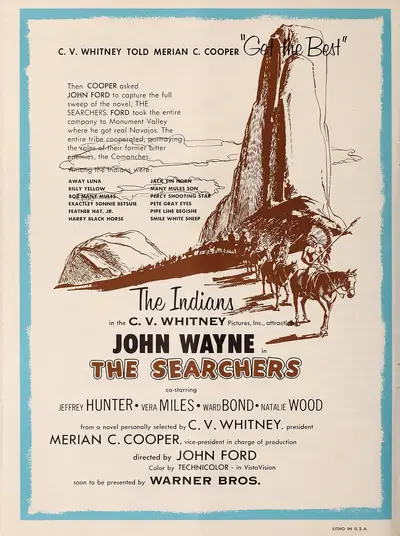
The film was produced by Cornelius Vanderbilt Whitney's C.V. Whitney Pictures and distributed by Warner Bros. Winton C. Hoch photographed it in the widescreen VistaVision process, and Max Steiner wrote the music. The story is set on the flat Llano Estacado of Texas, but Ford shot it mainly in Monument Valley on the Arizona–Utah border, his favourite location. It was perhaps the first major film to have a documentary deliberately made about its own production. Warner Bros. broadcast a behind-the-scenes programme as part of its publicity in 1956.
Historical roots
Le May researched dozens of real 19th-century captivity cases in Texas. His notes point to Britton Johnson, an African American teamster who ransomed his family from the Comanche in 1865. Many critics also see parallels with Cynthia Ann Parker, who was abducted by Comanche in 1836 at the age of nine. She lived among them for 24 years, became the mother of Quanah Parker, and was "rescued" by Texas Rangers against her will. Her uncle spent years searching for her.
Themes
Ethan is one of Wayne's darkest roles. His search is driven as much by hatred and revenge as by love, and he says he would rather see Debbie dead than "living with a buck". Many critics read the film as Ford's imperfect attempt to portray the racial hatred of some frontiersmen rather than to endorse it. Critics have also discussed the unspoken love between Ethan and his brother's wife, Martha, and the film's fear of "miscegenation". These themes make the film more troubling, and more modern, than most Westerns of its decade.
Reception and legacy
The film earned about $4.8 million in North American rentals in its first year. Reviews were broadly positive, though some critics found it long. Its reputation has grown ever since:
- One of the first 25 films chosen for the US National Film Registry (1989)
- Named the greatest American Western by the American Film Institute (2008), and ranked 12th on AFI's 2007 list of the greatest American films
- Ranked 7th in the BFI Sight and Sound critics' poll of 2012
It has influenced generations of film-makers. David Lean studied it before making Lawrence of Arabia, and Martin Scorsese, Paul Schrader (Taxi Driver), Wim Wenders and Steven Spielberg have all drawn on it. George Lucas echoed the burning homestead in Star Wars (1977). Wayne's catchphrase "That'll be the day" inspired Buddy Holly's song of the same name.
Key facts
- Released: 1956 (premiered 16 May 1956, Chicago)
- Director: John Ford
- Screenplay: Frank S. Nugent, from the novel by Alan Le May (1954)
- Cast: John Wayne, Jeffrey Hunter, Vera Miles, Ward Bond, Natalie Wood, John Qualen, Henry Brandon, Harry Carey Jr.
- Cinematography: Winton C. Hoch (VistaVision, Technicolor prints)
- Music: Max Steiner
- Running time: 119 minutes
- Budget: about $3.75 million
- Filmed in: Monument Valley, Arizona/Utah
- Directed by John Ford
- Released 1956
- Written by Frank S. Nugent
- Based on Alan Le May's 1954 novel
- Shot in VistaVision
Cast
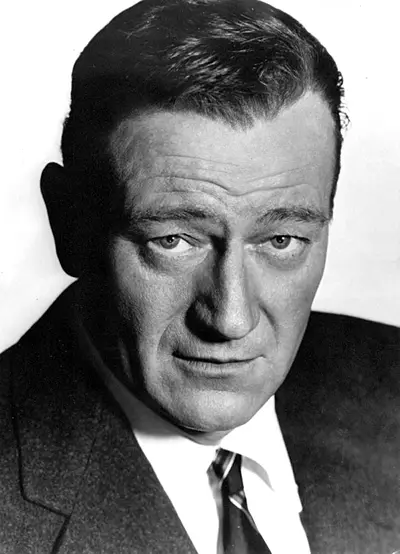
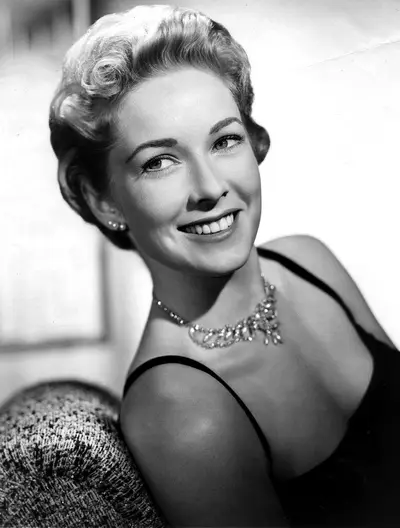


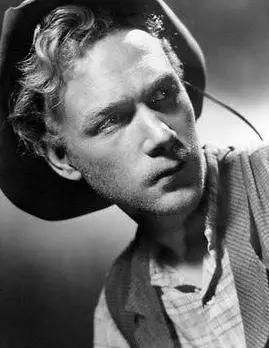
See also
If you liked this
Picked from this wiki's own links: same film series, same director, same lead actor.


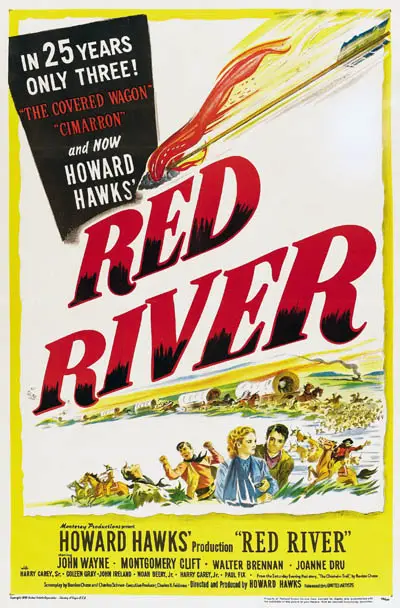 Red River1948Also starring John Wayne
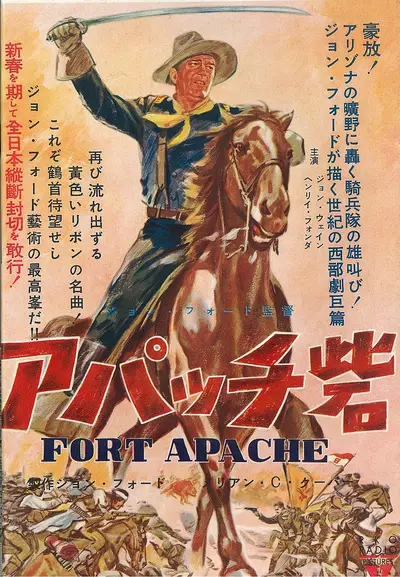 Fort Apache1948Also starring John Wayne
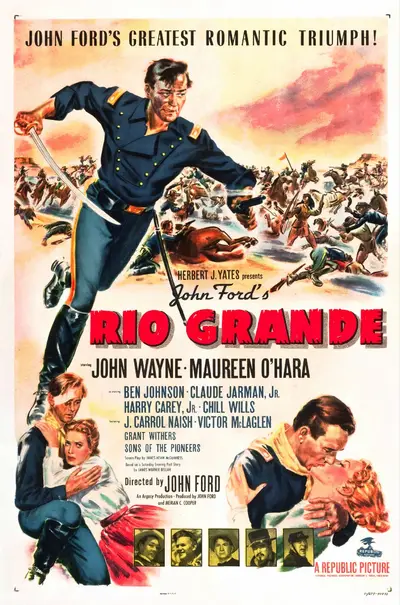 Rio Grande1950Also starring John Wayne
Guns on screen
- Winchester Model 1892 saddle-ring carbine (enlarged loop lever) used by Ethan Edwards (John Wayne) Anachronistic: the film starts in 1868. Sources: The Searchers – Internet Movie Firearms Database (accessed 26 October 2026) · John Wayne's Blue Cowboy Bib Shirt in The Searchers – BAMF Style (2026) (accessed 26 October 2026)
- Colt Single Action Army, 4¾-inch used by Ethan Edwards (John Wayne) Anachronistic (introduced 1873). Sources: The Searchers – Internet Movie Firearms Database (accessed 26 October 2026) · John Wayne's Blue Cowboy Bib Shirt in The Searchers – BAMF Style (2026) (accessed 26 October 2026)
- Winchester Model 1873 used by Martin Pawley (Jeffrey Hunter) Also carries a Single Action Army. Scar holds a '73 when Martin shoots him. (single source) Sources: The Searchers – Internet Movie Firearms Database (accessed 26 October 2026)
- N. P. Ames–Jenks 'mule ear' percussion carbine used by Mose Harper (Hank Worden) A rare 1840s US Navy breech-loader. (single source) Sources: The Searchers – Internet Movie Firearms Database (accessed 26 October 2026)
Filming locations
- Monument Valley · Arizona–Utah border, Navajo Nation, Arizona / Utah, United States · map · Wikidata · Most of the location shooting, standing in for the Texas plains. · Sources: The Searchers – AFI Catalog (accessed 26 October 2026) · The Searchers – Wikipedia (accessed 26 October 2026) · The Searchers essay – Library of Congress National Film Preservation Board (accessed 26 October 2026) · Wikidata: The Searchers (P915 filming location) (accessed 26 October 2026)
- Mexican Hat · San Juan County, Utah, United States · map · Wikidata · Additional scenes. · Sources: The Searchers – Wikipedia (accessed 26 October 2026)
- Gunnison · Gunnison County, Colorado, United States · map · Wikidata · Winter scenes. · Sources: The Searchers essay – Library of Congress National Film Preservation Board (accessed 26 October 2026) · The Searchers – AFI Catalog (accessed 26 October 2026) · Wikidata: The Searchers (P915 filming location) (accessed 26 October 2026)
- Elk Island National Park · near Edmonton, Alberta, Canada · map · Wikidata · Buffalo sequences, shot by a second unit. · Sources: The Searchers essay – Library of Congress National Film Preservation Board (accessed 26 October 2026) · The Searchers – Wikipedia (accessed 26 October 2026) · The Searchers – AFI Catalog (accessed 26 October 2026)
- Bronson Canyon, Griffith Park · Los Angeles, California, United States · map · Wikidata · Named only by later sources. · Sources: The Searchers – AFI Catalog (accessed 26 October 2026) · The Searchers – Wikipedia (accessed 26 October 2026)
Frontier folk
This film is listed on: Union and Confederate soldiers and veterans · Frontier wives, mothers and widows · Homesteaders, settlers and wagon-train families · Renegade raiding bands (by tribe) · Comanche (all Frontier folk)
Gallery 3




True Grit RatingWhat's this?Woke: None foundSVLIMDb ★7.8Partly checked
True Grit score: 99/100, Gold Partly checked
How the score is worked out:
- Start100
- Diamond needs all five checks; not met (raw score under 109): 100 → 99
- Presumed (Hays Code, 1934–1967): violence, language presumed no, counted as checked0
- True Grit score99 · Gold
Classic Western checks
1 of 5 yes · Mostly classic
- Called “revisionist”YesYes: a reliable source calls it revisionist (or an anti-Western).[1]
- Settlers or cavalry as villainsNoThe villains are Comanche raiders who kill most of the Edwards family and abduct Debbie and Lucy; Debbie is held by the chief Scar. [2]
more
The villains are Comanche raiders who kill most of the Edwards family and abduct Debbie and Lucy; Debbie is held by the chief Scar. The film also examines the hero Ethan's own hatred of Comanches. - Faith shown negativelyNoThe plot shows no clergy or faith portrayed negatively.[2]
- History rewrittenNoFiction (Alan Le May’s novel) loosely inspired by the Cynthia Ann Parker captivity; no source says it misstates that history.[3][4][2]
- A people shown as villainsNoNo: the plot source pins the villainy on named individuals or a specific band, not on a people as a whole.[5]
Woke content (modern messaging)
None found0 of 8 items found so far
Show all 8 (3 not found · 5 not known)
Unless noted: Unknown.
- Characters recast for representationNot foundMartin Pawley is played by Jeffrey Hunter, and no character is cast with a different sex or ethnicity.[6]
- Gender roles reversed or critiquedNot known
- Present-day political languageNot known
- Allegory for current politicsNot foundReleased in 1956, before the 21st-century debates this item covers, so it cannot be an allegory of them.[2]
- Western civilisation framed as inherently guiltyNot known
- Environmental activismNot foundNo: no source raises an environmental message (5 Nov 2026).[2]
- Source material changed for messagingNot known
- LGBT or gender-identity themesNot known
Content guide
Presumed no (Hays Code)
UK classification advice lists no sex or nudity issues.
Certificates: BBFC U FSK FSK 12
NoneMildModerateStrongNot known
Audience
★ 7.8/10 from viewers on IMDb (104k votes)No deduction (5.0 and up).
Sources
- Deep Focus Review: The Searchers
- Wikipedia: films/the-searchers-1956 (plot) (checked 17 October 2026)
- Texas Public Radio (9 Apr 2013) (checked 17 October 2026)
- NPR, interview with Glenn Frankel (17 Feb 2013) (checked 17 October 2026)
- catalog.afi.com/Catalog/MovieDetailsPrintView/53577
- Scott Allen Nollen, essay for the Library of Congress National Film Registry
- bbfc.co.uk/release/the-searchers-q29sbgvjdglvbjpwwc0ymzkwmtc
Information courtesy of IMDb (https://www.imdb.com). IMDb rating as of 13 October 2026.
Checked 17 October 2026 · Reviewed by Frontier Editor
Partly checked: 1 check not known. Not known items are left out of the score.
Member reviews
What members think. Member reviews never change the True Grit score. The True Grit score is worked out by the editors from sources.
Sources
- The Searchers - Wikipedia en.wikipedia.org
- The Searchers (Q276769) - Wikidata wikidata.org
- Wikimedia Commons: SearchersPoster-BillGold.jpg commons.wikimedia.org
- Wikimedia Commons: The searchers Ford Trailer screenshot (13-crop).jpg commons.wikimedia.org
- The Searchers - Britannica britannica.com
- IMDb Non-Commercial Datasets developer.imdb.com
- The searchers q29sbgvjdglvbjpwwc0ymzkwmtc - bbfc.co.uk bbfc.co.uk
- Rotten Tomatoes (score via Wikidata) rottentomatoes.com
- Metacritic (score via Wikidata) metacritic.com
- Wikimedia Commons: Monument Valley, Arizona, US - panoramio (4).jpg commons.wikimedia.org
- Wikimedia Commons: Motionpictureher203quig 0311 01.jpg commons.wikimedia.org
- Wikimedia Commons: Motionpictureher203quig 0311 02.jpg commons.wikimedia.org

