
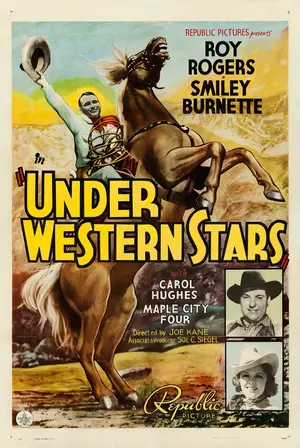
True Grit Rating: Under Western Stars
Loading the ticket…
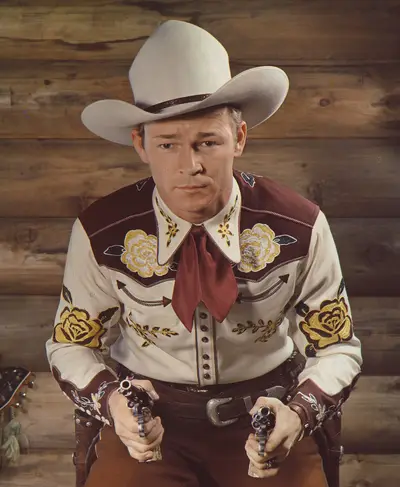
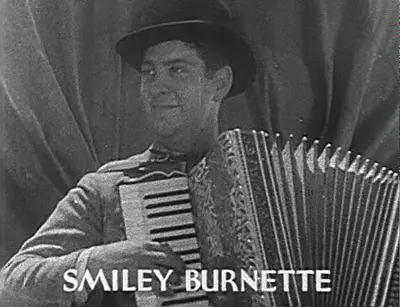
Under Western Stars is a 1938 American Western directed by Joseph Kane for Republic Pictures, the first starring film of Roy Rogers. Rogers plays a singing cowboy who runs for Congress to win federal help for small ranchers whose water has been cut off by a greedy water company during the Dust Bowl years, with Smiley Burnette as his campaign manager, Frog Millhouse, Carol Hughes as the company boss's daughter and the singing quartet the Maple City Four. Made while Gene Autry was in dispute with the studio, it launched Rogers on the way to becoming "King of the Cowboys". Its song "Dust" was nominated for an Academy Award, and in 2009 the film was added to the National Film Registry.
Plot
John Fairbanks's water company is holding back water behind its dam and refuses to let the farmers and ranchers have any for free. When Roy and his friends overpower the guards and open the valve, the friendly mayor fines him a dollar and persuades him to follow his father into politics and run for Congress. Helped by the comic campaigning of Frog Millhouse, and secretly by Fairbanks's spirited daughter Eleanor, Roy beats the company's man and goes to Washington.
There Fairbanks uses his connections to keep other congressmen away from him, especially Congressman Marlowe, whose support is vital to a federal water bill. Roy gets into a party at Marlowe's estate and sings "Dust" over film of the ruined farms. The congressmen agree to see the district for themselves, and Roy quietly arranges for "outlaws" to take their cars so that they have to ride home across the dry country through the dust storms. Once Marlowe has seen how the farmers live, he agrees to back the bill, and Roy rides out to stop a group of desperate ranchers from blowing up the dam.
History behind the film
The story is fiction, but it was made at the height of the Dust Bowl, when drought and dust storms ruined farms across the southern plains and drove many families west. Unusually for a B-Western, the villains are not rustlers or bandits but a company that controls the water, and the hero fights them through the ballot box and in Congress. The critics of the Brooklyn Daily Eagle credited Kane's "sensitive directing eye" with giving the horse opera "a social consciousness".
Production
The film was planned for Gene Autry under the working title Western Cowboy. Autry, Republic's biggest Western star, quarrelled with the studio's head, Herbert Yates, over his pay and over Yates's demand for a share of his earnings from merchandise and personal appearances, and from December 1937 he refused to work. Yates had already been looking for a singing cowboy to rival him, and chose Leonard Slye, a member of the Sons of the Pioneers who had been playing small parts for $75 a week. Republic renamed him Roy Rogers, after the humorist Will Rogers, and gave him the lead.
The screenplay was by the brothers Dorrell and Stuart McGowan, veteran Western writers, with Betty Burbridge. The film was shot in the Alabama Hills near Lone Pine, California, where hundreds of Westerns have been made. Rogers rode the palomino who became famous as Trigger. Besides "Dust", his songs include "Listen to the Rhythm of the Range" and "Send Our Mail to the County Jail".
The song "Dust" was written by Johnny Marvin, and Republic bought it from Marvin and Autry for the film. Shortly before the release Autry sued the studio for $25,000, claiming unauthorised use and dramatisation of the lyrics. The case was settled out of court, and Marvin is credited as the sole writer. "Dust" was nominated for the Academy Award for Best Original Song, the first song from a B-Western to be nominated.
Reception
Audiences made the film a box-office success, and it established Rogers as a rising star. Louella Parsons likened him to "Gary Cooper in personal appeal" and, in a report for the International News Service in November 1938, called him an "upstanding young American" who had made the picture "a delight". In 2009 the Library of Congress chose Under Western Stars for the National Film Registry as "culturally, historically or aesthetically" significant.
Legend and history
- Autry's strike. The dispute was settled and Autry went on making films for Republic, but the studio now had two singing cowboys. While Autry was serving in the Second World War, Rogers took his place as the most popular Western star.
- Who wrote "Dust"? Republic bought the song from both Autry and Marvin, but after the lawsuit Johnny Marvin alone is credited as its writer.
Key facts
- Released: 1938
- Director: Joseph Kane
- Stars: Roy Rogers, Smiley Burnette, Carol Hughes, the Maple City Four
- Screenplay: Dorrell McGowan, Stuart McGowan and Betty Burbridge
- Studio: Republic Pictures
- Filmed at: Alabama Hills, Lone Pine, California
- Academy Award nomination: Best Original Song ("Dust")
- National Film Registry: 2009
- Running time: 65 minutes (data)
- IMDb rating: 5.9 (data)
- Directed by Joseph Kane
Cast
See also
If you liked this
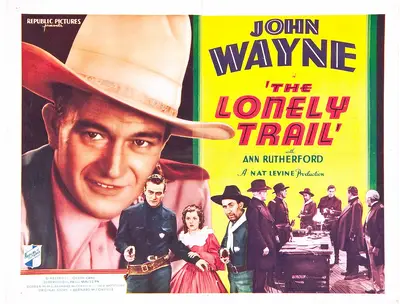
Picked from this wiki's own links: same film series, same director, same lead actor.


True Grit RatingWhat's this?SVLIMDb ★5.9Provisional
True Grit score: 84/100, Silver Provisional
How the score is worked out:
- Start100
- Provisional, capped at Silver: 100 → 84 (3 checks not known, provisional)
- Presumed (Hays Code, 1934–1967): sex & nudity, violence, language presumed no, counted as checked0
- True Grit score84 · Silver
Classic Western checks
0 of 4 yes · Classic Western · 1 not known
- Called “revisionist”Not knownUnknown.
- Settlers or cavalry as villainsNoNo: a plot summary names outlaws (or other traditional villains) as the villains, not settlers or the army.[1]
- Faith shown negativelyNoNo: Hays-era titles presume no faith attack unless a source flags one.[1]
- History rewrittenNoOwner-rule application (H2 true-story gate): the article (rev 1369449328, retrieved 2026-11-06T10:34:39Z) gives a plot synopsis and makes no true-story claim … [1]
more
Owner-rule application (H2 true-story gate): the article (rev 1369449328, retrieved 2026-11-06T10:34:39Z) gives a plot synopsis and makes no true-story claim; the quoted plot passage is evidence of the story only. history_rewritten no is an inference under the owner rule, not a statement by the source. Citation audit 2026-11-06.
Content guide
- SSex & nudityPresumed no
- VViolencePresumed no
- LLanguagePresumed no
Presumed no (Hays Code)
NoneMildModerateStrongNot known
Audience
★ 5.9/10 from viewers on IMDb (485 votes)No deduction (5.0 and up).
Sources
- Wikipedia: Under Western Stars (plot) (checked 24 October 2026)
Information courtesy of IMDb (https://www.imdb.com). IMDb rating as of 13 October 2026.
Checked 24 October 2026 · Reviewed by Frontier Editor
Provisional: not enough sources yet, so this rating may change.
Member reviews
What members think. Member reviews never change the True Grit score. The True Grit score is worked out by the editors from sources.
Sources
- Under Western Stars - Wikipedia en.wikipedia.org
- Wikidata: Q1230963 wikidata.org
- Wikimedia Commons: Under Western Stars (1938 poster).jpg commons.wikimedia.org
- IMDb Non-Commercial Datasets developer.imdb.com