
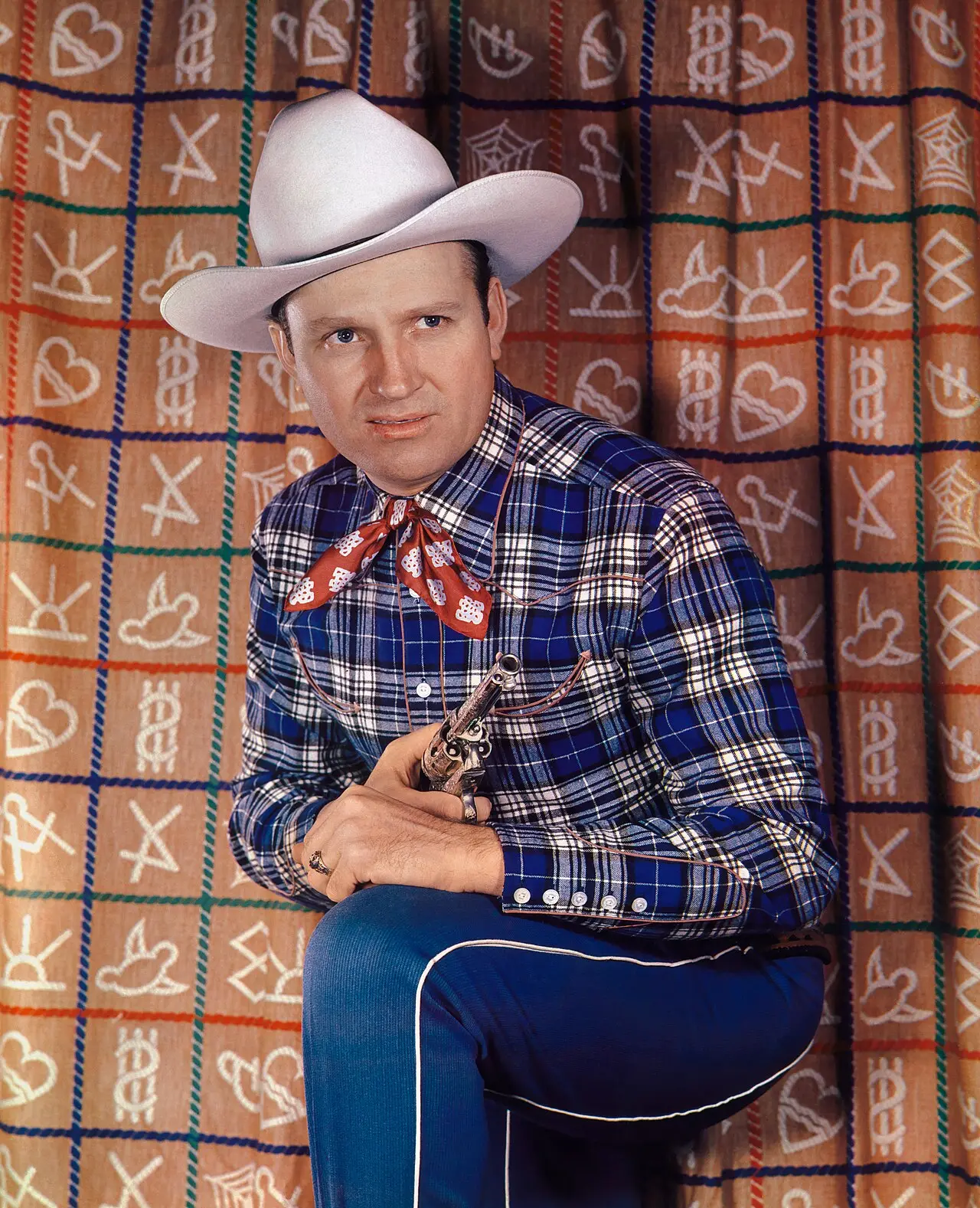

Gene Autry (1907–1998) was an American singer, songwriter, actor and businessman, the most famous of Hollywood's singing cowboys. Discovered singing in a small-town railway telegraph office, he became a radio and recording star, the top Western box-office attraction of the late 1930s, and one of the first film stars to make a television series. With his horse Champion and his signature song "Back in the Saddle Again", he gave a generation of children a hero who never shot first and always kept his word. In later life he built a broadcasting business, founded the California Angels baseball team and opened a museum of the American West in Los Angeles. He was billed as "America's Favorite Cowboy".
Early life
Orvon Gene Autry was born on 29 September 1907 on a small tenant farm near Tioga, Grayson County, Texas, to Delbert Autry and Elnora Ozment Autry, and was the grandson of a Baptist preacher. The family moved to Achille, Oklahoma, and later homesteaded near Ravia. As a teenager Autry hauled baggage at the local depot of the St. Louis and San Francisco ("Frisco") Railway, and the stationmaster paid him with lessons in telegraphy. After leaving school he worked as a telegrapher for the railway, singing and playing the guitar to pass the long night shifts.
The Yodeling Cowboy
One night, so the story goes, while Autry was working the telegraph office at Chelsea, Oklahoma, the humorist Will Rogers came in to send his newspaper column, heard him singing and encouraged him to sing professionally. Autry went to New York in the late 1920s to try for a recording contract. He returned to Oklahoma to sing on KVOO radio in Tulsa as "Oklahoma's Yodeling Cowboy", signed with Columbia Records in 1929 and then spent four years on the National Barn Dance on WLS in Chicago, where he met the singer and comedian Smiley Burnette. His 1931 hit "That Silver-Haired Daddy of Mine" sold more than a million copies and became the first record ever certified gold.
Autry made more than 600 recordings in all, including more than 300 songs he wrote or co-wrote, and sold more than 100 million records. Besides his Western songs he is remembered for Christmas music: he introduced "Here Comes Santa Claus", which he co-wrote, "Frosty the Snowman" and his biggest hit of all, "Rudolph, the Red-Nosed Reindeer".
The singing cowboy
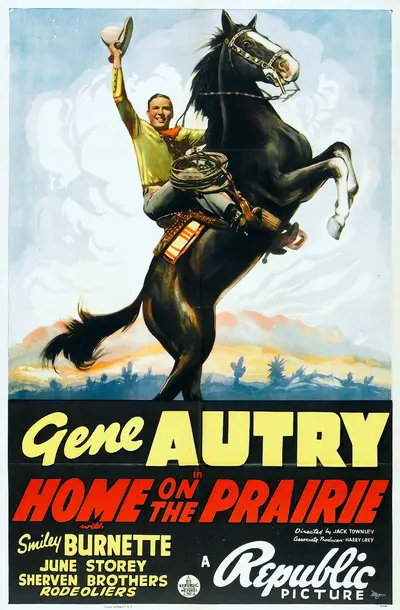
The producer Nat Levine of Mascot Pictures brought Autry and Burnette to Hollywood in 1934. After a small singing part with Ken Maynard in In Old Santa Fe (1934), Autry starred in the science-fiction Western serial The Phantom Empire (1935). When Mascot became part of the new Republic Pictures, he went with it, and a long series of fast, tuneful B-Westerns followed, usually with Burnette as his comic sidekick and with Champion. Autry played a cowboy called Gene Autry, and the films mixed riding and fist-fights with songs, often in a modern West of cars and radios. He made 93 feature films between 1934 and 1953.
He topped the Motion Picture Herald poll of money-making Western stars every year from 1937 to 1942, and in 1940 cinema owners voted him the fourth biggest box-office attraction in the country, behind only Mickey Rooney, Clark Gable and Spencer Tracy. When he quarrelled with Republic over his pay in 1937–38, the studio looked for a new singing cowboy and found Roy Rogers, who starred in Under Western Stars (1938) and later succeeded Autry as Republic's top Western star. In 1941 the town of Berwyn, Oklahoma, near Autry's Flying A Ranch and rodeo headquarters, renamed itself Gene Autry; 35,000 people came to the ceremony on 16 November 1941.
War service
Autry joined the Army Air Corps in 1942. Already a private pilot, he earned his service pilot rating in 1944 and served as a flight officer with Air Transport Command, flying fuel, ammunition and arms over "the Hump", the dangerous air route over the Himalayas between India and China. After the war he toured with a USO troupe in the South Pacific before returning to films in 1946. He made his last pictures for Republic and then, from 1947, made Westerns for Columbia Pictures through his own production unit, with Pat Buttram as his new sidekick, until The Last of the Pony Riders (1953).
Radio and television
Autry's weekly CBS radio programme Gene Autry's Melody Ranch ran from 1940 to 1956, with "Back in the Saddle Again" as its theme. For his young listeners he set out the "Cowboy Code", ten rules for a good cowboy, which begin with the rule that he "must never shoot first, hit a smaller man, or take unfair advantage" and go on to truthfulness, keeping his word, gentleness to children, the elderly and animals, helping people in distress, hard work, clean living, respect for women, parents and the law, and patriotism. One rule says the cowboy must not hold racially or religiously intolerant ideas.
In 1950 Autry became one of the first major film stars to move into television. His company Flying A Pictures made 91 episodes of The Gene Autry Show for CBS from 1950 to 1955, and went on to make Annie Oakley, The Range Rider, Buffalo Bill, Jr., The Adventures of Champion and the first 39 episodes of Death Valley Days. In 1953 he bought the Monogram Ranch near Newhall, California, and renamed it Melody Ranch after one of his films; it remained a working movie ranch.
Business and later life
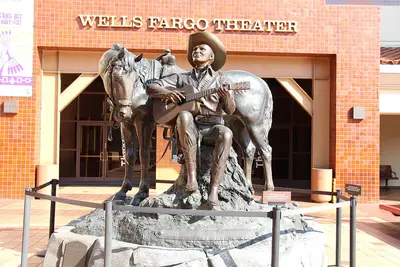
Autry retired from performing in 1964. He had already built a broadcasting business, Golden West Broadcasters, which owned radio and television stations including KMPC radio and KTLA television in Los Angeles. A lifelong baseball fan, he was the founding owner of the Los Angeles (later California) Angels from 1961 until 1997. In November 1988 he opened the Gene Autry Western Heritage Museum in Griffith Park, Los Angeles, now the Autry Museum of the American West.
He married Ina Mae Spivey, niece of his frequent songwriting collaborator Jimmy Long, in 1932; after her death in 1980 he married Jacqueline Ellam in 1981. A Freemason from 1927, he became a 33rd-degree Scottish Rite Mason. Autry died at his home in Studio City, California, on 2 October 1998, aged 91, and was buried at Forest Lawn, Hollywood Hills.
Legend and history
- Grover or Gene? Some sources give his birth name as Orvon Grover Autry; others, including the Oklahoma and Great Plains encyclopedias, give Orvon Gene Autry.
- How many records? Accounts differ slightly: his official biography gives 640 recordings, while other sources give 635.
- Five stars. Autry is the only person with stars on the Hollywood Walk of Fame in all five categories: film, television, recording, radio and live performance.
Key facts
- Born: 29 September 1907, near Tioga, Texas, US
- Died: 2 October 1998, Studio City, California, US
- Known as: "America's Favorite Cowboy"; "the Singing Cowboy"
- Horse: Champion
- Feature films: 93 (1934–1953)
- Signature song: "Back in the Saddle Again"
- Spouses: Ina Mae Spivey (1932–1980, her death); Jacqueline Ellam (1981)
- Honours: five stars on the Hollywood Walk of Fame; Country Music Hall of Fame (1969); Nashville Songwriters Hall of Fame (1970)
- Guest credits in Western TV episodes in this wiki (IMDb title.principals): 0
- Main cast of a Western TV series in this wiki (IMDb title.principals)
- Birth name: accounts differ – Orvon Grover Autry (Handbook of Texas entry “Autry, Orvon Grover”; Wikipedia) or Orvon Gene Autry (Encyclopedia of Oklahoma History and Culture; New Grove Dictionary of American Music). The Library of Congress name authority record lists both forms.
- Born in Tioga, Texas on 29 September 1907; died in Studio City, California on 2 October 1998 at age 91. (GeneAutry.com biography)
- Autry first appeared on screen in 1934 and, up to 1953, starred in 93 feature films (GeneAutry.com biography).
- In 1940, American theater exhibitors voted Autry the fourth biggest box-office attraction, behind Mickey Rooney, Clark Gable, and Spencer Tracy. (GeneAutry.com biography)
- From 1950, for five years, he produced and starred in 91 half-hour episodes of The Gene Autry Show for CBS Television through his Flying A Pictures (GeneAutry.com biography).
- Produced TV series including Annie Oakley, The Range Rider, Buffalo Bill Jr., The Adventures of Champion, and the first 39 episodes of Death Valley Days. (GeneAutry.com biography)
- Only entertainer with all five stars on the Hollywood Walk of Fame (Radio, Recording, Motion Pictures, Television, and Live Theatre/performance). (GeneAutry.com biography)
- Gene Autry's Cowboy Code (ten Cowboy Commandments) includes: never shoot first, hit a smaller man, or take unfair advantage; never go back on his word; always tell the truth; be gentle with children, the elderly, and animals; not advocate racially or religiously intolerant ideas; help people in distress; be a good worker; keep clean in thought, speech, action, and habits; respect women, parents, and the nation's laws; be a patriot. (Gene Autry Cowboy Code PDF (Autry Qualified Interest Trust))
See also
Filmography
Books 1
Television 1
- 1950The Gene Autry Show main cast
Gallery 1

Appears in 1

Sources
- Nm0000810 - imdb.com imdb.com
- Geneautry biography.php - GeneAutry.com geneautry.com
- Cowboycode.pdf - GeneAutry.com geneautry.com
- Gene Autry - Wikipedia en.wikipedia.org
- Autry, Gene, 1907-1998 – Library of Congress Name Authority File (n82077164) id.loc.gov
- Autry, Orvon Gene – Encyclopedia of Oklahoma History and Culture okhistory.org
- Autry, Orvon Grover [Gene] – Handbook of Texas Online tshaonline.org
- Wikidata: Q342723 wikidata.org
- Wikimedia Commons: Gene Autry and Champion statue - Autry National Center.jpg commons.wikimedia.org
- Wikimedia Commons: Gene Autry, NPG 94 39.jpg commons.wikimedia.org