
The Battle of the Little Bighorn was fought on 25–26 June 1876 along the ridges, bluffs and ravines of the Little Bighorn River in what is now south-central Montana. Lakota, Northern Cheyenne and Arapaho warriors defeated the US 7th Cavalry Regiment and its Crow and Arikara scouts. Lieutenant Colonel George Armstrong Custer and all five companies under his direct command were killed. Popularly remembered as "Custer's Last Stand", it was the Army's most famous defeat of the Indian Wars, but it was one battle in a wider campaign to bring the Lakota and Cheyenne bands that had stayed off the reservation onto reservation land.
Background
Fighting between the Army and Lakota and Cheyenne warriors in 1865–67 ended with the Treaty of Fort Laramie of 1868. It created a large Lakota reservation in the western half of present-day South Dakota, including the Black Hills. Some Lakota leaders signed, but others, among them Sitting Bull and Crazy Horse, rejected the reservation system, and many roving bands never signed at all. Their hunting and war parties beyond the treaty lands brought them into conflict with settlers, travellers and other tribes. During the fighting of the 1860s, Lakota, Northern Cheyenne and Arapaho warriors led by the Oglala leader Red Cloud had fought to close the Bozeman Trail to travellers and had besieged the Army's posts along it (see Fort Phil Kearny). The Lakota and Cheyenne had also long been at war with the Crow, and had pushed into hunting grounds that the 1851 Treaty of Fort Laramie recognised as Crow country. Margaret Irvin Carrington, an army officer's wife at Fort Phil Kearny, wrote in 1868 that the Sioux and Northern Cheyenne were the Crows' "hereditary and deadly enemies". In 1873 Crow leaders asked the United States to act against Lakota on their land. This is one reason why Crow and Arikara men enlisted as Army scouts in 1876, and the battle itself was fought inside the Crow reservation.
In 1874 Custer led an Army expedition into the Black Hills to map the area and look for a site for a fort. Geologists with the expedition found gold. Miners poured in, although the 1868 treaty barred outsiders from settling on the reservation (see Deadwood). The United States offered to buy the Hills, but the Lakota turned down the price. In the winter of 1875 the Commissioner of Indian Affairs ordered all Lakota to report to a reservation by 31 January 1876 or be treated as "hostiles". Almost none did, and the matter passed to the Army.
General Philip Sheridan sent three columns into the field: Colonel John Gibbon from Fort Ellis, General George Crook from Fort Fetterman, and General Alfred Terry from Fort Abraham Lincoln. The core of Terry's force was Custer's 7th Cavalry. On 17 June Lakota and Cheyenne warriors fought Crook's column to a standstill on the Rosebud, and Crook pulled back. Earlier that month, at a Sun Dance near present-day Lame Deer, Sitting Bull had a vision of soldiers falling into his camp, which his people took as a promise of victory.
The battle
On 22 June Terry sent Custer and his twelve companies on a wide march up Rosebud Creek. The plan was for Custer to come at the village from the east and south while Terry and Gibbon blocked the way north. On the morning of 25 June the regiment was about twelve miles from the camp. Custer had meant to wait and attack at dawn on 26 June, but his scouts reported that the regiment had been seen. Fearing the village would scatter, he attacked at once.
He split the regiment four ways:
- the pack train with the ammunition and supplies, about 125 men;
- three companies, about 125 men, under Captain Frederick Benteen, sent to scout to the south-west;
- three companies, about 140 men, under Major Marcus Reno;
- five companies, about 210 men, under Custer himself.
Reno crossed the river and attacked the south end of the village. Warriors quickly checked him. He fell back first to a stand of timber and then, with heavy losses, to the bluffs east of the river, where Benteen joined him. A party under Captain Thomas Weir tried to push north towards Custer but was driven back. Reno's and Benteen's men were besieged on what is now Reno Hill until the evening of 26 June, when the whole village moved off to the south. Cut off from the river, the wounded suffered badly from thirst, and volunteers crept down the ravines under fire to bring back water. Many of the 24 Medals of Honor awarded for the battle went to these water carriers. The warriors, for their part, were defending a village full of their families.
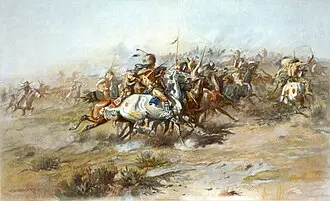
What happened to Custer's command will never be fully known. It has been pieced together from Indian accounts, archaeology and the positions of the bodies. Custer rode north along the bluffs to Medicine Tail Coulee, where there was skirmishing at the ford. His companies then fell back along what is now called Custer or Battle Ridge and were overwhelmed one after another. About 40 men made a final stand on the hill where the monument now stands. Those who tried to break out were killed within minutes.
Aftermath
Terry's and Gibbon's column arrived on 27 June, relieved Reno's survivors and found Custer's dead. The wounded were carried down river on the steamer Far West, and the Bismarck Tribune broke the news on 6 July. The victory was short-lived for the Lakota and Cheyenne. The Army put more troops into the field, and most of the bands surrendered within a year. Crazy Horse surrendered at Camp Robinson in May 1877 and was killed there that September. Sitting Bull took his people to Canada and surrendered at Fort Buford in July 1881. Congress took the Black Hills in 1877, and their ownership is still disputed.
Legend and history
- "Custer's Last Stand". Paintings, Wild West shows and films made the last stand on the hill the whole story. In fact it was the end of a running fight across several miles, and most of the regiment, under Reno and Benteen, survived.
- Comanche, the "only survivor". The cavalry horse Comanche was found badly wounded after the battle and became a celebrated survivor. Calling him the only survivor is a legend: hundreds of Reno's and Benteen's men lived, and accounts differ on whether any other horses of Custer's command were found alive. His breed is also disputed (see Morgan horse).
- Jammed carbines. How far jamming in the Springfield Model 1873 carbine contributed to the defeat is still argued over.
- The Crow scouts. Stories that Custer dismissed his Crow scouts just before the fight, or that they changed out of uniform because they foresaw defeat, are disputed. Most of them were sent back to the pack train and did not fight with Custer.
- Custer's last movements are reconstructed, not documented. Why his companies fell back from the ford is not fully understood.
In Westerns
The battle and Custer have been retold many times, often with great freedom: They Died with Their Boots On (1941), Sitting Bull (1954), Chief Crazy Horse (1955), 7th Cavalry (1956), which is set just after the battle, and Custer of the West (1968). She Wore a Yellow Ribbon (1949) opens with news of Custer's defeat, and Fort Apache (1948) draws on it. Custer also had a short-lived TV series, Custer (1967).
Key facts
- Date: 25–26 June 1876
- Place: Little Bighorn River valley, south-central Montana (then Montana Territory)
- Plains nations: Lakota, Northern Cheyenne and Arapaho
- US forces: 7th Cavalry under Lt Col George Armstrong Custer, with Crow and Arikara scouts
- Other nations: Crow and Arikara men served as Army scouts against the Lakota, whom Margaret Carrington's Ab-sa-ra-ka (1868) called the Crows' "hereditary and deadly enemies"
- Leaders: Sitting Bull, Crazy Horse and Gall; Custer, Maj. Marcus Reno and Capt. Frederick Benteen
- Size of the village: accounts differ; about 7,000 to 8,000 Lakota, Cheyenne and Arapaho people, with about 1,500 to 2,000 warriors
- US losses: 268 soldiers, scouts and civilians killed
- Lakota and Cheyenne losses: Unknown; estimates vary widely
- Outcome: Lakota and Cheyenne victory; most bands surrendered within a year
- Fought on 25–26 June 1876 beside the Little Bighorn River (NPS chronology).
- The 1868 Treaty of Fort Laramie recognised the Black Hills as part of the Great Sioux Reservation; after gold was found during Custer's 1874 expedition, miners entered the Black Hills in breach of the treaty (treaty text at NARA; NPS; US Supreme Court, United States v. Sioux Nation, 1980).
- About 7,000 Lakota, Cheyenne, Dakota and Arapaho people, including 1,500–2,000 warriors, were camped in the village; the National Park Service notes that the warriors were defending their families as well as fighting the Army.
- US losses were 268 killed; Lakota and Cheyenne losses are less certain, with the NPS estimating about 60–100 (NPS chronology). Estimates vary.
- Crow and Arikara scouts served with the 7th Cavalry, and six scouts were killed (NPS, Indian scouts). Margaret Irvin Carrington, an army officer's wife at Fort Phil Kearny, wrote in Ab-sa-ra-ka (1868) that the Sioux (Lakota) were the Crows' "hereditary and deadly enemies" and had taken Crow hunting grounds.
- Many Medals of Honor were awarded to troopers who carried water to the wounded on Reno Hill under fire (US Army Medal of Honor citations).
- Congress ratified the 1877 agreement taking the Black Hills (Act of 28 February 1877, 19 Stat. 254). In 1980 the US Supreme Court held this was a taking that required just compensation; the dissent and the 1942 Court of Claims had taken the opposite view, so accounts differ on how to judge it.
- Legend vs history: 'Custer's Last Stand' as painted and filmed (a last heroic stand on the hilltop) is largely legend; how Custer's men died has been pieced together from Indian testimony, archaeology and the positions of the bodies, and many details are disputed.
See also
Gallery 1

Sources
- The Battle of the Little Bighorn - Little Bighorn Battlefield National Monument (NPS) nps.gov
- A Chronology of the Battle of the Little Bighorn (NPS) nps.gov
- Indian Village - Little Bighorn Battlefield (NPS) nps.gov
- Indian Scouts - Little Bighorn Battlefield (NPS) nps.gov
- Treaty of Fort Laramie (1868) - National Archives (primary) archives.gov
- Act of 28 February 1877, 19 Stat. 254 (primary) - GovInfo govinfo.gov
- United States v. Sioux Nation of Indians, 448 U.S. 371 (1980) - Cornell LII law.cornell.edu
- Medal of Honor recipients: Indian Wars period - US Army army.mil
- Scout, Warrior, Witness: The Legacy of White Man Runs Him - Buffalo Bill Center of the West centerofthewest.org
- Army Scouts, 1866–1890 - Smithsonian National Museum of the American Indian americanindian.si.edu
- Battle of the Little Bighorn - Britannica britannica.com
- Battle of the Little Bighorn - Wikipedia en.wikipedia.org
- Wikidata: Q205422 wikidata.org
- Wikimedia Commons: Red Horse pictographic account of the Battle of the Little Bighorn, 1881. 0000.png commons.wikimedia.org
- Wikimedia Commons: Charles Marion Russell - The Custer Fight (1903).jpg commons.wikimedia.org
- Little Bighorn Battlefield National Monument – NPS nps.gov
- “Fetterman Battlefield” – WyoHistory.org (Wyoming State Historical Society) wyohistory.org
- “Fetterman battle history” – Fort Phil Kearny/Bozeman Trail Association fortphilkearny.org
- John H. Monnett (ed.), Eyewitness to the Fetterman Fight: Indian Views – Smithsonian Libraries catalogue record si.edu
- The Crow Nation nps.gov
- Margaret Irvin Carrington, Ab-sa-ra-ka, Home of the Crows: Being the Experience of an Officer's Wife on the Plains (1868) archive.org
