
Nokota horse
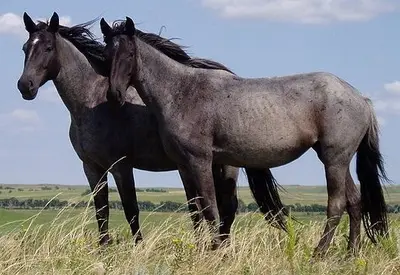
The Nokota horse is a hardy, often blue-roan horse from the badlands of the Little Missouri River in south-western North Dakota. It grew out of the free-ranging herds of the late nineteenth century, a mix of Native American horses, Spanish-type stock and ranch breeds, and it survived largely by accident when a few bands were fenced inside Theodore Roosevelt National Park. Saved from dispersal by two ranching brothers, it is now North Dakota's honorary state equine.
Badlands horses
When cattlemen came to the Little Missouri country in the 1880s, they found wild horses already running there, descended from runaways of Native and ranch herds. The young Theodore Roosevelt, who ranched in the area from 1883 to 1886, wrote about these feral horses, noting that though they came of domestic stock they were as wild as the antelope. Ranchers crossed local Indian ponies with Spanish, Thoroughbred, harness and draught horses to breed tough working stock. In 1884 the HT Ranch near Medora bought sixty mares from a herd of Lakota horses said to have been taken from Sitting Bull's people after their surrender, and crossed some with a Thoroughbred and with Percheron stallions, which explains the draught blood found in many Nokotas today.
Near extinction and rescue
In the early twentieth century ranchers, later helped by state and federal agencies, set out to clear the wild herds off the grazing land, and many horses were caught, shot or sold for slaughter. When Theodore Roosevelt National Park was created and fenced from the late 1940s, a few bands were shut inside by chance, and by 1960 they were the last wild horses in the state, though the park at first tried to remove them as well. In 1986 it auctioned off many horses and brought in outside stallions to change the herd's look. Concerned that the old type would vanish, the brothers Leo and Frank Kuntz bought dozens of horses, including the leading blue-roan stallion, and went on breeding them. They founded the Nokota Horse Conservancy in 1999. The brothers' belief that the park horses descended directly from Sitting Bull's ponies is a cherished story but not proven, and another breed group has disputed it.
Character
Nokotas have an angular frame, prominent withers, a sloping croup and a low-set tail. Blue roan is the best-known colour, though black and grey are common too. Many have a smooth ambling gait once called the "Indian shuffle". Breeders recognise two types: a smaller, finer "traditional" horse close to the Colonial Spanish type, at roughly 14 to 14.3 hands, and a larger "ranch" type resembling the early Quarter Horse. They are used for endurance, ranch and Western riding.
The park herd today
The horses that remain in the park are a little different from the Nokotas bred by the Kuntz family, and since 2009 the North Dakota Badlands Horse Registry has recorded them. In 2024 the National Park Service dropped plans that could have removed the herd, after strong public objection. As of October 2026 a bill requiring the park to keep a genetically diverse herd of at least 150 horses had passed the US Senate (June 2026) and was awaiting action in the House of Representatives.
Key facts
- Origin: Little Missouri badlands, North Dakota, 19th century
- Ancestry: Native American, Spanish, Thoroughbred, harness and draught horses
- Typical colour: blue roan
- Height: about 14–14.3 hands (traditional type); larger ranch type
- Registries: Nokota Horse Conservancy (1999); North Dakota Badlands Horse Registry (2009)
- State status: honorary state equine of North Dakota (1993)
- Instance of: horse breed (Wikidata P31)
See also
Gallery 1

Sources
- Nokota horse - Wikipedia en.wikipedia.org
- Wikidata: Q529139 wikidata.org
- Wikimedia Commons: Blue-Moon-Roan-Nokota-Stallion.jpg commons.wikimedia.org
- Wikimedia Commons: Nokota Horses cropped.jpg commons.wikimedia.org
