
Black cowboys (1866)
Black cowboys were among the first cowboys in the United States. They roped, branded, broke horses and rode on the great cattle drives of the late 19th century, especially out of Texas. Nobody knows exactly how many there were, and accounts differ, but they made up a sizeable share of the men on the trails. Early Western novels and films seldom showed them, so for many years the popular picture of the cowboy left them out.
Background
Texas had been cattle country since Spanish times, and the skills of the vaquero were already established there. American settlers who moved into Texas from the 1820s brought enslaved people with them, and by 1860 they made up about 30 per cent of the state's population. Many enslaved men learned cattle work on Texas ranches. During the Civil War, when many ranchers went off to fight, the herds were often left in their care.
After the war Texas was overrun with half-wild Longhorns, and ranchers needed skilled hands to round them up. Freedmen with cattle experience were hired as paid cowhands. Cowboy work was one of the few trades open to Black men in the South at the time. Many worked as horse-breakers, and large numbers went north on the drives (see Cattle drives and Chisholm Trail). Few became trail bosses, foremen or ranch managers. Accounts differ on how they were treated in the cattle towns: some historians find informal segregation in some saloons and hotels, others largely fair treatment. Within a trail crew a man was usually judged by his work.
Notable figures
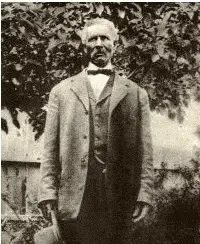
- Bose Ikard (1843–1929) was a top hand for the cattleman Charles Goodnight on the Goodnight–Loving Trail. Goodnight trusted him to carry and guard large sums of money. When Ikard died, Goodnight wrote his epitaph: "Served with me four years on the Goodnight-Loving Trail, never shirked a duty or disobeyed an order, rode with me in many stampedes, participated in three engagements with Comanches. Splendid behavior."
- Daniel W. "80 John" Wallace rode the trails from his teens and later built up his own ranch near Loraine, Texas, of more than 1,200 acres. He belonged to the Texas and Southwestern Cattle Raisers Association for more than thirty years.
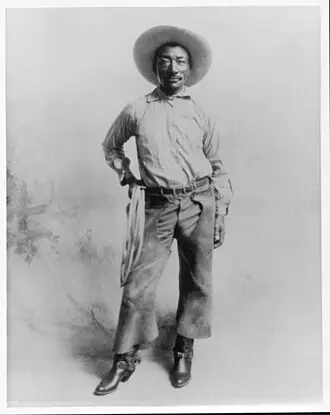
- Nat Love (1854–1921) was born enslaved near Nashville, Tennessee, and went west as a teenager. He told his story in his autobiography, The Life and Adventures of Nat Love (1907), including his arrival in Dodge City. When the open range closed he became a Pullman porter on the railways.
- Bill Pickett (1870–1932) was born in Texas to formerly enslaved parents. He is credited with inventing bulldogging, the ancestor of rodeo steer wrestling, by throwing a steer with his teeth on its upper lip, as he had seen cattle dogs do. He was also a deacon of his Baptist church in Taylor, Texas. He caused a sensation at Cheyenne Frontier Days in 1904 and from 1905 performed with the 101 Ranch Wild West Show. He also appeared in silent films, among them The Bull-Dogger, made in 1921. He died in 1932 after a horse kicked him in the head.
Later years and legacy
The long drives ended in the 1880s and 1890s, as railways spread, barbed wire closed the open range and ranches needed fewer hands. In Pickett's day Black riders were kept out of many white rodeo contests, mostly by local custom rather than written rules, and he was sometimes billed as an Indian or a Mexican so that he could compete. Black rodeo traditions carried on all the same. The Negro Cowboys Rodeo Association, formed in 1947 by Black ranchers and cowboys in East Texas, began a tradition of weekend rodeos, and the touring Bill Pickett Invitational Rodeo began in 1984. Pickett was inducted into the National Rodeo Hall of Fame in Oklahoma City, its first Black honoree, and in 1994 he appeared on a US postage stamp, though the picture used was of one of his brothers.
Legend and history
- How many? No count was kept. Estimates suggest that as many as one in four cowhands in Texas were Black.
- "Deadwood Dick". Nat Love said he won the name by beating all comers at a roping and shooting contest in Deadwood on 4 July 1876. No independent record of the contest has been found, and his book mixes real cowboy life with tall tales.
- Bill Pickett's Hall of Fame year. Accounts differ between 1971 and 1972.
In Westerns
Pickett appeared in the silent film The Bull-Dogger, made in 1921. The scout Josh Deets in Larry McMurtry's Lonesome Dove is said to have been inspired by Bose Ikard; Danny Glover played him in the 1989 TV miniseries. Harlem Rides the Range (1939) was one of a handful of 1930s Westerns made with all-Black casts.
Key facts
- Period: from the early 19th century in Texas; peak in the trail-drive era, about 1866 to the 1880s
- Numbers: Unknown; estimates suggest as many as one in four cowhands in Texas
- Heartland: Texas, especially the coastal plain
- Notable people: Bose Ikard, Daniel W. "80 John" Wallace, Nat Love, Bill Pickett
- Later legacy: Negro Cowboys Rodeo Association (1947); Bill Pickett Invitational Rodeo (from 1984)
- Many early Black cowboys were born into slavery; Texas ranchers relied on enslaved workers to run their herds during the Civil War, and those men were hired as paid hands after emancipation (Texas State Historical Association; Smithsonian; Library of Congress).
- By 1860 enslaved people were over 30 per cent of Texas's population (Smithsonian, citing the 1860 census).
- Bose Ikard rode for Charles Goodnight, who later wrote that Ikard 'never shirked a duty or disobeyed an order' (Smithsonian; TSHA).
- Nat Love, born enslaved in Tennessee, told his life as 'Deadwood Dick' in his 1907 autobiography (Love, 1907; Library of Congress). Some of its tales are told as legend rather than documented fact.
- Bill Pickett (born 5 December 1870 to former slaves) was credited with inventing bulldogging, appeared in silent films, among them The Bull-Dogger (made in 1921, released January 1922), was a Baptist deacon in Taylor, Texas, and became the first Black honoree of the National Rodeo Hall of Fame, in 1971 or 1972 (accounts differ) (TSHA). The 1994 US stamp meant to honour him showed his brother by mistake (TSHA).
- Estimates suggest that as many as one in four cowhands in Texas were Black (Library of Congress; Smithsonian; NPS).
See also
Gallery 2


Sources
- Black Cowboys - Handbook of Texas (TSHA) tshaonline.org
- Pickett, William - Handbook of Texas (TSHA) tshaonline.org
- The Lesser-Known History of African-American Cowboys - Smithsonian Magazine smithsonianmag.com
- Black Cowboys: At Home on the Range - Library of Congress blog blogs.loc.gov
- Nat Love, The Life and Adventures of Nat Love (1907) (primary) - Project Gutenberg gutenberg.org
- Black cowboys - Wikipedia en.wikipedia.org
- Nat Love, Life and Adventures of Nat Love (1907) archive.org
- Dianna Everett, 'Pickett, William', Encyclopedia of Oklahoma History and Culture (Oklahoma Historical Society) okhistory.org
- NPS, "Cowpoke History: Black Cowboys and Cowgirls" nps.gov
- “The Bull Dogger” – Norman Studios normanstudios.org
- The Bull Dogger, 1921 (original 3-sheet poster) – University of Tulsa Archival Catalog utulsa.as.atlas-sys.com
- John Wooley, “Striking Gold” (1 March 2021) – Oklahoma Magazine okmag.com
- Wikidata: Q40510792 wikidata.org
- Wikimedia Commons: Natlove2.jpg commons.wikimedia.org
- Wikimedia Commons: Bose Ikard.jpg commons.wikimedia.org
- Wikimedia Commons: Bill Picket North Fort Worth Historical Society.jpg commons.wikimedia.org
