
Central Pacific Railroad
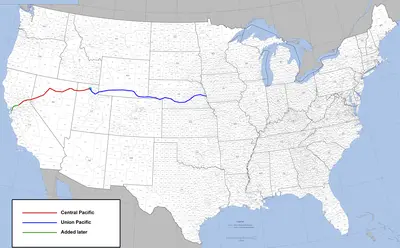
The Central Pacific Railroad built the western part of the first transcontinental railroad, eastwards from Sacramento, California, through the Sierra Nevada and across Nevada and Utah. Its crews, most of them Chinese labourers, met the Union Pacific at Promontory Summit on 10 May 1869. The company was incorporated in California in 1861, given its part of the line by the Pacific Railway Act of 1862, and leased to the Southern Pacific in 1885.
Judah and the Big Four
The railway was the idea of the engineer Theodore Judah, who found a workable route over the Sierra Nevada and lobbied hard for a railway to the Pacific. He persuaded four Sacramento merchants to back the scheme: Leland Stanford, Collis P. Huntington, Mark Hopkins and Charles Crocker, later known as the "Big Four". Judah fell out with them and died in 1863, before the line was built, while the Big Four became some of the richest men in America.
The Pacific Railway Act of 1862 gave the Central Pacific the task of building the western section, with land grants and government bonds for each mile of track. Ground was broken in Sacramento in January 1863.
Through the Sierra
Every rail, locomotive and tool had to be shipped from the East Coast, around Cape Horn or across Panama. Labour was short until, from 1865, the company began hiring Chinese workers in large numbers. By the later years of construction they made up most of the workforce. They blasted tunnels through solid granite, built ledges along cliffs, and worked through winters so heavy that many miles of wooden snowsheds were later built over the track. Many workers died, though the number is not known.
Across the desert
Once out of the mountains, the line raced across Nevada and Utah. On 28 April 1869 Central Pacific crews laid ten miles of track in a single day, a record. The two lines met at Promontory, where Leland Stanford of the Central Pacific and Thomas Durant of the Union Pacific struck the last spikes at the golden spike ceremony, and the Central Pacific's locomotive Jupiter stood nose to nose with the Union Pacific's No. 119.
See also
Key facts
- Founded/established: 1861 (Wikidata P571)
- Ended/dissolved: 1885 (Wikidata P576)
- Country: United States (Wikidata P17)
- Located in: California, Nevada (Wikidata P131)
- Instance of: transport company (Wikidata P31)
- Incorporated in California in 1861; given its part in the first transcontinental railroad by the Pacific Railway Act of 1862
Gallery 1

Sources
- Central Pacific Railroad - Wikipedia en.wikipedia.org
- Wikidata: Q1053930 wikidata.org
- Harper's Weekly, 29 May 1869, “The Pacific Railroad” – Internet Archive archive.org
- W. F. Bailey, “The Central Pacific” (1908) – transcribed by CPRR.org cprr.org
- “Chronological History” – Union Pacific (company site; not independent of the UP) up.com
- Wikimedia Commons: CPRR Locomotive -113 FALCON 1869.jpg commons.wikimedia.org
- Wikimedia Commons: Transcontinental railroad route.png commons.wikimedia.org
