
Cowboy
A cowboy is a herder who tends cattle on horseback on the ranches of North America. The American cowboy of the late 19th century, who drove herds up the trails from Texas and worked the open range, became one of the best-known figures in the world and the central hero of the Western.
Origins
The cowboy's skills came from the vaquero, the Mexican horseman whose traditions went back to Spain. In Texas and California, Anglo-American ranchers learned from vaqueros how to rope, brand and work cattle from the saddle, and borrowed their gear and much of their language. Words such as lariat, chaps, rodeo and buckaroo all come from Spanish.
The working cowboy
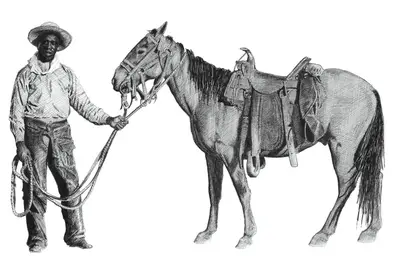
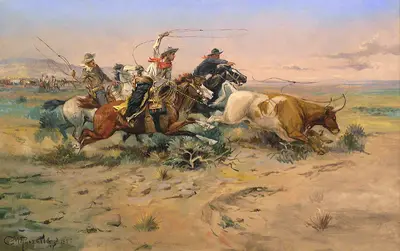
The great age of the cowboy lasted from the end of the Civil War to the late 1880s, the era of the long cattle drives. A cowboy's year centred on the spring and autumn round-ups, when cattle were gathered, counted and branded, and on the drives north to the railheads. He spent long days in the saddle in all weathers, earning about $25 to $40 a month. Most cowboys were young men, and many were Mexican, Black or Native American as well as white. Cowgirls and ranch women also worked cattle, though their part is less well recorded.
Gear
The cowboy's outfit was built for hard work. His wide-brimmed hat kept off sun and rain, his bandana kept out dust, and his high-heeled boots held the stirrup. Leather chaps protected his legs from brush and thorns. His Western saddle had a horn for holding a rope, and he might carry a revolver such as the Colt Single Action Army or a rifle such as the Winchester 1873, mainly for snakes, wolves and emergencies.
Code and character
The cowboy's world prized courage, loyalty, hard work and plain dealing. A man was judged by his word and by how he treated his horse and his friends. Many cowboys were churchgoing men, and camp meetings and circuit preachers reached some of the remotest ranches. These values, sometimes called the "cowboy code", passed into the Western as the hero who stands up for what is right.
In film and legend
Dime novels and Wild West shows made the cowboy a hero even while the trail drives were still going on. In the 20th century films and television made him a worldwide figure, from John Wayne in Red River (1948) to the boys of The Cowboys (1972). Working cowboys still ride on ranches across the West today, and rodeo keeps their skills alive.
Key facts
- Instance of: profession (Wikidata P31)
Gallery 2


Sources
- Cowboy - Wikipedia en.wikipedia.org
- Wikidata: Q178521 wikidata.org
- Fact & Fiction: Popular Western Imagery from the Glenn D. Shirley Collection nationalcowboymuseum.org
- Wikimedia Commons: The Cow Boy 1888.jpg commons.wikimedia.org
- Wikimedia Commons: Cowboy %26 horse.jpg commons.wikimedia.org
- Wikimedia Commons: HerdQuit.jpg commons.wikimedia.org
