
Durango, Colorado
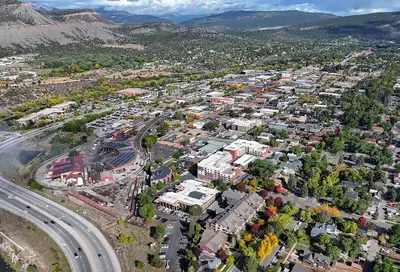
Durango is a city in the Animas River valley of south-western Colorado and the county seat of La Plata County. It was laid out in 1880 by the Denver and Rio Grande Railway as the base for its push into the silver and gold country of the San Juan Mountains, and it grew into the railway, smelting and trading centre of the region. Its old railway line to Silverton still runs as the steam-hauled Durango and Silverton Narrow Gauge Railroad, and its Victorian Main Avenue is a historic district. The surrounding country has served as the backdrop for many Westerns. Durango had about 19,000 people at the 2020 census and is home to Fort Lewis College.
A railway town
Before the mining rush the Animas valley was Ute country, and the Ute hunted and camped there in summer. After the Brunot Agreement of 1873 opened the San Juan Mountains to mining, a small farming and supply settlement, Animas City, grew up on the river. When the Denver and Rio Grande approached in 1880, it held brief talks with Animas City, but they came to nothing, and, as it had done elsewhere, the company founded its own town instead, two miles to the south. The site was surveyed in September 1880 and the railway's land company, the Durango Trust, sold the lots. The name was chosen by Alexander C. Hunt, a former governor of Colorado Territory and a friend of the railway's president, William Jackson Palmer, after the city of Durango in Mexico, which Hunt had admired on a scouting trip.
Growth was rapid. By the end of 1880 Durango had about 2,000 people, several times as many as Animas City. A post office opened on 19 November 1880, and the town was incorporated on 27 April 1881. The railway arrived in July 1881 and immediately began building north to Silverton.
The travel writer George A. Crofutt, who visited on 15 October 1880, described Durango as the railway company's "pet child", laid out to become the great city of south-western Colorado. He reported broad streets, lots selling fast (the company took $96,000 in the first sixty days), brick and stone required in the business district, three brickyards at work, and the foundations going in for a large smelter of the San Juan and New York Smelting Company. Coal, he noted, could be dug within the town limits.
Smelters and ranches
The completion of the Silverton branch in 1882 made Durango the place where the ore of the San Juans came down to be smelted and shipped. By 1885 the business district had seven hotels and restaurants, eleven saloons, dance halls and stores, bakeries, blacksmiths and many other businesses. The Rio Grande Southern Railroad later linked Durango with mining towns to the west, and the town also served the farms and cattle ranches of the Animas valley and the country to the south. The Victorian Strater Hotel still stands at the south end of Main Avenue, near the depot. Animas City, left behind by the railway, became a small neighbour and was finally merged into Durango in 1948.
The Depression and the decline of mining hit the railways hard. The Rio Grande Southern lost its mail contract in 1951 and closed soon afterwards, and passenger trains east to Alamosa ended. Freight on the remaining Rio Grande lines dwindled, and the tracks east to Chama and south to Farmington were taken up after 1968. The Silverton branch survived because of its tourists, and since 1981 it has been run as an independent heritage railway.
Durango on film
From the 1930s the Rio Grande promoted the area to Hollywood, and its scenery and narrow-gauge trains drew many Western productions. Parts of Colorado Territory (1949) were shot at the Durango depot and on the line south towards Farmington; A Ticket to Tomahawk (1950) was filmed largely in La Plata County; much of The Naked Spur (1953) was shot in the area; and Night Passage (1957) and Butch Cassidy and the Sundance Kid (1969) both used the country north of town and the Silverton line. Part of City Slickers (1991) was also filmed at Durango.
Legend and history
- A "wild" railway camp? Durango had plenty of saloons and dance halls in its boom years, but it was a planned company town from the start, with a regular street grid and a contract rule that buildings in the business district be of brick or stone.
- Named after Mexico. The usual account is that Hunt named the town after Durango in Mexico.
Key facts
- Location: Animas River valley, La Plata County, Colorado
- Founded: 1880, by the Denver and Rio Grande Railway
- Incorporated: 27 April 1881
- Named after: Durango, Mexico
- Elevation: about 6,500 feet
- Population: 19,071 (2020 census)
- Known for: the Durango and Silverton Narrow Gauge Railroad; Main Avenue historic district; Fort Lewis College
- Wikidata P571 date (not the original founding): 1881
- Country: United States (Wikidata P17)
- Located in: La Plata County (Wikidata P131)
- Instance of: city in the United States, county seat (Wikidata P31)
- Incorporated: 27 April 1881 (Wikipedia infobox)
See also
Nearby
- Durango and Silverton Narrow Gauge Railroad 3 km
- Silverton, Colorado 63 km
- Leadville, Colorado 259 km
- Cripple Creek, Colorado 288 km
- Fort Union National Monument 298 km
Gallery 1

Sources
- Durango, Colorado - Wikipedia en.wikipedia.org
- Wikidata: Q1012665 wikidata.org
- Wikimedia Commons: Durango-downtown.jpg commons.wikimedia.org
- Wikimedia Commons: Durango, Colorado.jpg commons.wikimedia.org
