
Fort Bowie
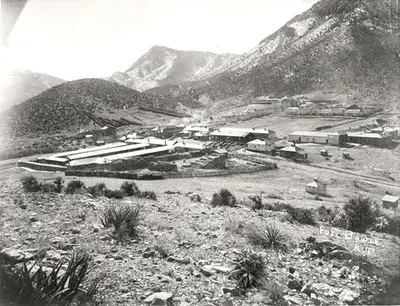
Fort Bowie was a US Army post at Apache Pass in south-eastern Arizona, between the Chiricahua and Dos Cabezas mountains. Set up in 1862 to guard the pass and its precious spring, it was the base for more than thirty years of campaigns against the Chiricahua Apaches, which ended with Geronimo's surrender in 1886. The fort was abandoned in 1894, and its adobe ruins are now Fort Bowie National Historic Site.
Apache Pass
Apache Pass was one of the few places in that dry country where travellers could be sure of water, at Apache Spring. From 1858 the Butterfield Overland Mail ran its stagecoaches through the pass and kept a stage station there. The Chiricahua leader Cochise and his people lived in the surrounding mountains and at first let the stages pass in peace.
That changed in February 1861 with the Bascom Affair. A rancher's stepson had been kidnapped and his cattle taken in an Apache raid, and the army sent Lieutenant George Bascom to Apache Pass. Bascom blamed Cochise, though the raid was later traced to a different Apache band, and tried to hold him hostage during a parley in a tent. Cochise cut his way out and escaped, hostages were taken and killed on both sides, and years of war followed.
The Battle of Apache Pass
In July 1862, Union volunteers of the California Column were marching east to drive Confederate forces out of New Mexico. On 15 and 16 July their advance party was attacked at the spring by Apache warriors under Cochise and Mangas Coloradas. The soldiers drove them off with the help of mountain howitzers. Their commander, General James H. Carleton, ordered a post built to hold the pass, and the 5th California Infantry built it that summer. It was named after their colonel, George Washington Bowie.
The Apache campaigns
The first fort was little more than a rough camp. In 1868 a larger fort with adobe barracks, officers' houses, corrals, a store and a hospital was built on a plateau nearby. Fort Bowie became the headquarters for operations against the Chiricahuas, and in the 1880s it was the base of General George Crook and then General Nelson Miles in their pursuit of Geronimo. After Geronimo surrendered to Miles in Skeleton Canyon in September 1886, he and his band were brought to Fort Bowie and then sent by train to imprisonment in Florida. Later many Chiricahuas, including scouts who had served the army, were also sent east.
With the Apache wars over, the army closed the fort in 1894.
The site today
Fort Bowie National Historic Site protects the ruins of both forts, the spring, the old stage station and the post cemetery. There is no road to the fort itself: visitors walk a trail of about 1.5 miles each way from the car park through the pass.
See also
Nearby
- Shakespeare, New Mexico 69 km
- Tombstone, Arizona 76 km
- Bird Cage Theatre 77 km
- Contention City, Arizona 84 km
- Fort Huachuca 108 km
- Tucson, Arizona 141 km
Key facts
- Founded/established: 1864 (Wikidata P571)
- Country: United States (Wikidata P17)
- Located in: Cochise County (Wikidata P131)
- Instance of: fort (Wikidata P31)
Gallery 1

Sources
- Fort Bowie - Wikipedia en.wikipedia.org
- Wikidata: Q3077790 wikidata.org
- Bascom Affair – Fort Bowie National Historic Site, National Park Service nps.gov
- The Apache Wars Part I: Cochise – Chiricahua National Monument, National Park Service nps.gov
- Karen Weston Gonzales, 'A Boy Once Named Felix' – Fort Bowie NHS park archives (npshistory.com) npshistory.com
- 'John Ward's Ranch' historical marker (Arizona Historical Society, 1991), SR 82 near Patagonia – Historical Marker Database hmdb.org
- 'SR 82 stop offers two-for-one history lessons', ADOT blog, 16 June 2020 azdot.gov
- Wikimedia Commons: Ft Bowie AZ.jpg commons.wikimedia.org
- Wikimedia Commons: Fort Bowie in 1893.jpg commons.wikimedia.org
