
Arapaho
Either side · Part of Frontier folk
Some statements on this page are still being checked and are marked "Needs further sources".
The Arapaho, allies of the Cheyenne on the central Plains, appear by name in a few Westerns.
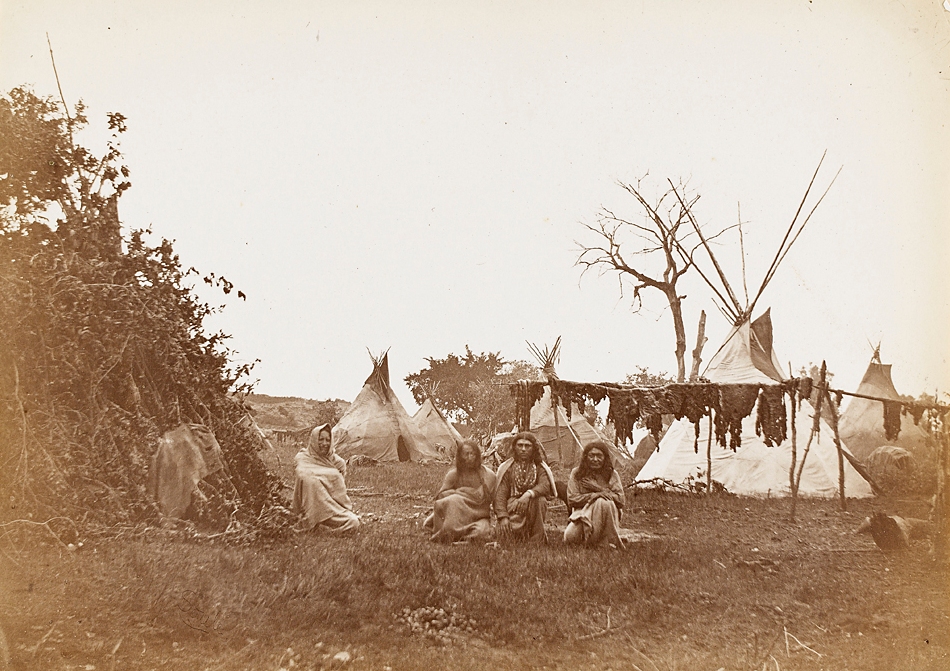
An Arapaho camp drying buffalo meat, about 1870, said to be near Camp Supply, Indian Territory.
Photograph · William S. Soule · c.1870 · Source: https://commons.wikimedia.org/wiki/File:William_S._Soule_-_Arapaho_camp.jpg · Licence: Public domain – UK: William S. Soule died 1908, more than 70 years ago (CDPA 1988 s.12(2))

In classic Westerns
Arapaho characters appear mostly alongside the Cheyenne in cavalry stories.
- Naming: Named as the sources and films name them; no generic label is used.
- Role in the story: Varies from film to film: allies, enemies, families, or the centre of the story.
Sub-types
Chiefs and leaders
Named Arapaho leaders as the films show them.
Scouts and trackers
Arapaho scouts, trackers and guides, often serving with the army.
Raiding bands (as films show them)
Films that show a Arapaho war party or raiding band, described in each film's own terms and by its named leader where there is one.
Peoples and families
Films that portray Arapaho people and their home life, or name the Arapaho at all.
In history
Documented history from period sources. The film portrayal is described above under "In classic Westerns"; this section is kept separate.
A traveller visited an Arapaho camp in 1846 and notes that the "Grosventre Blackfeet" (Gros Ventre) were their allies. The Arapaho lived in buffalo-hide lodges.
Period writers record that the Comanche and Arapaho wanted Kit Carson to lead them against the Sioux, and that he talked them into negotiating instead. A photograph of about 1870 shows an Arapaho camp drying buffalo meat.
How the films differ
Films rarely name the Arapaho. Period writers do, as neighbours and allies of the Cheyenne and the Comanche.
Films
| # | Film | How it qualifies | From the wiki's summary |
|---|---|---|---|
| 1 | How the West Was Won (1962) | Peoples and families | An epic that follows the settling of the West across several decades. |
| 2 | She Wore a Yellow Ribbon (1949) | Chiefs and leaders; Raiding bands (as films show them); Peoples and families | In 1876, a veteran cavalry captain days from retirement leads one last patrol while trouble builds after Custer's defeat. |
| 3 | The Guns of Fort Petticoat (1957) | Chiefs and leaders; Peoples and families | The Guns of Fort Petticoat (1957) is a cavalry Western directed by George Marshall and produced by Harry Joe Brown and Audie Murphy, who stars as Lieutenant Frank Hewitt, with Hope Emerson. |
| 4 | Tomahawk (1951) | Raiding bands (as films show them); Peoples and families | Tomahawk (1951) is a Western directed by George Sherman, starring Van Heflin as the frontiersman Jim Bridger and Yvonne De Carlo. |
| 5 | Chuka (1967) | Chiefs and leaders; Peoples and families | Chuka (1967) is an American cavalry Western directed by Gordon Douglas from Richard Jessup's 1961 novel, starring Rod Taylor as the gunfighter Chuka, who also produced it and worked on the screenplay. |
| 6 | A Ticket to Tomahawk (1950) | Scouts and trackers; Raiding bands (as films show them); Peoples and families | A rail company races to deliver a locomotive to a Colorado town while a rival stagecoach line tries to stop it. |
Fewer than 10 films: the wiki's film data has only 6 qualifying film(s) for this type.
Films are listed in order of popularity, with older classics given extra weight. Information courtesy of IMDb (https://www.imdb.com).
See also
Sources
- The Oregon Trail (Francis Parkman), Project Gutenberg #1015, 1849 (accessed 28 October 2026)
- The Old Santa Fé Trail (Henry Inman), Macmillan, New York, 1897 (accessed 28 October 2026)
- The Prairie Traveler: A Hand-Book for Overland Expeditions (Randolph B. Marcy, Capt. U.S. Army), Harper & Brothers, New York, published by War Department authority, 1859 (accessed 28 October 2026)