
Kiowa
Either side · Part of Frontier folk
Some statements on this page are still being checked and are marked "Needs further sources".
The Kiowa of the southern Plains were allies of the Comanche and appear in a smaller number of Westerns.
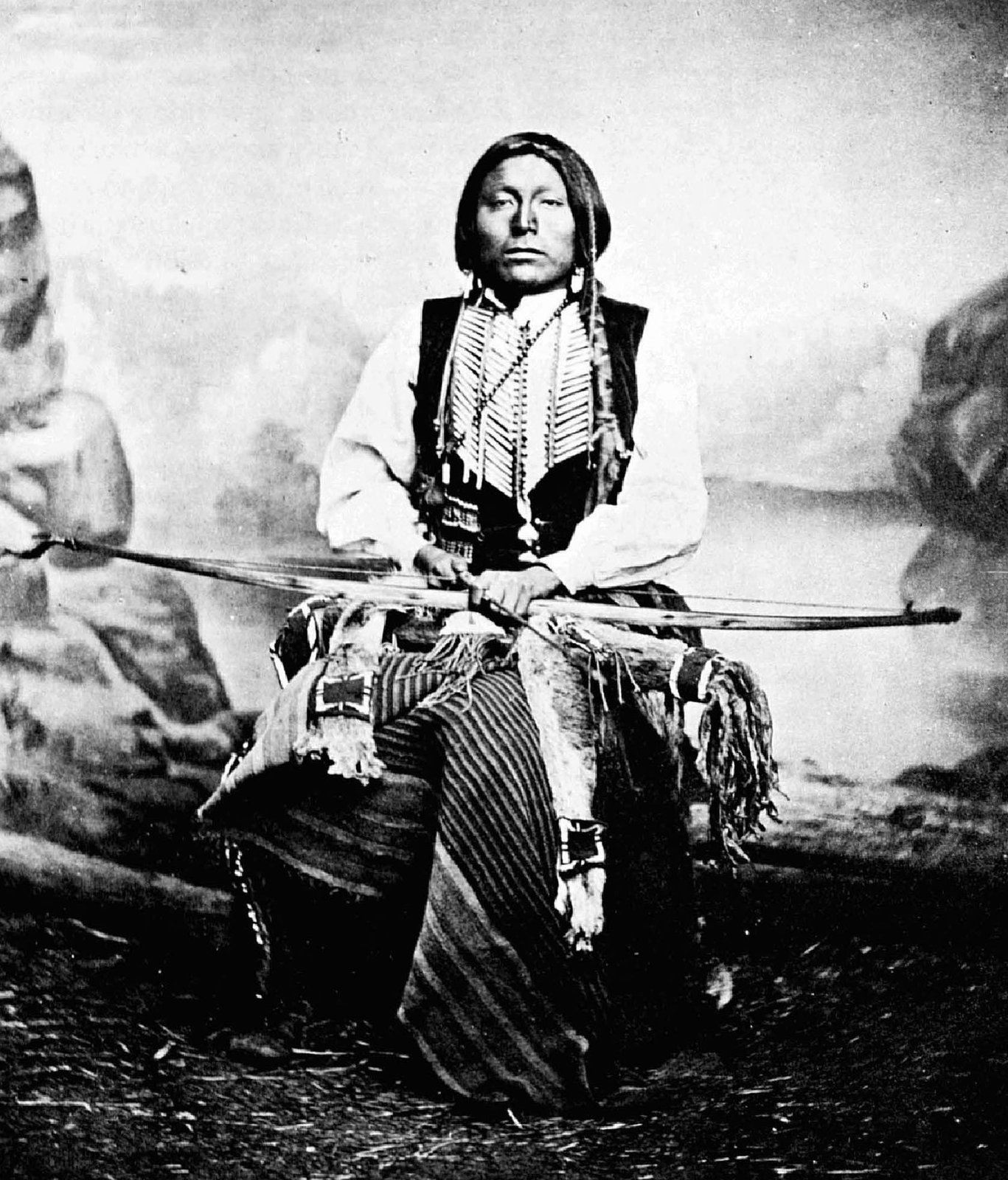
A Kiowa man, photographed by William S. Soule at Fort Sill in the 1870s. His name is not recorded.
Posed photograph · William S. Soule · 1870s · Source: https://commons.wikimedia.org/wiki/File:William_S._Soule_-_Kiowa_Brave.jpg · Licence: Public domain – UK: William S. Soule died 1908, more than 70 years ago (CDPA 1988 s.12(2)) · Scan from a 1968 book; archive copy to be found.

In classic Westerns
In News of the World (2020) a girl raised by the Kiowa is being returned to her relatives; Kiowa characters also appear in The Unforgiven (1960).
- Naming: Named as the sources and films name them; no generic label is used.
- Role in the story: Varies from film to film: allies, enemies, families, or the centre of the story.
Sub-types
Chiefs and leaders
Named Kiowa leaders as the films show them.
Scouts and trackers
Kiowa scouts, trackers and guides, often serving with the army.
Raiding bands (as films show them)
Films that show a Kiowa war party or raiding band, described in each film's own terms and by its named leader where there is one.
Peoples and families
Films that portray Kiowa people and their home life, or name the Kiowa at all.
In history
Documented history from period sources. The film portrayal is described above under "In classic Westerns"; this section is kept separate.
An army officer of 1859 notes that the Kiowa lived in buffalo-hide lodges like those of the Comanche. Period writers call Satanta "the great Kiowa chief", and describe a joint winter camp of Cheyenne, Kiowa and Arapaho at the Big Timbers on the Arkansas River.
A Texas Ranger's memoir names the Kiowa, with the Comanche, Lipan and Kickapoo, as raiders who timed attacks on Texas settlements by the full moon. (Needs further sources: one source only; reported as that writer's account, not stated as fact.)
How the films differ
Films tend to blur the southern Plains peoples together. Period writers name the Kiowa, their leaders and their alliances with the Comanche, Cheyenne and Arapaho.
Films
| # | Film | How it qualifies | From the wiki's summary |
|---|---|---|---|
| 1 | News of the World (2020) | Peoples and families | An ageing Civil War veteran has to take a girl raised by the Kiowa back to her last remaining relatives. |
| 2 | The War Wagon (1967) | Raiding bands (as films show them); Peoples and families | A rancher, played by John Wayne, comes out of prison and teams up with a hired gunman, played by Kirk Douglas, to rob the armoured wagon of the man who stole his land. |
| 3 | The Unforgiven (1960) | Raiding bands (as films show them); Peoples and families | John Huston's Western, adapted from Alan Le May's novel and starring Burt Lancaster and Audrey Hepburn, puts racism at the centre of its story, which was unusual for its time. |
| 4 | Apache Gold (1963) | Chiefs and leaders; Peoples and families | Apache Gold (1963), originally Winnetou and also known as Winnetou the Warrior, is a West German Western directed by Harald Reinl, starring Lex Barker and Pierre Brice as the Apache hero Winnetou, with Mario Adorf and Marie Versini. |
| 5 | The Scalphunters (1968) | Peoples and families | The Scalphunters (1968) is a Western directed by Sydney Pollack, starring Burt Lancaster as the trapper Joe Bass and Ossie Davis as Joseph Lee, a slave traded to him, with Telly Savalas and Shelley Winters. |
| 6 | Flaming Star (1960) | Raiding bands (as films show them); Peoples and families | A young man with a white father and a Kiowa mother is caught between his two families when a war breaks out on the Texas frontier. |
| 7 | Billy Two Hats (1974) | Peoples and families | Billy Two Hats (1974) is a Western directed by Ted Kotcheff and filmed in Israel, starring Gregory Peck as the Scottish outlaw Arch Deans and Desi Arnaz Jr. as his young half-Kiowa partner, with Jack Warden. |
| 8 | Rust (2024) | Peoples and families | An ageing outlaw goes on the run towards Mexico with his teenage grandson, with lawmen in pursuit. |
| 9 | Two Flags West (1950) | Chiefs and leaders; Raiding bands (as films show them); Peoples and families | Confederate prisoners agree to serve the Union at a remote New Mexico fort, where they have to stand with their old enemies against an attack by Kiowa warriors. |
Fewer than 10 films: the wiki's film data has only 9 qualifying film(s) for this type.
Films are listed in order of popularity, with older classics given extra weight. Information courtesy of IMDb (https://www.imdb.com).
See also
Sources
- Six Years with the Texas Rangers, 1875 to 1881 (James B. Gillett), Von Boeckmann-Jones, Austin, 1921 (accessed 28 October 2026)
- The Prairie Traveler: A Hand-Book for Overland Expeditions (Randolph B. Marcy, Capt. U.S. Army), Harper & Brothers, New York, published by War Department authority, 1859 (accessed 28 October 2026)
- The Old Santa Fé Trail (Henry Inman), Macmillan, New York, 1897 (accessed 28 October 2026)