
Navajo
Either side · Part of Frontier folk
Some statements on this page are still being checked and are marked "Needs further sources".
The Navajo (Diné) of the Four Corners appear by name in a handful of Westerns, though Navajo people from Monument Valley played many other peoples in John Ford's films.
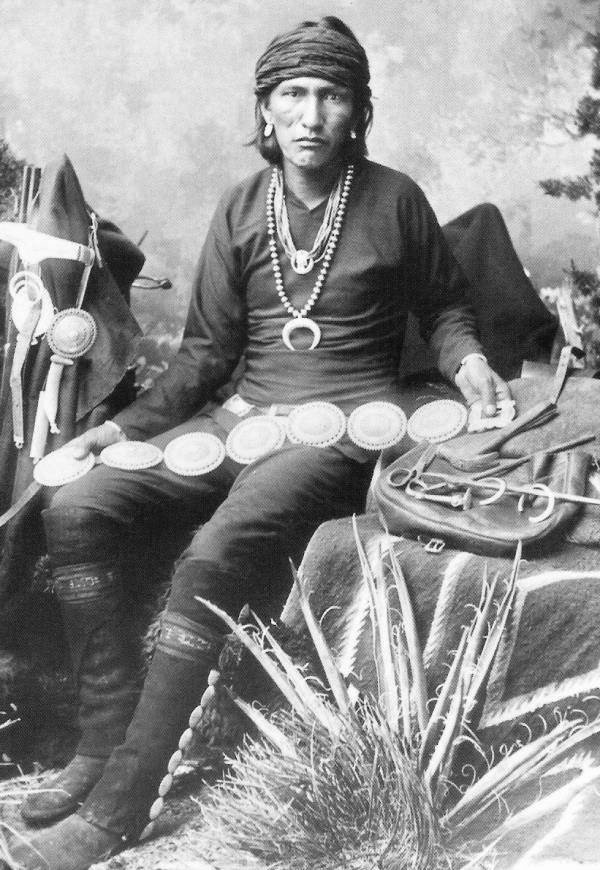
A Navajo silversmith with his work, 1883, recorded as "Slender Silversmith".
Posed photograph · Ben · 1883 · Source: https://commons.wikimedia.org/wiki/File:Atsidi_Sani.jpg · Licence: Public domain – UK: Ben Wittick died 1903, more than 70 years ago (CDPA 1988 s.12(2)) · Copy from a photo-sharing site; archive copy to be found.

In classic Westerns
Navajo characters are named in films such as Wagon Master (1950) and Navajo Joe (1966). This page lists only films where the Navajo are characters, not those where Navajo extras played other peoples.
- Naming: Named as the sources and films name them; no generic label is used.
- Role in the story: Varies from film to film: allies, enemies, families, or the centre of the story.
Sub-types
Chiefs and leaders
Named Navajo leaders as the films show them.
Scouts and trackers
Navajo scouts, trackers and guides, often serving with the army.
Raiding bands (as films show them)
Films that show a Navajo war party or raiding band, described in each film's own terms and by its named leader where there is one.
Peoples and families
Films that portray Navajo people and their home life, or name the Navajo at all.
In history
Documented history from period sources. The film portrayal is described above under "In classic Westerns"; this section is kept separate.
A Santa Fe trader writing in 1844 says that the finest native weaving in New Mexico was found only among the Hopi and the Navajo, "who still retain their independence". Period writers also record a Navajo war in 1823 and an American expedition against the Navajo in 1846.
A portrait of 1883 shows a Navajo silversmith with his work.
How the films differ
Films often use Navajo extras and Monument Valley to stand for many different peoples. Period writers knew the Navajo (Diné) for their weaving, and the photographs for their silverwork.
Films
| # | Film | How it qualifies | From the wiki's summary |
|---|---|---|---|
| 1 | The Outlaw Josey Wales (1976) | Chiefs and leaders; Peoples and families | A Missouri farmer whose family is killed during the Civil War becomes a feared gunfighter seeking revenge. |
| 2 | Wagon Master (1950) | Raiding bands (as films show them); Peoples and families | A Mormon pioneer wagon train crosses dangerous desert country to the San Juan River in Utah. |
| 3 | Navajo Joe (1966) | Peoples and families | Burt Reynolds plays a Navajo man hunting the bandits who wiped out his people. |
| 4 | Stay Away, Joe (1968) | Peoples and families | Stay Away, Joe (1968) is a comedy Western with musical interludes, set in modern times and directed by Peter Tewksbury from Dan Cushman's 1953 novel, starring Elvis Presley as Joe Lightcloud with Burgess Meredith, Joan Blondell, Katy Jurado and Thomas Gomez. |
| 5 | Column South (1953) | Peoples and families | Column South (1953) is a cavalry Western directed by Frederick de Cordova, set in 1861, starring Audie Murphy as a Union officer trying to prove local Navajo innocent of a prospector's killing, with Joan Evans. |
| 6 | The Vanishing American (1925) | Peoples and families | George B. Seitz directed this silent Western from Zane Grey's novel about the treatment of the Navajo, with Richard Dix as a Navajo man and Lois Wilson. |
Fewer than 10 films: the wiki's film data has only 6 qualifying film(s) for this type.
Films are listed in order of popularity, with older classics given extra weight. Information courtesy of IMDb (https://www.imdb.com).
See also
Sources
- Commerce of the Prairies, part 2 (Josiah Gregg; Thwaites ed., Early Western Travels vol. 20), Arthur H. Clark, Cleveland 1905, 1844 (accessed 28 October 2026)
- The Old Santa Fé Trail (Henry Inman), Macmillan, New York, 1897 (accessed 28 October 2026)