
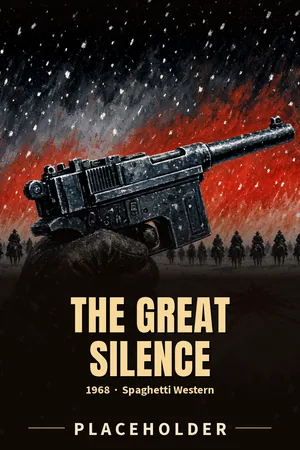

True Grit Rating: The Great Silence
Loading the ticket…
The Great Silence (Il grande silenzio) is a 1968 Italian western directed by Sergio Corbucci, starring Jean-Louis Trintignant as a mute gunfighter called Silence and Klaus Kinski as the bounty hunter Tigrero (renamed Loco in the English version). Set in a snowbound Utah town near the end of the nineteenth century, it is famous for its winter landscapes and for one of the bleakest endings in the whole genre. The story is fiction. No real event lies behind it, although it borrows a real backdrop of rewards, outlaws and a savage winter.
The film's story
In the town of Snow Hill, Utah, a band of outlaws is hiding in the hills, waiting for an amnesty that the governor has promised. Hunger drives them down into the valley for food, where bounty hunters are waiting to kill them and collect the rewards on their heads. The killers are encouraged by the local banker, Pollicut, who is also the justice of the peace and takes a cut of the reward money. In some critics' reading, the outlaws are less criminals than poor people driven into debt by him.
Silence, who never speaks a word, is a gunman who also kills for money, but he takes the side of the outlaws and of a widow caught up in the killings. A newly arrived sheriff, sent by the governor to restore order before the amnesty, is well-meaning but unable to stop what follows. In the final scenes nearly everyone who could be called good is killed, and Loco leaves promising to come back for the bodies, "all nice and legal". A closing title card blames "the massacres of 1898, year of the Great Blizzard" for a public outcry against bounty killing.
Corbucci wrote Silence as mute partly because Trintignant could not speak Italian. The snow scenes were filmed in the Dolomites near Cortina d'Ampezzo, with some of the drifts made from shaving cream. A happier alternative ending was shot, but it seems never to have been shown to audiences.
The real history behind the setting
Snow Hill and the "massacres of 1898"
There was no Snow Hill in Utah connected with any such events, and no historical record has been found of a massacre of outlaws by bounty killers in Utah in 1898, or of a public outcry that ended the trade. The closing title card is a storytelling device that dresses the film in the look of history.
Rewards and "dead or alive"
Utah law in 1898 allowed the governor to offer a reward of up to a thousand dollars for the apprehension of escaped convicts and people charged with felonies, meaning their capture. Killing was lawful only when it was necessary to arrest a fleeing or resisting felon, and the law gave private men no licence to shoot wanted people on sight. Loco's "all nice and legal" is the film's irony, not Utah law. In the Utah statute books of the day, "bounty" mostly meant money paid for killing mountain lions, bears and other predators.
Most government wanted notices of the period asked for "arrest and delivery" or similar wording. Offers of payment "dead or alive" came mainly from private companies such as railways and express firms. Even so, some public offers used the phrase: newspapers of 1898 reported rewards for Butch Cassidy "dead or alive", and one transcribed report has Utah's governor offering a reward on those terms for two murderers. Those reports still need checking against the original pages.
Statehood and the only real amnesty
Utah became a state on 4 January 1896. Its governor was elected, not appointed as in the film; in 1898 he was Heber M. Wells. Under the new state constitution, pardons came from a Board of Pardons, and only after a conviction, so a governor could not simply declare an amnesty for men hiding in the hills. The constitution also guaranteed "perfect toleration of religious sentiment".
The only real amnesty in 1890s Utah was quite different. After the Church of Jesus Christ of Latter-day Saints renounced plural marriage in its 1890 Manifesto, Presidents Harrison and Cleveland issued pardons in 1893 and 1894 for polygamy and related offences, noting that Church members were now living in obedience to the law. It had nothing to do with outlaws or bounty hunters.
The outlaws of the day
Real outlaws were active in Utah at the time. On 21 April 1897 Butch Cassidy, born Robert LeRoy Parker in Beaver, Utah, took part in the daylight robbery of the Pleasant Valley Coal Company's payroll at Castle Gate. The Wild Bunch used Robbers' Roost, a remote Utah hideout that the authorities never managed to break into, until it was largely abandoned after 1902. These were armed robbers, not the starving, debt-ridden people of the film, and The Great Silence does not portray any real gang.
The great cold
The film places its blizzard in 1898. The record cold actually came in February 1899, when a cold wave the Weather Bureau called the most remarkable in its history swept the United States, and Woodruff, Utah, recorded fifty degrees below zero (Fahrenheit) on 6 February, still the lowest temperature recorded in an inhabited part of the state.
How the film differs from history
- Snow Hill is invented.
- The amnesty is invented. A governor could not grant one, and the only real amnesty in 1890s Utah concerned polygamy.
- The governor was elected, not appointed.
- Bounty killing is exaggerated. State rewards paid for capture, and the law allowed killing only when it was necessary to make an arrest, though some "dead or alive" offers did exist.
- The massacres of 1898 and the public outcry are invented.
- The Great Blizzard is moved a year early: the record cold came in February 1899.
- Religion. Only the English dub hints that the outlaws are persecuted for their faith; Corbucci's original does not. No source records anyone, Latter-day Saints included, being hunted by bounty killers in 1890s Utah, and this page does not treat the outlaws as Mormons.
Critics' readings
Critics have read the film politically: as a parable of the rich paying hired killers to murder the poor, as an expression of Corbucci's despair at the murders of Malcolm X and Che Guevara, or as a reflection of the mood of the Vietnam years. Some call Silence a Christlike hero; one reviewer reads the ending as anti-Christian. These are opinions about the film, not history, and the film makes no historical claim about faith in Utah. Seen from a Christian point of view, the film is a hard picture of a world where wrong goes unpunished, which is a reason to watch it with care rather than a lesson about the real West.
Cast
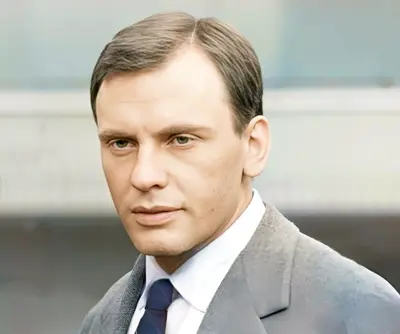
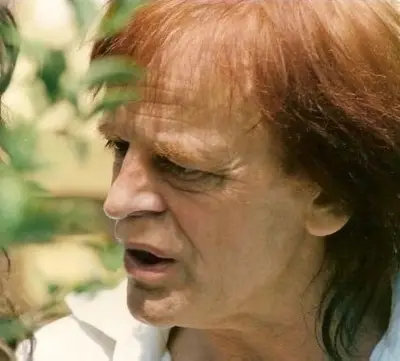

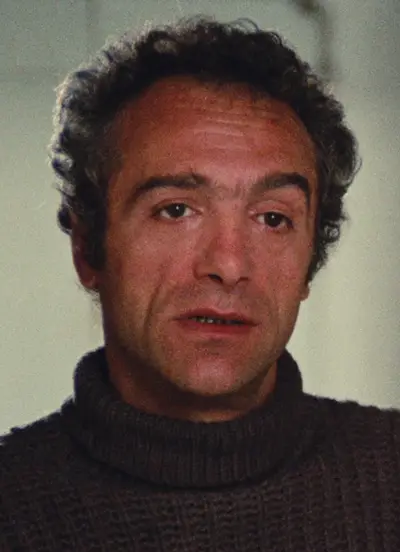
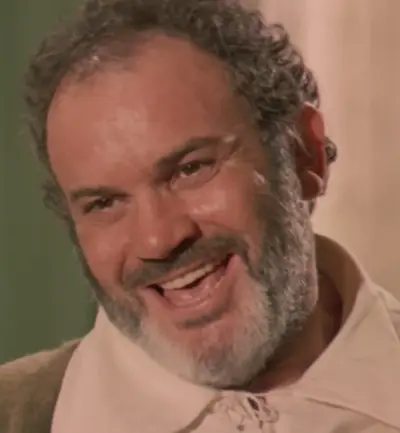
Frontier folk
This film is listed on: Bounty hunters · Cattle barons, crooked railroad men and bankers · Hired guns and range bullies (all Frontier folk)
Key facts
- Directed by Sergio Corbucci
- Released 1968
- Italian-French co-production
- Vonetta McGee's film debut
True Grit RatingWhat's this?Woke: None foundSIMDb ★7.7Partly checked
True Grit score: 99/100, Gold Partly checked
How the score is worked out:
- Start100
- Diamond needs all five checks; not met (raw score under 109; content guide not complete): 100 → 99
- True Grit score99 · Gold
Classic Western checks
1 of 5 yes · Mostly classic
- Called “revisionist”YesYes: three reviews call it a revisionist Western.[1][2][3]
- Settlers or cavalry as villainsNoThe villains are the corrupt banker and justice of the peace Pollicut, who puts prices on the heads of townspeople forced to steal to survive, and the bounty … [4]
more
The villains are the corrupt banker and justice of the peace Pollicut, who puts prices on the heads of townspeople forced to steal to survive, and the bounty killer Loco and his gang. - Faith shown negativelyNoThe plot shows no clergy or faith portrayed negatively.[4]
- History rewrittenNoFiction with invented characters; it portrays no real historical events or people, so nothing documented is rewritten.[4]
- A people shown as villainsNoNo: the plot source names the villains as individuals; no ethnic, national or religious people is the enemy as a group.[3]
Woke content (modern messaging)
None found0 of 8 items found so far
Show all 8 (4 not found · 4 not known)
Unless noted: Unknown.
- Characters recast for representationNot foundAn original story with invented characters (no source work and no real people), so no established or historical figure could be recast.[4]
- Gender roles reversed or critiquedNot known
- Present-day political languageNot known
- Allegory for current politicsNot foundReleased in 1968, before the 21st-century debates this item covers, so it cannot be an allegory of them.[4]
- Western civilisation framed as inherently guiltyNot known
- Environmental activismNot foundNo: no source raises an environmental message (5 Nov 2026).[4]
- Source material changed for messagingNot foundAn original screenplay (no novel, earlier film or established characters), so there is no source to change.[4]
- LGBT or gender-identity themesNot known
Content guide
Unknown.
UK classification advice lists no sex or nudity issues.
Certificates: BBFC 15 FSK FSK 18
NoneMildModerateStrongNot known
Audience
★ 7.7/10 from viewers on IMDb (21k votes)No deduction (5.0 and up).
Sources
Information courtesy of IMDb (https://www.imdb.com). IMDb rating as of 13 October 2026.
Checked 17 October 2026 · Reviewed by Frontier Editor
Partly checked: 3 checks not known. Not known items are left out of the score.
Member reviews
What members think. Member reviews never change the True Grit score. The True Grit score is worked out by the editors from sources.
Sources
- The Great Silence - Wikipedia en.wikipedia.org
- Wikidata: Q1813890 wikidata.org
- IMDb Non-Commercial Datasets developer.imdb.com
- The great silence q29sbgvjdglvbjpwwc0ynjk5otq - bbfc.co.uk bbfc.co.uk
- Rotten Tomatoes (score via Wikidata) rottentomatoes.com