
Durango and Silverton Narrow Gauge Railroad
The Durango and Silverton Narrow Gauge Railroad is a 3-foot narrow-gauge line that runs about 45 miles up the valley and canyon of the Animas River, from Durango to Silverton in the San Juan Mountains of south-western Colorado. The Denver and Rio Grande built it in 1881–82 to carry silver and gold ore down from the mines, and it has run ever since, despite floods, avalanches and fires. Today it is a heritage railway, still worked mainly by steam locomotives and carrying hundreds of thousands of passengers a year. It is a National Historic Landmark, and Hollywood has filmed many Westerns along it.
Building the line
Large-scale mining in the San Juans began after the Brunot Agreement of 1873, under which the Ute gave up some four million acres of the mountains in return for a reservation and an annual payment. The mines were rich but remote, and ore had to go out by pack train and wagon at great cost. In 1880 William Jackson Palmer's Denver and Rio Grande Railway began pushing its narrow-gauge "San Juan Extension" west from the San Luis Valley, over Cumbres Pass and across the Southern Ute reservation, towards the Animas River. Narrow gauge suited the mountains: its tighter curves and lighter construction made it far cheaper to build than standard gauge.
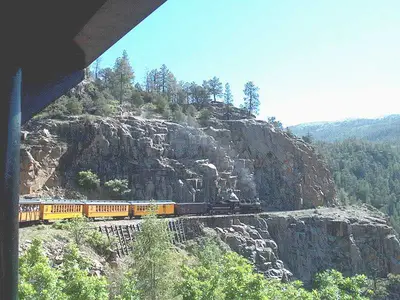
The railway reached its new town of Durango in July 1881 and began work on the final stretch to Silverton almost at once. The first 18 miles, to Rockwood, ran through open valley and were finished by late November. Beyond Rockwood the line entered the narrow granite gorge of the Animas, and the crews had to blast a ledge out of the canyon wall, high above the river, to carry the track; this shelf, known as the High Line, has been the favourite view of the line ever since. About 500 labourers, most of them Chinese and Irish, did the work, reportedly for $2.25 a day. Silverton heard its first train whistle on 27 June 1882 and held a celebration on 4 July, though the rails were still about two miles short. Accounts give the date the track reached the town as 8 or 10 July; passenger trains began within days, and the first ore went down on 13 July, less than a year after work had started.
Ore trains
The railway cut freight rates by more than half, and the San Juan mines boomed. Silverton's population doubled to about 2,000, and Otto Mears and others built short narrow-gauge lines from Silverton up to the mines in the surrounding valleys. The line had to fight the mountains: snowslides damaged it in 1905, 1916 and 1928, and floods in 1909, 1911 and 1927. The flood of October 1911 washed away long stretches of track, and the railway called in the veteran road and railway builder Otto Mears to help rebuild it before winter.
After the Panic of 1893 and the end of free coinage of silver, the branch struggled. Mining declined, lorries and new highways took away traffic, and passenger revenue was small.
From ore to tourists
After the Second World War the branch found a new trade. Hollywood studios came to film Westerns along it, and in June 1947 the Rio Grande started a summer passenger train, The Silverton, and soon afterwards painted a locomotive and four coaches in a bright yellow scheme to attract visitors. Passenger numbers rose from about 3,500 in 1947 to more than 12,000 in 1953. The line was declared a National Historic Landmark in 1961. In the early 1960s the Rio Grande asked the Interstate Commerce Commission for permission to abandon it, but the request was refused because tourist traffic was growing, and the company reluctantly invested in rolling stock, track repairs and improvements to the Durango depot, where shops and tourist businesses grew up around the station.
When the last train ran into Durango from the east in December 1968 and the rest of the San Juan Extension was abandoned, the Durango–Silverton branch was left as an isolated line, kept alive by its tourists; part of the abandoned route over Cumbres Pass became the Cumbres and Toltec Scenic Railroad. In March 1981 the Rio Grande sold the branch to the Florida businessman Charles Bradshaw Jr., and it took its present name. Bradshaw restored 1880s coaches, rebuilt bridges so that larger locomotives could run to Silverton for the first time, and ran more trains. The original Durango roundhouse burned down in 1989; a new one, using bricks saved from the old, opened in 1990. After a short spell under First American Railways from 1997, the railway was bought in July 1998 by Allen Harper's American Heritage Railways, which still runs it, together with museums at Durango and Silverton.
In June 2018 a wildfire near the line, the 416 Fire, closed the railway for several weeks; the owners have since been converting the steam locomotives from coal to oil firing, because of the risk of cinders starting fires, and have added diesel locomotives. The railway closed again for several months in 2020 during the COVID-19 pandemic.
On screen
The scenery of the Animas valley and canyon drew film-makers from the late 1940s. Westerns shot on or beside the line include A Ticket to Tomahawk (1950), Across the Wide Missouri (1951), Run for Cover (1955), Night Passage (1957), with James Stewart riding the High Line, The Sons of Katie Elder (1965), whose opening scenes follow the train along the Animas, Butch Cassidy and the Sundance Kid (1969), whose famous cliff jump was shot near Baker's Bridge, and Support Your Local Gunfighter (1971).
Legend and history
- "Continuous since 1882." The line is often described as having run continuously since it opened. Trains have never stopped for good, but floods, snow, fire and the pandemic have all closed it for weeks or months at a time.
- Silver by the ton. Silverton's name is said to come from a miner's boast that the mountains held silver by the ton rather than gold by the ounce. The story is a local tradition rather than a documented fact.
Key facts
- Route: Durango to Silverton, Colorado, about 45 miles
- Gauge: 3 feet (narrow gauge)
- Built: 1881–82 by the Denver and Rio Grande Railway
- First train to Silverton: July 1882
- Climb: roughly 2,800–3,000 feet
- National Historic Landmark: 1961
- Present operator: American Heritage Railways (since 1998)
- Country: United States (Wikidata P17)
- Located in: La Plata County, San Juan County, Durango (Wikidata P131)
- Instance of: historic district, heritage railway, museum (Wikidata P31)
- Opened 1882 by the Denver and Rio Grande Railroad (Wikipedia)
See also
Nearby
- Durango, Colorado 3 km
- Silverton, Colorado 60 km
- Leadville, Colorado 257 km
- Cripple Creek, Colorado 286 km
- Fort Union National Monument 298 km
Gallery 1

Sources
- Durango and Silverton Narrow Gauge Railroad - Wikipedia en.wikipedia.org
- Wikidata: Q2962363 wikidata.org
- National Historic Landmark nomination: Durango-Silverton Narrow-Gauge Railroad – NPS NPGallery npgallery.nps.gov
- “Durango & Silverton Narrow Gauge Railroad” – Colorado Encyclopedia coloradoencyclopedia.org
- Wikimedia Commons: Durango and Silverton Narrow Gauge Railroad 1.jpg commons.wikimedia.org
- Wikimedia Commons: DurangoSilverton1.jpg commons.wikimedia.org
