
Stage drivers, shotgun guards and express riders
Usually good · Part of Frontier folk
Some statements on this page are still being checked and are marked "Needs further sources".
The stagecoach, the express rider and the strongbox carry the mail, the money and the passengers across country where every pass may hide an ambush.
In classic Westerns
The film stage driver is a grizzled, talkative old hand with a whip and a team of six, like Andy Devine's Buck in Stagecoach (1939); beside him sits the shotgun guard, the man "riding shotgun" over the Wells Fargo box. The Pony Express rider is young, light and fearless, racing between relay stations. Their stories are journeys: a coach full of mismatched passengers, a hold-up, a race to deliver the mail.
- Look: Concord coach, a six-horse team, a coachman's whip, a double-barrelled shotgun and a strongbox; the Pony Express rider in light kit with a mochila over the saddle.
- Values: Getting through, whatever the danger; reliability and grit.
- Role in the story: Sidekick, comic relief or the target of the outlaws.
Sub-types
Stagecoach drivers
The "whip" who handles the team, usually played as a comic old-timer with nerves of steel.
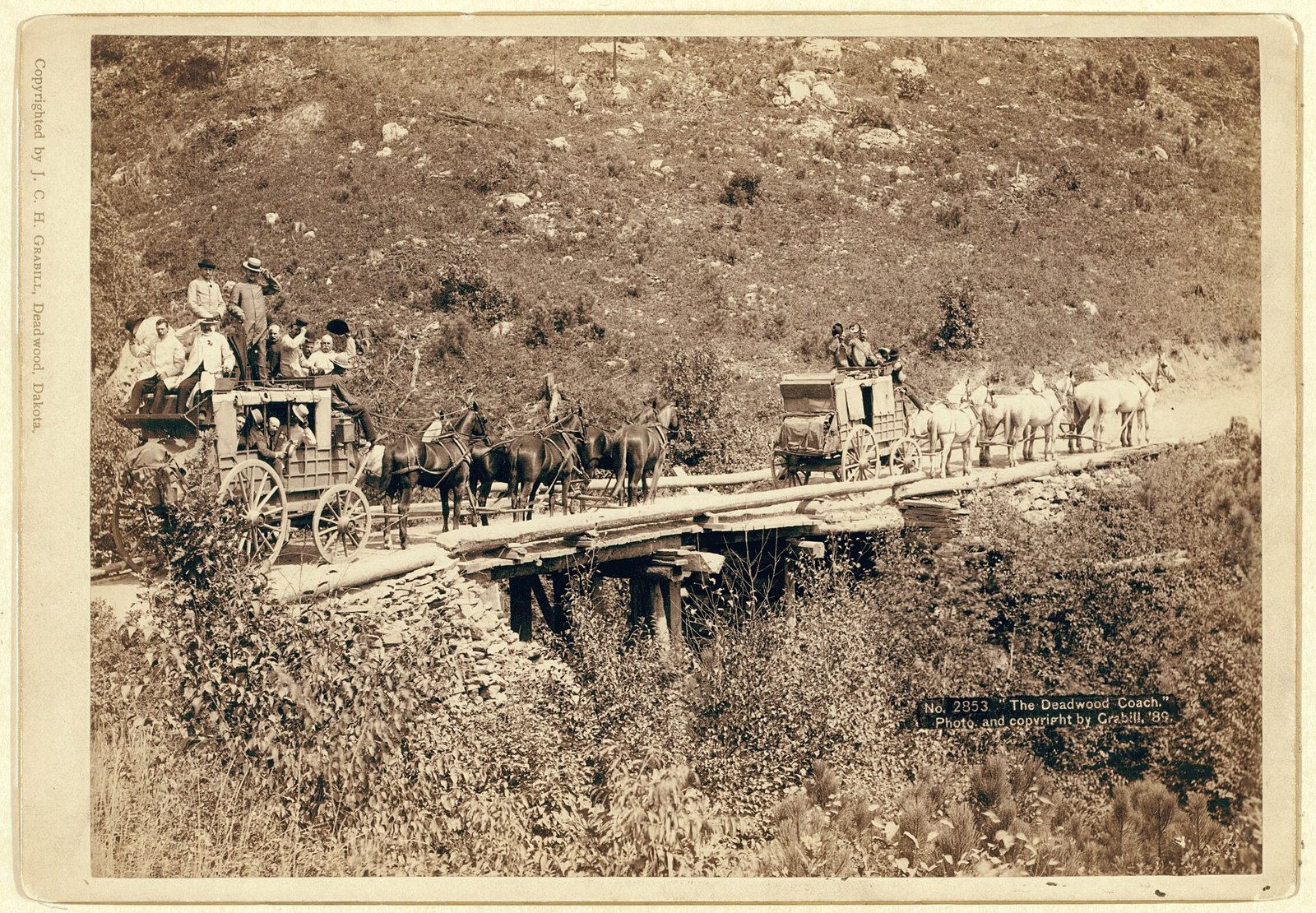
"The Deadwood Coach", 1889: the driver and passengers with a Concord-type coach of the Black Hills line.
Posed photograph · John C. H. Grabill · 1889 · Source: https://commons.wikimedia.org/wiki/File:%22The_Deadwood_Coach%22_LCCN99613881.jpg · Licence: Public domain – UK: photographer John C. H. Grabill died 1903, more than 70 years ago (CDPA 1988 s.12(2))

Shotgun guards
The express messenger riding beside the driver to protect the strongbox.
Needs a photo: A Wells Fargo shotgun messenger, period photograph.
Pony Express riders
The young riders of 1860–61, shown racing across the plains with the mail.
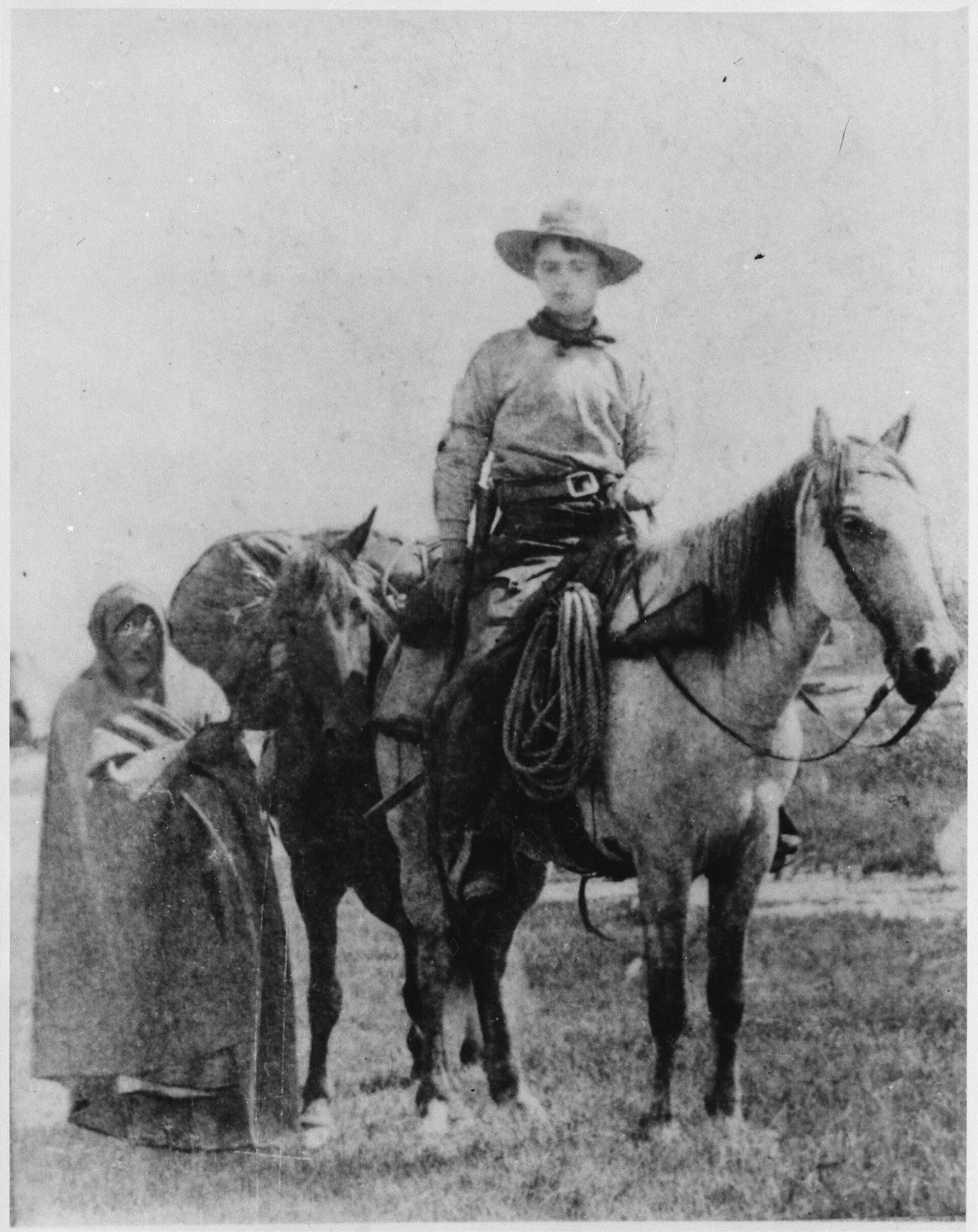
Frank E. Webner, Pony Express rider, about 1861. A studio portrait; riders carried less on the trail than such portraits sometimes show.
Posed photograph · Unknown · c.1861 · Source: https://commons.wikimedia.org/wiki/File:%22Frank_E._Webner,_pony_express_rider,%22_ca._1861_-_NARA_-_513351.jpg · Licence: Public domain – UK: author unknown and work made/published more than 70 years ago (CDPA 1988 s.12(3))

Wells Fargo and express agents
Express-company men, from the station agent to the detective who hunts the robbers.
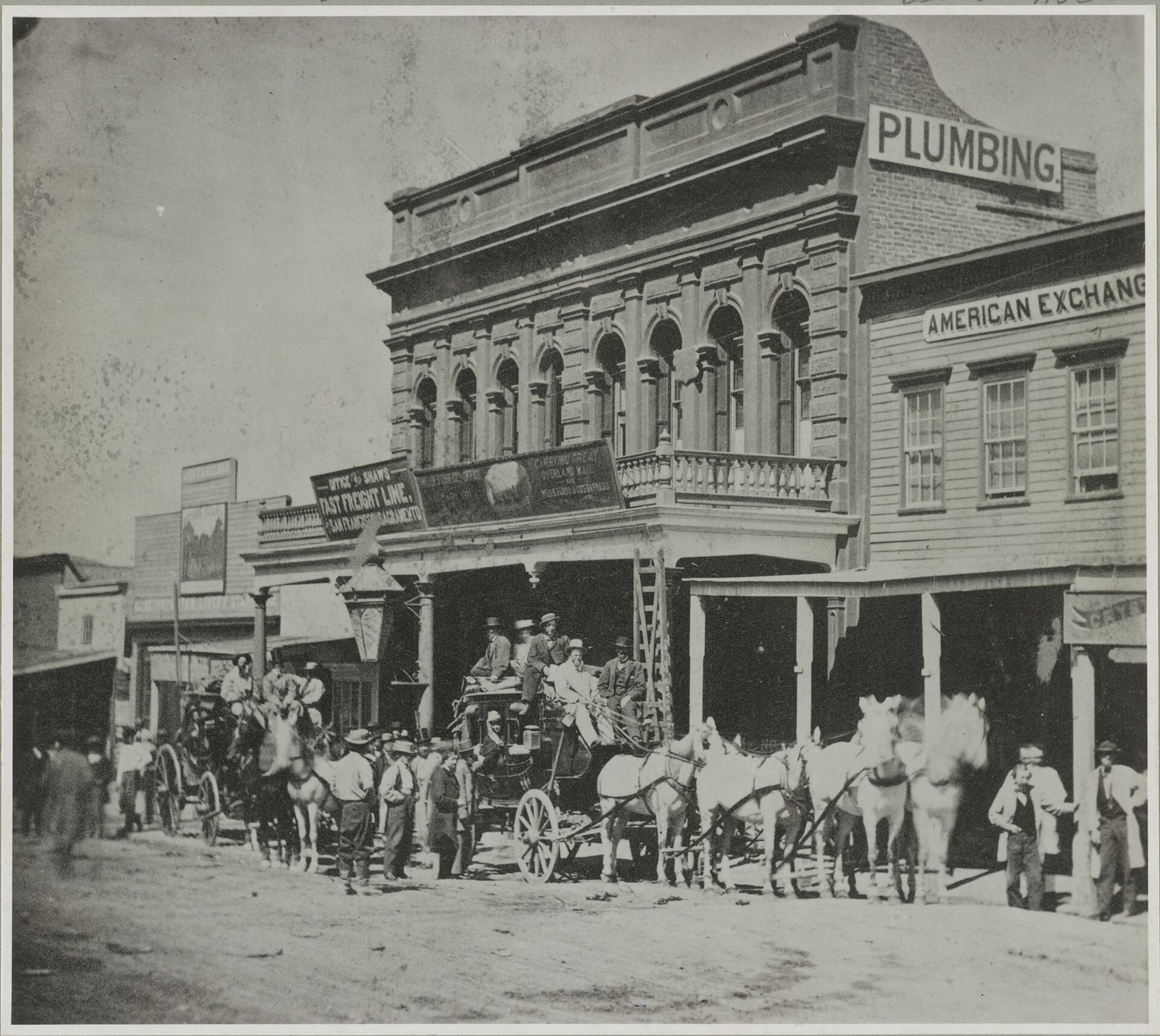
The Wells, Fargo & Co. express office on C Street, Virginia City, Nevada, 1866.
Photograph · Lawrence & Houseworth, San Francisco · 1866 · Source: https://commons.wikimedia.org/wiki/File:Wells,_Fargo_%26_Co.%27s_Express_Office,_C_Street,_Virginia_City_LCCN2002719065.jpg · Licence: Public domain – UK: author unknown and work made/published more than 70 years ago (CDPA 1988 s.12(3))

In history
Documented history from period sources. The film portrayal is described above under "In classic Westerns"; this section is kept separate.
A passenger on the Overland stage in 1861 wrote that, to the station-keepers and stable hands along the line, the stage-driver was a hero. Coaches covered about 100 to 125 miles a day; a Pony Express rider covered about 250.
The Pony Express rider was usually a small, light man in thin, close-fitting clothes who carried no weapons, so as to save weight. At its height the line had about 190 stations and eighty riders, and the average run was seventy-five miles.
Alexander Majors, a partner in the firm behind the Pony Express, made his men pledge not to swear, get drunk, gamble or be cruel to their animals.
How the films differ
Film Pony Express riders bristle with guns; the first-hand account says they carried nothing they did not need. Films often show express companies as heartless; one of the founders of the Pony Express ran his men under a Christian pledge of good conduct.
Films
| # | Film | How it qualifies | From the wiki's summary |
|---|---|---|---|
| 1 | Stagecoach (1939) | Stagecoach drivers | A mixed group of passengers, among them an outlaw on the run, a drunken doctor and a woman driven out of town, crosses Apache country by stagecoach. |
| 2 | 3:10 to Yuma (1957) | Stagecoach drivers; Wells Fargo and express agents | A struggling rancher takes on the dangerous job of escorting a notorious outlaw to face justice. |
| 3 | Hombre (1967) | Stagecoach drivers | Hombre (1967) is a revisionist Western directed and produced by Martin Ritt from Elmore Leonard's 1961 novel, starring Paul Newman with Fredric March, Richard Boone, Diane Cilento, Cameron Mitchell, Barbara Rush and Martin Balsam. |
| 4 | Seven Men from Now (1956) | Wells Fargo and express agents | Seven Men from Now (1956) is a Western directed by Budd Boetticher, starring Randolph Scott as Ben Stride, with Gail Russell and Lee Marvin. |
| 5 | Stagecoach (1966) | Stagecoach drivers | A group of mismatched passengers travel together by stagecoach through dangerous country. |
| 6 | Rough Night in Jericho (1967) | Stagecoach drivers | Rough Night in Jericho (1967) is a Western directed by Arnold Laven from Marvin H. Albert's novel, starring Dean Martin, in a rare villain role, as the town boss Alex Flood, George Peppard and Jean Simmons. |
| 7 | Pony Express (1953) | Pony Express riders | Pony Express (1953) is a Western directed by Jerry Hopper and filmed in Kanab, Utah, starring Charlton Heston as Buffalo Bill Cody and Forrest Tucker as Wild Bill Hickok, with Rhonda Fleming and Jan Sterling. |
| 8 | Riding Shotgun (1954) | Shotgun guards | Riding Shotgun (1954) is a Western directed by André de Toth from a Kenneth Perkins story, starring Randolph Scott as Larry Delong, a man hunting an outlaw gang, with Wayne Morris and Joan Weldon. |
| 9 | Randy Rides Alone (1934) | Wells Fargo and express agents | Randy Rides Alone (1934) is a 53-minute pre-Code B Western directed by Harry L. Fraser for Lone Star Productions, starring John Wayne as a cowboy falsely accused of a saloon massacre, with Yakima Canutt and George Hayes. |
| 10 | Winds of the Wasteland (1936) | Stagecoach drivers; Pony Express riders | Winds of the Wasteland (1936) is a Republic Western directed by Mack V. Wright, starring John Wayne as John Blair, a stagecoach operator in 1861, with Phyllis Fraser and an early appearance by Jon Hall. |
| 11 | Wells Fargo (1937) | Wells Fargo and express agents | Wells Fargo (1937) is a historical Western directed by Frank Lloyd for Paramount, starring Joel McCrea as Ramsay MacKay, an employee helping build the Wells Fargo express service, with Bob Burns and Frances Dee. |
Films are listed in order of popularity, with older classics given extra weight. Information courtesy of IMDb (https://www.imdb.com).
See also
Sources
- Roughing It (Mark Twain), American Publishing Company, Hartford, 1872 (accessed 28 October 2026)
- Seventy Years on the Frontier (Alexander Majors), Rand, McNally & Co., Chicago, 1893 (accessed 28 October 2026)
- The Story of the Pony Express (Glenn D. Bradley), A. C. McClurg & Co., Chicago, 1913 (accessed 28 October 2026)